
A CEO does not need to be perfect to lead a successful company.
Every executive has limitations, blind spots and areas in which they depend on other people. In the right context, these weaknesses can be compensated for by the leadership team, the organization or the governance structure.
But some CEO weaknesses have a much broader impact.
They affect strategic choices, the quality of decisions, the effectiveness of the executive team and the organization’s ability to execute. Under pressure, they may become more pronounced and gradually turn into significant leadership risks.
The difficulty is that these risks are not always obvious from a résumé, a strong track record or a series of convincing Board presentations.
The executives who work most closely with the CEO often see them first. They experience the repeated changes in direction, delayed decisions, excessive centralization, unresolved conflicts or deterioration in relationships. Boards and investors may only recognize the full impact later, once performance, talent retention or execution has already been affected.
Here are ten CEO weaknesses that can derail a company — and the questions Boards, investors and leadership teams should ask when they appear.
1. Lack of Strategic Clarity
A CEO may have an ambitious vision without providing the organization with sufficiently clear strategic direction.
The company is encouraged to grow, innovate, improve margins, expand internationally, launch new products and transform its operating model — all at the same time.
Each objective may sound reasonable. The problem is the absence of explicit choices.
When priorities are unclear, functions interpret the strategy differently. Sales focuses on revenue, operations on stability, finance on profitability and product teams on innovation. Resources become dispersed, trade-offs are delayed and the organization remains busy without necessarily moving in a coherent direction.
Strategic clarity is not simply the ability to articulate an inspiring vision. It is the ability to identify the few priorities that matter most, make difficult choices and translate them into responsibilities and action.
A CEO weakness becomes visible when the organization cannot answer basic questions consistently: What are we trying to achieve first? What are we not going to do? Where should resources be concentrated? Who is accountable for delivery?
2. Poor Judgment and Decision-Making
The quality of a CEO is revealed not only by the decisions that succeed, but by the way decisions are made when information is incomplete, time is limited and the available options are imperfect.
Some CEOs postpone difficult decisions until circumstances force their hand. Others decide too quickly, rely excessively on intuition or remain committed to a choice after the underlying facts have changed.
Poor judgment may take several forms:
- avoiding difficult people decisions;
- taking risks without fully considering the downside;
- reacting to the latest information rather than following a consistent direction;
- allowing personal preferences or relationships to distort decisions;
- failing to distinguish a temporary setback from a structural problem.
No CEO will make the right decision every time. The real concern is a repeated pattern: weak analysis, poor timing, limited consultation, failure to learn or an inability to acknowledge errors.
Because CEO decisions shape the entire organization, small weaknesses in judgment can create disproportionately large consequences.
3. Inability to Prioritize and Maintain Focus
Some CEOs generate energy through ideas, opportunities and new initiatives. This can be a major strength in an entrepreneurial environment.
It becomes a weakness when the organization is constantly redirected.
New priorities are announced before earlier ones have been completed. Projects accumulate. Teams repeatedly reallocate resources. Leaders struggle to determine which commitments remain valid and which have quietly lost importance.
The company may appear highly dynamic while suffering from chronic execution failure.
A strong CEO does not only identify opportunities. They protect the organization from excessive dispersion. They understand that every new priority consumes management attention, resources and organizational energy.
The ability to say no, sequence initiatives and sustain focus is therefore a critical leadership capability — particularly during scaling, transformation or underperformance.
4. Excessive Centralization and Failure to Delegate
Many successful CEOs have built their companies through exceptional personal involvement.
They understand the market, know the customers, recruit key people and intervene quickly when problems arise. Their central role may have been essential during the company’s early development.
But as the business grows, this strength can become a major constraint.
Decisions continue to move upward. Executives wait for the CEO’s approval. Managers become reluctant to take responsibility. The CEO works harder, but the organization does not become more autonomous.
Excessive centralization slows execution and prevents the development of other leaders. It can also create an organization that performs well only while the CEO remains personally involved in a large number of decisions.
The issue is not simply whether the CEO delegates tasks. It is whether they genuinely transfer authority, tolerate different approaches and allow others to become accountable for outcomes.
This weakness is especially damaging when the company needs to scale, operate across multiple countries, integrate acquisitions or manage greater complexity.
5. Failure to Build a Strong Executive Team
A CEO cannot deliver an ambitious strategy alone.
Yet some CEOs surround themselves with loyal but insufficiently strong executives. Others recruit capable people but fail to create the trust, clarity and collective discipline required for them to operate as a true leadership team.
The result is often a collection of functional leaders rather than an effective executive team.
Members defend their own areas, cross-functional issues remain unresolved and the CEO becomes the main point of coordination and arbitration. Important debates happen privately rather than collectively, while difficult subjects are postponed or softened.
A weak executive team may therefore reflect more than individual shortcomings. It may reveal a CEO who struggles to:
- recruit people who are stronger than they are in critical areas;
- clarify roles and expectations;
- encourage constructive disagreement;
- hold executives accountable;
- replace leaders who are no longer suited to the role;
- build shared ownership of company-wide decisions.
An Executive Team Assessment can help distinguish problems of composition, role clarity, collective dynamics and CEO leadership.
6. Avoidance of Conflict and Difficult Conversations
Not every ineffective CEO is overly aggressive or authoritarian.
Some create problems because they avoid confrontation.
They postpone feedback, tolerate repeated underperformance, leave disagreements unresolved and seek consensus when a clear decision is required. They may preserve superficial harmony while tensions continue to grow beneath the surface.
This avoidance is often interpreted as empathy or patience. Over time, however, it creates uncertainty and weakens accountability.
Strong performers become frustrated when poor performance is tolerated. Conflicts spread because they are not addressed. Executives spend increasing amounts of time managing around unresolved problems.
Leadership courage does not require unnecessary confrontation. It means being able to address reality, give clear feedback, make difficult people decisions and remain engaged in uncomfortable conversations.
7. Low Self-Awareness
One of the most dangerous CEO weaknesses is a limited understanding of one’s own impact.
A CEO may see themselves as demanding while others experience them as intimidating. They may believe they are empowering the team while repeatedly taking decisions back. They may consider themselves open to challenge while reacting defensively whenever someone disagrees.
Low self-awareness makes other weaknesses harder to correct.
If the CEO does not recognize the pattern, feedback is dismissed, rationalized or attributed to other people’s shortcomings. The organization gradually learns to adapt around the leader rather than address the underlying issue.
This is why close collaborators often identify leadership risks earlier than the Board. They experience the CEO’s behavior every day and observe the gap between intended leadership and actual impact.
An independent Executive Assessment can help identify these blind spots by examining the executive’s decisions, relationships, behavior under pressure and impact on the team and organization.
8. Destabilizing Behavior Under Pressure
Most executives can present an effective leadership style when the environment is favorable.
The more revealing question is what happens under sustained pressure.
Some CEOs become increasingly controlling. Others grow impatient, impulsive, suspicious or emotionally withdrawn. They may overreact to bad news, communicate inconsistently or create fear around disagreement and failure.
These behaviors have organizational consequences.
Executives begin filtering information. Problems are reported later. Teams focus on managing the CEO’s reactions rather than solving the underlying issues. Trust declines and decision quality deteriorates precisely when the company most needs open debate and accurate information.
Leadership derailment is rarely caused by one isolated incident. It emerges through repeated behaviors that become stronger as pressure, fatigue or complexity increases.
This is why evaluating resilience should go beyond asking whether the CEO can tolerate a heavy workload. It should examine how pressure changes their judgment, relationships and leadership behavior.
9. Resistance to Change and Limited Learning Agility
A CEO may be highly effective in one stage of a company’s development and poorly suited to the next.
The leadership required to launch a business is not identical to the leadership required to scale it. A growth phase, an acquisition strategy, an international expansion or a turnaround each creates different demands.
The risk appears when the CEO relies too heavily on the methods that produced past success.
They continue making decisions in the same way, preserve structures that no longer work or resist bringing in people with different experience. New information is interpreted through old assumptions.
Experience then becomes a constraint rather than an advantage.
Learning agility is the ability to question one’s own model, absorb feedback, adapt leadership posture and continue developing as the business changes.
The relevant question is therefore not simply whether the CEO has succeeded before. It is whether they can evolve quickly enough to succeed in the company’s next stage.
10. Loss of Energy, Motivation or Commitment
A CEO may retain the formal capabilities required for the role while losing the energy or motivation to exercise them fully.
This can happen after years of intense effort, following repeated setbacks or when the role has evolved away from what gives the executive meaning and satisfaction.
The signs are not always dramatic.
The CEO may become less curious, less present or less willing to address difficult issues. They may avoid long-term decisions, rely more heavily on familiar routines or struggle to mobilize the leadership team.
A loss of energy can also affect resilience, judgment and relationships. Underperformance may then be interpreted as a pure capability problem when the deeper issue is motivation, fatigue or role fit.
Boards should neither pathologize a temporary difficult period nor ignore a sustained change in the CEO’s engagement.
The key questions are whether the situation is temporary, whether the executive recognizes it and whether the role or environment can be adapted without creating unacceptable risk for the company.
Why CEO Weaknesses Are Often Detected Too Late
Major CEO risks are rarely completely invisible.
Signals usually exist, but they appear separately and are often explained away.
A delayed decision is attributed to complexity. The departure of a senior executive is treated as an individual issue. Repeated changes in direction are presented as agility. A tense relationship with the Board is viewed as healthy challenge.
Each event may have a reasonable explanation. The pattern only becomes clear when these signals are connected.
Boards and investors may also have limited exposure to the CEO’s daily behavior. They see prepared presentations, formal meetings and selected information. The executive team and closest collaborators see how decisions are actually made, how disagreement is handled and what happens when performance deteriorates.
Another reason is that strong CEO qualities can mask corresponding risks.
Confidence can become overconfidence. Speed can become impulsiveness. Attention to detail can become micromanagement. Loyalty can become reluctance to replace weak executives. Vision can become detachment from operational reality.
A meaningful assessment must therefore examine both the value of a leadership strength and the conditions under which it may become counterproductive.
How CEO Weaknesses Affect the Company
A CEO weakness rarely remains confined to the individual.
It shapes the behavior of the executive team and progressively influences the wider organization.
When the CEO changes priorities frequently, teams stop committing fully to long-term initiatives. When disagreement is punished, information is filtered. When decisions are centralized, managers become less accountable. When underperformance is tolerated, standards decline.
The leadership pattern becomes an organizational pattern.
This is why CEO performance should not be evaluated in isolation. The analysis must consider the leader’s impact on strategic clarity, executive-team effectiveness, governance, culture and the organization’s ability to execute.
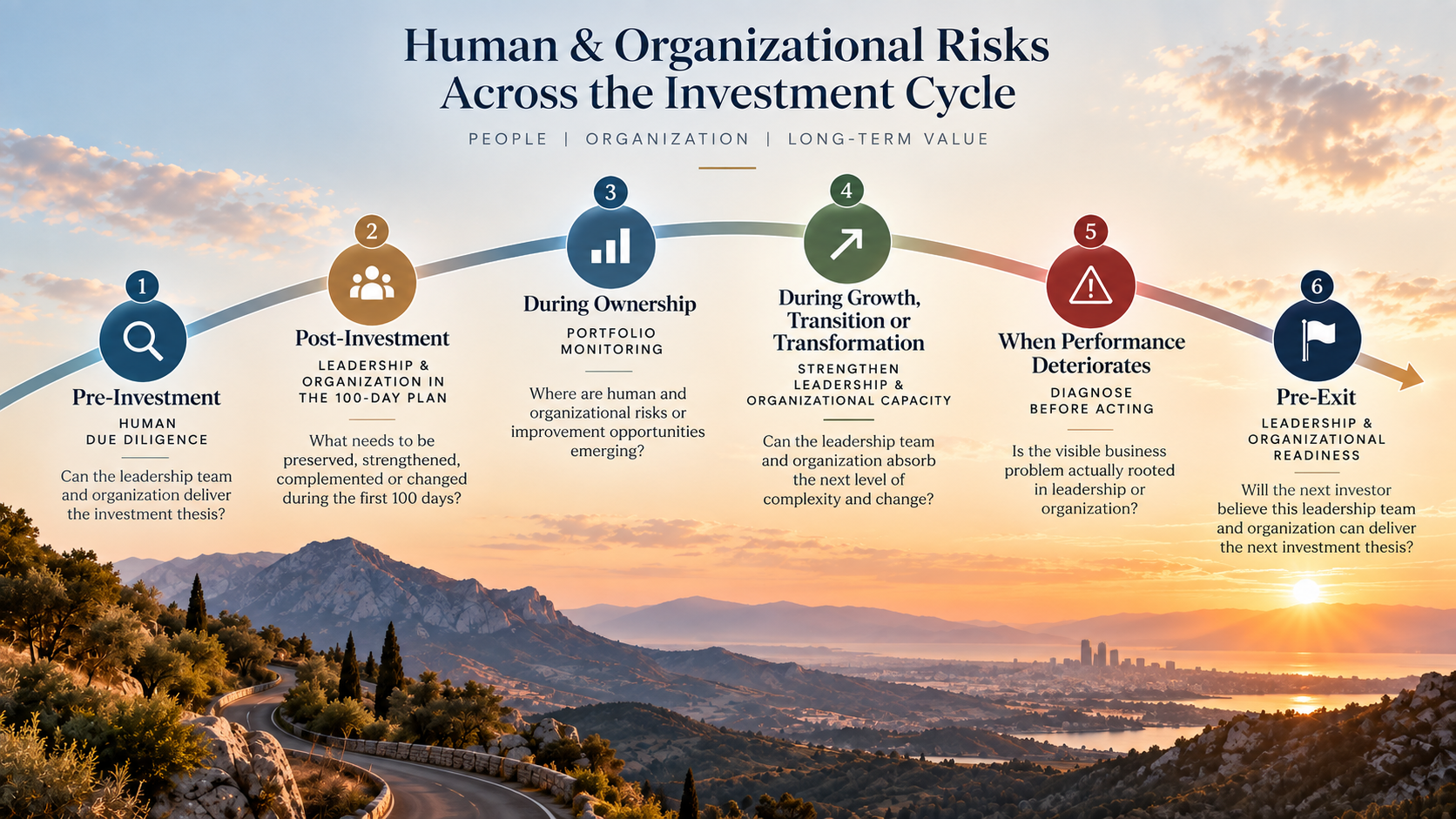
WINGMIND’s Human Due Diligence approach assesses leadership in this broader context, particularly before or after investment, during scaling, transformation or underperformance.
What Should the Board Do When It Identifies a CEO Weakness?
Identifying a weakness does not automatically mean that the CEO should be replaced.
The decision depends on the importance of the capability, the company’s context, the CEO’s ability to change and the level of risk created for the business.
Four broad responses are available.
Improve
The CEO remains suited to the role and can develop the capability or change the behavior.
Targeted feedback, Executive Coaching and clear follow-up can support meaningful progress — particularly when the executive recognizes the issue and is motivated to address it.
Compensate
The CEO’s limitation can be balanced by other people or stronger organizational mechanisms.
The company may recruit a COO, strengthen the CFO or CHRO role, add relevant expertise to the executive team or improve governance and decision processes.
Adapt
The problem may partly result from the scope of the role, unclear governance or an organizational design that places unrealistic demands on one person.
Responsibilities, decision rights, priorities or the relationship between the CEO and Board can be adjusted.
Replace
Replacement may become necessary when the weakness concerns a capability that is critical to the mandate, the executive cannot or will not adapt, trust has been irreparably damaged or the risk to the company has become too great.
The purpose of an assessment is not to defend or condemn the CEO. It is to help decision-makers understand the risk and choose the most appropriate response.
How to Assess a CEO’s Strengths and Risks
A relevant CEO assessment does not compare the executive with an abstract model of the perfect leader.
It assesses their fit with a specific role, company, strategy, team and stage of development.
The analysis should examine four dimensions:
- Leadership: judgment, decision-making, influence, courage, resilience, energy and adaptability;
- Strategic clarity: understanding of the business, priorities, trade-offs and translation of strategy into action;
- Organizational effectiveness: delegation, executive-team building, accountability, structure and execution;
- Culture and human capital: trust, relationships, conflict management, talent development and impact on engagement.
It should also distinguish between a stable personality characteristic, a behavior triggered by pressure, a capability that can be developed and a fundamental mismatch with the role.
An Executive Assessment provides an independent view of the CEO’s critical strengths, limitations, leadership risks, role fit and conditions for success.
Conclusion: The Question Is Not Whether the CEO Has Weaknesses
Every CEO has weaknesses.
The important questions are whether those weaknesses affect capabilities that are essential to the role, whether they are amplified by the company’s current situation and whether the executive and organization can manage them effectively.
A limitation that is harmless in one environment may become critical during rapid scaling, transformation, acquisition or turnaround.
Boards and investors should therefore avoid both extremes: expecting an unrealistic ideal CEO and overlooking patterns that materially weaken execution.
The strongest leadership decisions are based on a clear understanding of:
- the CEO’s critical strengths;
- the risks created by their limitations;
- their impact on the executive team and organization;
- their capacity and willingness to adapt;
- the actions required to improve, compensate, adapt or replace.
Recognizing these issues early gives the CEO, the Board and the company more options. Discovering them late often means addressing them after performance, trust or key talent has already been damaged.
Assessing a CEO or Senior Executive
WINGMIND supports investors, Boards and companies when they need an independent and decision-focused view of a CEO, Managing Director or key executive.
The assessment connects the leader’s capabilities and behavior with the actual requirements of the role, the next stage of the business, the executive team, governance and execution priorities.
It helps clarify:
- the executive’s critical strengths and leadership risks;
- their fit with the role and the company’s next stage;
- their impact on the executive team and organization;
- their potential to learn and adapt;
- the conditions and support required for success;
- whether to improve, compensate, adapt or consider replacement.
Discuss an Executive Assessment with WINGMIND

Founder of WINGMIND, David Chouraqui is an Operating Advisor & Executive Coach to PE/VC investors, boards and CEOs. A former private equity investor and entrepreneur, he specializes in Human Due Diligence, leadership assessments, organizational diagnostics and CEO & Board Advisory, helping organizations strengthen the human drivers of execution and value creation.