
Human Due Diligence
Financial Due Diligence tells you whether a company performed well yesterday. Human Due Diligence helps assess whether its leaders and organisation can deliver tomorrow.
For decades, investors have relied on Financial, Legal and Commercial Due Diligence to assess investment opportunities. These disciplines remain essential, but they focus primarily on the business itself.
Yet many investments, acquisitions, scale-ups and transformations fail for reasons that are neither purely financial nor commercial. They fail because leaders cannot deliver, leadership teams are misaligned, organisations cannot execute, or culture and HR practices are not ready for the next stage.
These are not “soft” issues. They are execution issues. And execution ultimately determines value creation.
In this article
Definition
What Is Human Due Diligence?
Human Due Diligence is the systematic assessment of the human and organisational factors that determine whether a company can successfully execute its strategy and create sustainable value.
It evaluates whether leaders, leadership teams and organisations are truly capable of delivering the company’s ambition.
Its objective is not simply to understand people. Its objective is to understand execution.
Human Due Diligence sits at the intersection of leadership assessment, organisational diagnostics, governance review, culture assessment and value creation planning.
It helps investors, Boards and CEOs answer a critical question: Can the people and the organisation actually deliver the plan?
Why it matters
Execution Risk Is Often Human and Organisational
Businesses rarely underperform because their strategy looked unrealistic on paper. They underperform because execution breaks down.
- a CEO who is no longer the right leader for the next stage – see Executive Assessment ;
- a leadership team that lacks alignment, trust or decision-making discipline – see Executive Team Assessment ;
- unclear strategic priorities;
- governance that slows or distorts decisions;
- organisational structures that create bottlenecks;
- a culture that resists change;
- HR practices that no longer support growth, integration or transformation.
Financial statements rarely reveal these risks directly. Yet they often explain why value creation slows, why integrations fail, why growth becomes harder or why a Board begins to lose confidence in leadership.
A broader lens
Why Leadership Assessments Alone Are Not Enough
CEO assessments, executive team reviews, culture surveys and HR audits can each provide useful insight. The problem is that they often remain disconnected.
A CEO assessment may reveal individual strengths and weaknesses, but not whether the organisation supports the CEO’s execution. A culture survey may reveal engagement issues, but not whether strategic priorities are clear. A leadership team review may reveal conflict, but not whether the operating model creates the tensions.
Human Due Diligence integrates these perspectives into one coherent assessment focused on execution.
Rather than asking only, “Is this CEO good?”, it asks: Can this leadership system deliver the business ambition?
The framework
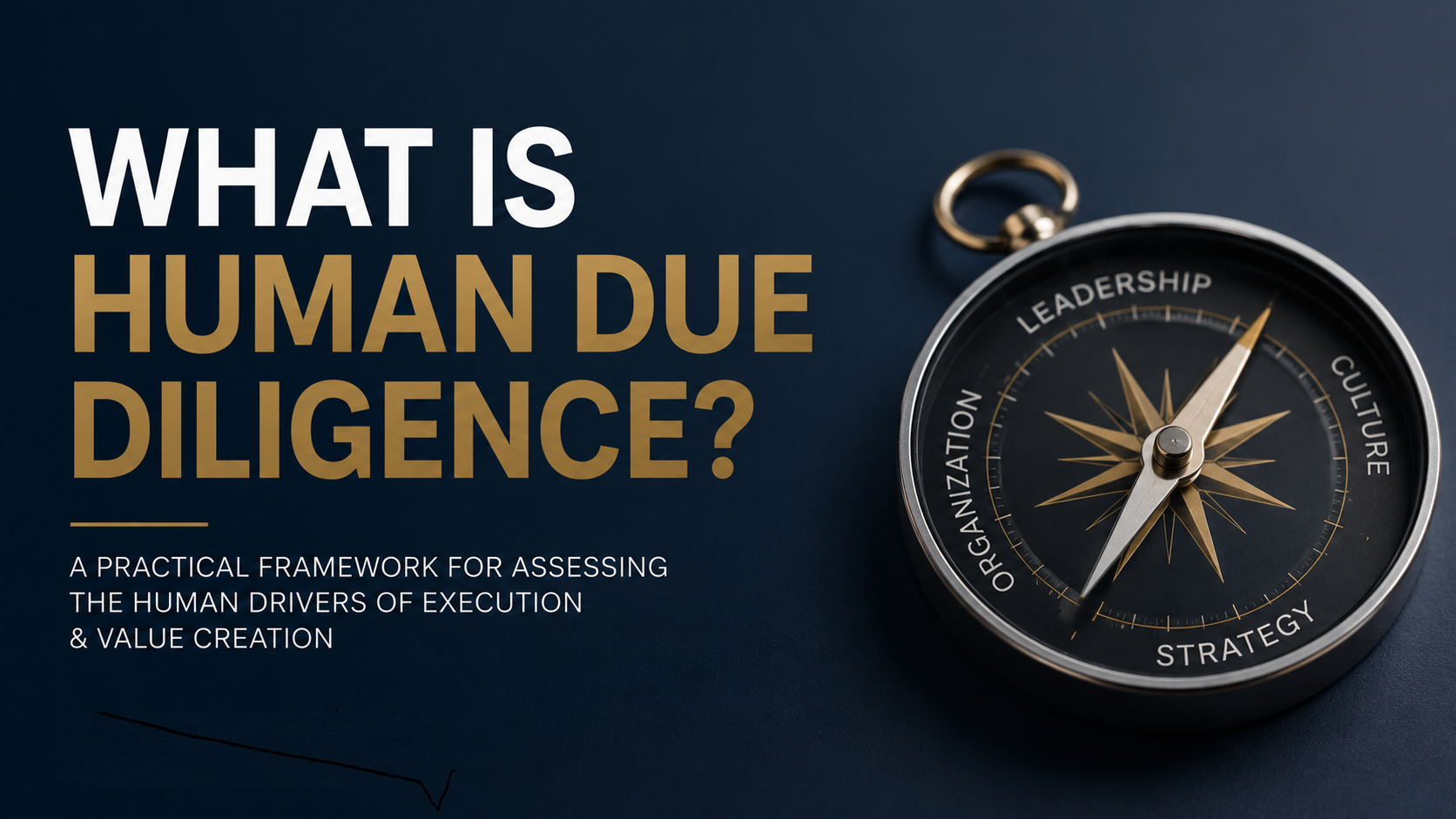
The Four Human Drivers of Execution
At WINGMIND, Human Due Diligence is built around four interconnected dimensions.

Human driver 1
Leadership Performance
Can leaders and leadership teams successfully deliver the business ambition?
Leadership Performance looks at both individual and collective leadership capacity.
- CEO and founder capability
- leadership style and role fit
- executive team cohesion
- trust and conflict dynamics
- governance and decision-making
- capacity to work with investors, Boards and stakeholders
- ability to perform under pressure

Human driver 2
Strategic Clarity
Is the strategy clear, actionable and translated into aligned execution?
Even excellent leaders cannot execute an unclear strategy. Human Due Diligence assesses whether the strategic direction is sufficiently clear, shared and operationalised across the organisation.
- vision and strategic direction
- priorities and trade-offs
- roadmap and milestones
- accountability
- alignment between CEO, Board, leadership team and functions
- ability to translate strategy into execution

Human driver 3
Organisational Effectiveness
Is the organisation designed and equipped to execute efficiently?
Organisations often become the invisible bottleneck to growth. As companies scale, acquire, restructure or transform, what used to work can suddenly become a constraint.
- organisational structure
- roles and responsibilities
- operating model
- processes and routines
- cross-functional collaboration
- resource allocation
- execution capacity
- ability to absorb growth, acquisitions or complexity

Human driver 4
Culture & HR Readiness
Will the culture, talent and HR practices sustain performance, growth and change?
Culture either accelerates or slows execution. Human Due Diligence assesses whether the human environment supports the company’s ambition and whether HR practices are mature enough for the next stage.
- culture and values
- engagement and trust
- talent quality and retention
- recruitment and onboarding
- compensation and rewards
- learning and development
- management practices
- change readiness
A complementary discipline
Human Due Diligence vs Other Forms of Due Diligence
Human Due Diligence does not replace Financial, Commercial or Legal Due Diligence. It complements them. Each discipline answers a different question.
| Type of Due Diligence | Main Question |
|---|---|
| Financial Due Diligence | Is the business financially sound? |
| Commercial Due Diligence | Is the market attractive and the commercial plan credible? |
| Legal Due Diligence | Are legal risks under control? |
| HR Due Diligence | Are people-related, employment and HR risks understood? |
| Human Due Diligence | Can leaders, teams and organisations actually execute and create value? |
Human Due Diligence and HR Due Diligence
Traditional HR Due Diligence often focuses on employment, compliance, compensation, benefits and HR processes. Increasingly, investors and Boards expect a broader assessment of leadership, organisational effectiveness, culture and execution capability.
At WINGMIND, we call this broader approach Human Due Diligence. The term best reflects the wider set of human and organisational factors that determine whether a company can execute and create value.
High-stakes situations
When Human Due Diligence Creates the Most Value
Human Due Diligence is particularly valuable when execution uncertainty is high.
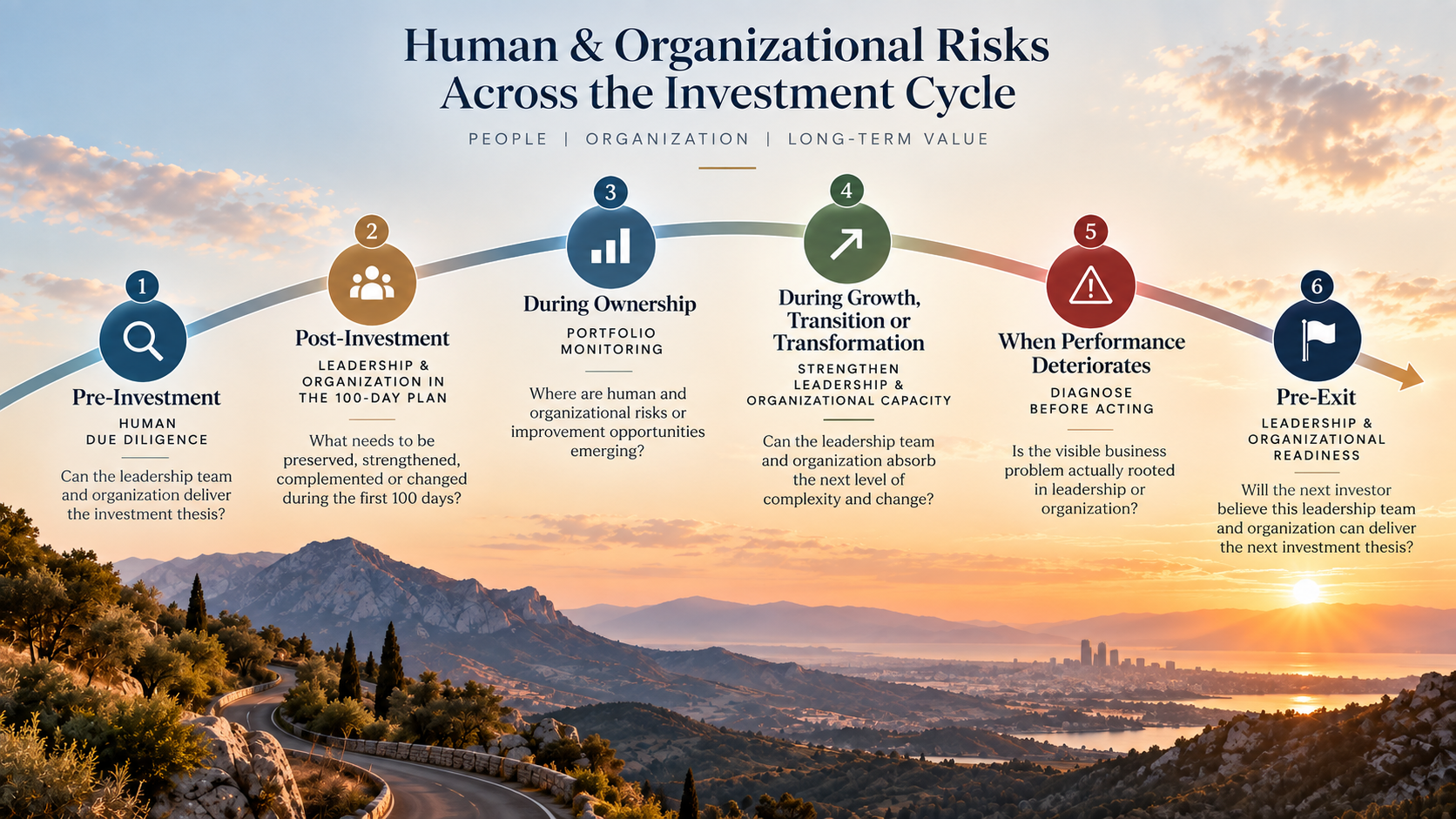
Pre-Investment
Assess whether the CEO, leadership team and organisation are capable of delivering the investment thesis.
M&A and Acquisitions
Identify leadership, cultural and organisational risks that can affect integration and value creation.
Scaling and Build-ups
Evaluate whether leadership, organisation, culture and HR practices can absorb growth, acquisitions and complexity.
CEO Succession and Leadership Transitions
Assess leadership fit, governance, team alignment and transition risks.
Critical Transformations
Clarify what must change in leadership, organisation and culture for the transformation to succeed.
Turnaround and Underperformance
Identify the internal blockers slowing execution and define the leadership and organisational actions required to restore momentum.
Decision-oriented outputs
What Clients Receive
A Human Due Diligence engagement provides a structured and decision-oriented view of the human drivers of execution and value creation.
The objective is not to produce another report. It is to support better decisions.
- a Human Due Diligence report
- leadership assessment reports
- organisational diagnostic findings
- an executive summary for investors or Boards
- key leadership and organisational risks
- value creation levers
- governance recommendations
- integration or transformation priorities
- a practical action roadmap
- CEO, Board or leadership team debriefs
Beyond transactions
Human Due Diligence Is Not Only for Investors
Boards use it to evaluate governance, leadership risks and CEO transitions. CEOs use it before major transformations or when execution slows down. Leadership teams use it to strengthen alignment and decision-making. Growing companies use it to prepare for scaling.
In all these situations, the central question remains the same: What human and organisational factors will accelerate—or block—execution and value creation?
Human Due Diligence is not another HR exercise. It is an execution discipline.
Frequently asked questions
Human Due Diligence
Is Human Due Diligence the same as HR Due Diligence?
No. Traditional HR Due Diligence often focuses on employment, compliance, compensation, benefits and HR processes. Human Due Diligence is broader. It assesses leadership performance, strategic clarity, organisational effectiveness, culture and HR readiness to determine whether the company can execute and create value.
Is Human Due Diligence the same as Leadership Due Diligence?
No. Leadership Due Diligence focuses mainly on the CEO, founders, leadership team, governance and decision-making. Human Due Diligence includes leadership, but also assesses strategy execution, organisation, culture and HR readiness.
When should investors conduct Human Due Diligence?
Human Due Diligence can be conducted before an investment, immediately after closing, during scaling, before acquisitions, during CEO transitions, or when a portfolio company underperforms without a clear explanation.
Who should use Human Due Diligence?
Human Due Diligence is useful for PE/VC investors, Boards, CEOs, founders and leadership teams facing high-stakes decisions involving execution, leadership, organisation, transformation or value creation.
What does Human Due Diligence assess?
Human Due Diligence assesses four critical dimensions: Leadership Performance, Strategic Clarity, Organisational Effectiveness, and Culture & HR Readiness.
Assess the human drivers of execution and value creation
WINGMIND helps PE/VC investors, Boards and CEOs identify leadership and organisational risks, clarify execution capacity and define practical actions before or after an investment.
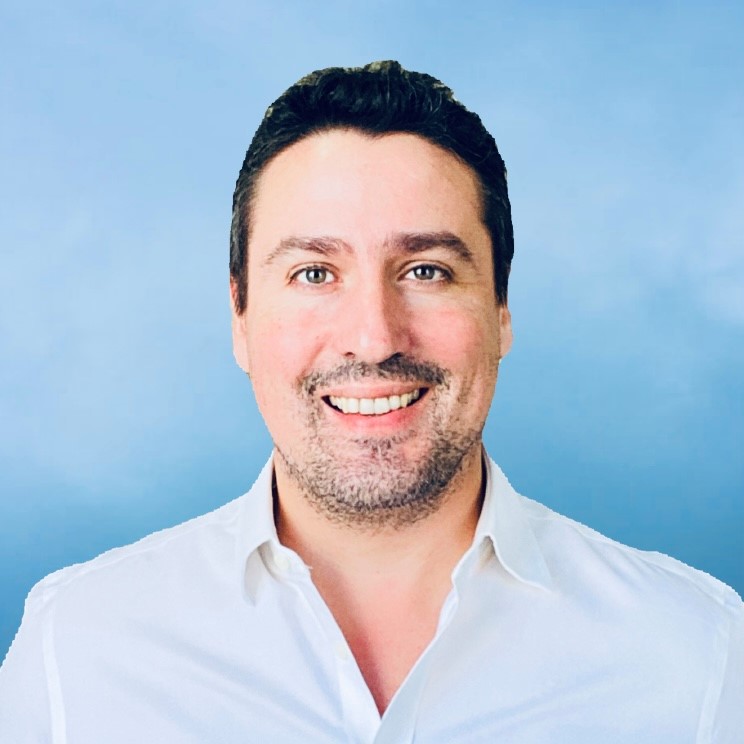
Founder of WINGMIND, David Chouraqui is an Operating Advisor & Executive Coach to PE/VC investors, boards and CEOs. A former private equity investor and entrepreneur, he specializes in Human Due Diligence, leadership assessments, organizational diagnostics and CEO & Board Advisory, helping organizations strengthen the human drivers of execution and value creation.