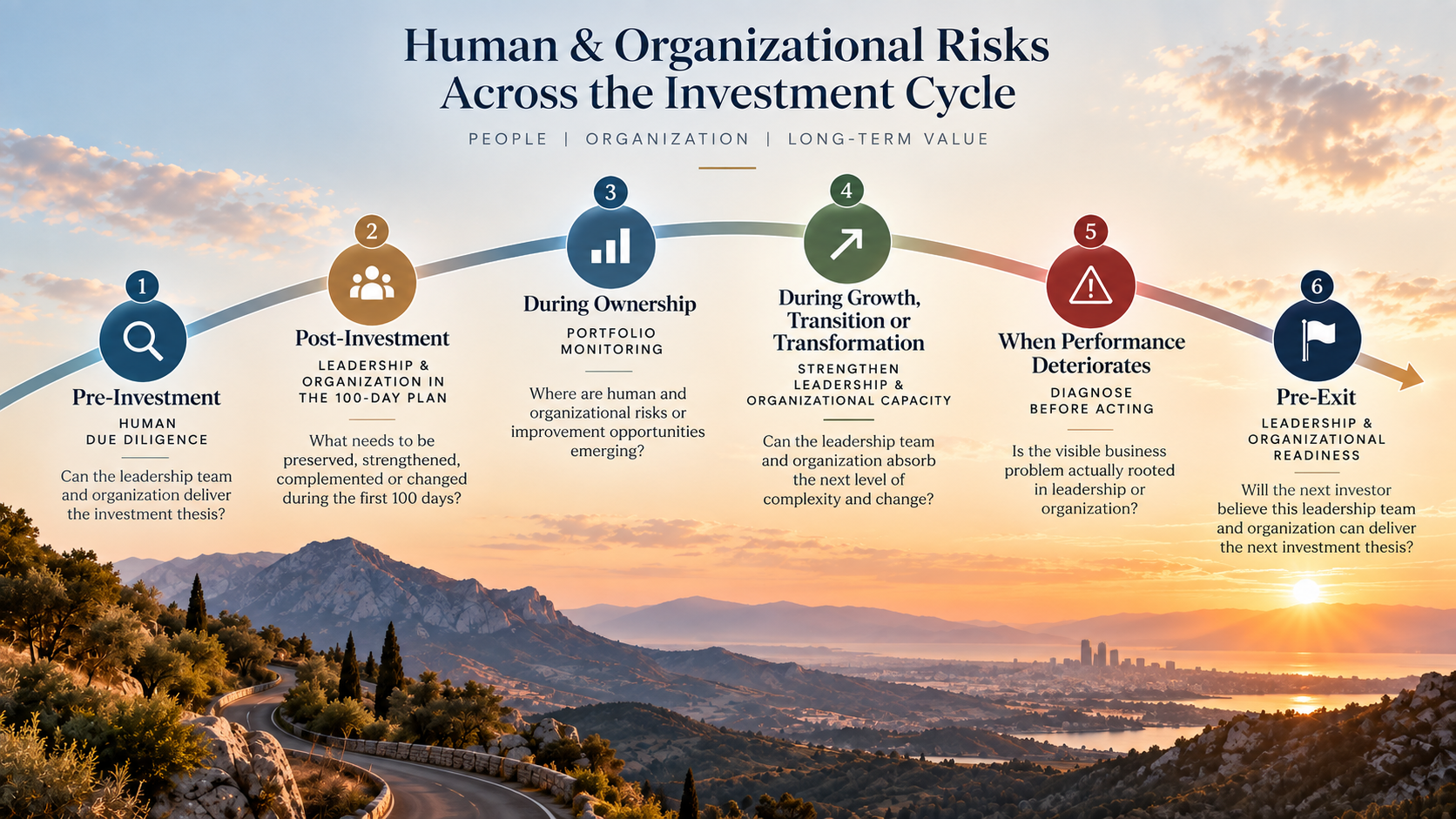

In private equity (PE) and venture capital (VC), one of the most critical factors in determining a portfolio company’s success is its leadership team. Strong leadership can propel a business to new heights, while poor leadership can derail growth and value creation. However, even experienced investors often make critical errors in evaluating leadership teams—errors that can lead to underperformance or, in extreme cases, failure. Here are four of the most common leadership evaluation mistakes made by PE/VC firms and how to avoid them:
These errors often occur because leadership is assessed informally through management presentations, references and investor intuition. A structured Human Due Diligence process provides a more complete view of leadership capability, team dynamics, governance and organizational readiness.
1. Focusing Too Much on Past Success
The Mistake:
Investors often fall into the trap of focusing heavily on a leader’s past accomplishments, assuming that previous successes will translate directly into future performance. While a strong track record is important, it doesn’t necessarily mean that those same skills will be effective in the next phase of the company’s growth. What worked in the past may not be enough to tackle new challenges, especially in rapidly scaling businesses or those entering new markets.
The Solution:
Investors must take a forward-looking approach, evaluating a leader’s potential to succeed in the context of future business needs. Key leadership capabilities such as adaptability, strategic thinking, and resilience become more important as a company evolves. A thorough leadership assessment should focus on these forward-looking skills to ensure the leader is capable of driving long-term success. Consider evaluating leaders’ ability to grow alongside the business and adapt to shifting market conditions.
Past success should always be compared with the requirements of the future role. An Executive Assessment helps distinguish transferable leadership capabilities from achievements that depended heavily on a different context.
2. Ignoring Team Dynamics and Alignment
The Mistake:
In many cases, investors focus primarily on the CEO or top leader while ignoring the dynamics of the broader leadership team. Misalignment among key leaders can create serious operational risks—conflicts, slow decision-making, and inefficiency. This can weaken a company’s ability to execute on strategy and meet key milestones, undermining investor confidence and value creation.
The Solution:
It is essential to assess the entire leadership team, not just the CEO. Investors should look for alignment in vision, values, and execution capabilities. Assessing how well the leadership team works together, how they handle decision-making, and whether they are unified around the company’s strategic goals can reveal hidden risks early on. Tools such as team assessments can provide valuable insights into leadership dynamics and prevent internal dysfunction from disrupting growth.
Individual interviews are not sufficient to understand how a leadership team actually operates. An Executive Team Assessment examines alignment, complementarity, trust, decision-making and collective execution capability.
3. Overlooking Personality and Emotional Intelligence
The Mistake:
Many investors concentrate solely on hard skills—such as operational expertise or technical competence—without paying enough attention to softer qualities like emotional intelligence (EQ). However, a leader’s ability to manage relationships, navigate conflicts, and maintain team morale is just as important as their technical know-how. Leaders who lack EQ often struggle to manage teams effectively, build trust, and inspire performance, leading to high turnover, low morale, or toxic work cultures.
The Solution:
Emotional intelligence is a critical component of effective leadership, and it should be evaluated during the due diligence process. Using personality assessments and behavioral interviews can help investors understand how a leader handles interpersonal dynamics and pressure. A leader with strong EQ is more likely to manage conflict constructively, foster a positive culture, and lead their team through challenges with resilience and focus.
4. Ignoring What Motivates the Leader
The Mistake:
A major oversight in leadership evaluation is failing to understand what motivates the leader. Investors may not consider whether the leader’s personal goals and ambitions align with the company’s strategic vision. A misalignment of motivations can result in leaders making decisions that prioritize personal interests over the company’s long-term success. For example, a leader looking for a quick exit might neglect long-term value creation in favor of short-term gains.
The Solution:
Understanding what drives a leader is crucial for ensuring alignment with the company’s objectives. Investors should take the time to uncover a leader’s personal motivations—whether it’s growth, innovation, financial gain, or creating a legacy—and assess how these motivations align with the company’s goals. This ensures that the leader remains engaged, focused, and committed to achieving the company’s long-term vision.
Motivation should be assessed not only at the time of the transaction but also against the expected holding period, governance model and likely evolution of the leader’s role.
Investing in strong leadership is one of the most important steps PE/VC firms can take to secure the success of their portfolio companies. By avoiding these four common mistakes—over-relying on past success, overlooking team dynamics, ignoring emotional intelligence, and failing to understand a leader’s motivations—investors can ensure they are backing leaders who are not only capable but aligned with the company’s long-term vision.
From Leadership Impressions to Investment Decisions
WINGMIND helps PE, VC and Growth Equity investors assess the human drivers of execution and value creation before and after an investment.
Our work examines:
- CEO and founder capability;
- leadership-team effectiveness;
- strategic alignment;
- governance;
- organizational scalability;
- culture and people practices.
The assessment translates these findings into clear recommendations: develop, complement, adapt or replace.
Are You Relying Too Heavily on Leadership Intuition?
Add an independent and structured perspective to your investment process.

Founder of WINGMIND, David Chouraqui is an Operating Advisor & Executive Coach to PE/VC investors, boards and CEOs. A former private equity investor and entrepreneur, he specializes in Human Due Diligence, leadership assessments, organizational diagnostics and CEO & Board Advisory, helping organizations strengthen the human drivers of execution and value creation.