
Many companies are currently facing significant external pressures : weaker demand, margin compression, geopolitical uncertainty, financing constraints or technological disruption with AI. What is striking is that companies exposed to similar conditions often react very differently. The initial shock may be external, but the quality of the response depends heavily on the company itself : its leadership, its organization and its ability to adapt.
I see this first-hand in my current work. Many situations start with underperformance, execution difficulties or increased external pressure, but the real differences appear in how management teams assess the situation, make decisions and mobilize the organization.
Some companies recognize what has changed relatively early, adjust their priorities and regain momentum. Others remain stuck for much longer, either because they are slow to acknowledge the problem, struggle to make decisions or are unable to translate those decisions into action.
The market may trigger the downturn, but the organization often determines the recovery.
Underperformance is rarely only a financial problem
When performance deteriorates, the first reaction is naturally to look at the numbers : revenue, margins, EBITDA, cash, pipeline, productivity or customer retention. These indicators are essential because they show where the gap is appearing, but they do not explain why the company is struggling to correct it.
This is why a performance issue often needs to be examined through several lenses : the business, the leadership, the executive team, the organization and the governance around it.
What makes some companies react faster?
1. They recognize the change early
One of the first differences is the ability to accept that the situation has genuinely changed. Management teams can spend considerable time explaining disappointing performance through temporary factors : a delayed contract, a weak quarter, the loss of one customer or a slowdown expected to reverse quickly.
Sometimes those explanations are correct, but they can also delay the moment when management accepts that the assumptions behind the original plan no longer hold. Companies that react well tend to create enough openness for difficult information to surface early and for previous assumptions to be challenged.
2. Leadership adapts to the new situation
The leadership required during rapid expansion is not necessarily the leadership required when conditions become more difficult. During expansion, companies often pursue several growth vectors at once (new markets, new products, new geographies, acquisitions or additional capabilities) while maintaining a strong focus on top-line growth.
When the environment becomes tougher, growth remains essential but leadership usually requires greater selectivity: clearer priorities, tighter resource allocation, stronger cost discipline, more explicit trade-offs and, sometimes, difficult people decisions or the willingness to stop initiatives that no longer justify the resources they consume.
The relevant question is therefore not simply whether the CEO is a strong leader, but whether the CEO’s leadership remains appropriate for what the company now needs. This is one of the situations in which an Executive Assessment can provide useful perspective.
3. The executive team aligns and mobilizes the organization
Pressure often exposes weaknesses that were less visible during periods of growth. When resources become scarcer, disagreements around priorities, budgets and responsibilities intensify. Functional leaders can start protecting their own perimeter, while decisions become slower and more issues are escalated to the CEO.
Effective executive teams do not avoid disagreement. They are able to debate difficult issues, reach a shared understanding of the situation, align around the priorities and then act collectively.
This alignment is essential because the CEO cannot mobilize the organization alone. If members of the executive team continue to send different messages, defend competing priorities or remain only partially committed to the chosen direction, execution quickly loses momentum.
The quality of the response therefore depends not only on the individual strength of the executives, but also on their ability to operate as a leadership team and mobilize the wider organization behind the decisions that have been made. An Executive Team Assessment can help identify whether these dynamics are supporting or constraining the response.
4. Priorities become clearer, not more numerous
A common reaction to underperformance is to launch many initiatives at the same time : a new sales plan, a cost programme, pricing changes, a reorganization, new reporting, recruitment or a transformation project. Each initiative may be justified individually but together they can overwhelm an organization that is already under pressure.
Recovery often requires greater focus rather than more activity. Management needs to identify what must change now, what needs to be protected, what should stop and what can wait. The ability to make these trade-offs clearly is often one of the most important elements of the response.
5. Resources actually follow the priorities
Changing priorities without changing the allocation of resources rarely has much impact. If a business decides that a particular market, customer segment or capability is now critical, capital, management attention and talent need to move accordingly.
This can be difficult because resources are also connected to influence, status and historical commitments. Projects have sponsors, teams have owners and budgets reflect previous strategic choices. Reallocation therefore requires both analytical discipline and leadership courage.
6. Important decisions are made quickly enough and revisited when the situation changes
In an uncertain environment, management rarely has all the information it would ideally like before making a decision. Debate is necessary, especially on important choices, but at some point the organization needs clear and sufficiently decisive decisions in order to move.
Companies lose valuable time when major questions remain permanently open, when decisions are repeatedly postponed or when previously settled issues are constantly reopened without new information. Once the debate has taken place, the leadership team needs to make the decision, communicate it clearly and create the conditions for execution.
At the same time, decisive action should not mean rigidity. New information continues to arrive, and an important decision can itself change the system : it may alter behaviours, resource allocation, customer reactions or the dynamics within the management team. The company therefore needs to be able to update its understanding of the situation and adapt subsequent decisions accordingly.
The objective is not to wait for certainty, nor to lock the organization into an initial answer. It is to make decisions at the right speed, act on them, observe the consequences and remain capable of adjusting the next move as the situation evolves.
7. Problems are raised early and uncomfortable information reaches the top
Boards, investors and management teams can only react to the reality they can see. Yet difficult situations often make information less reliable precisely when it matters most. Managers may soften bad news, forecasts remain optimistic for too long, operational issues are reframed as temporary exceptions and serious problems can reach senior management only after valuable time has been lost.
Companies that respond well tend to make it possible for problems to be raised early, including when the information is uncomfortable, politically difficult or contrary to the current narrative. This requires reliable upward information flows, but also a leadership environment in which people understand that surfacing a problem early is useful rather than dangerous.
The quality of the information reaching the top can materially affect the quality and timing of the response. A company that sees problems early has more options; a company that sees them late is often forced into more radical decisions.
8. The organization can translate decisions into execution
Even a good diagnosis and the right strategic decisions create little value if the organization cannot implement them. Management depth, clarity of roles, coordination across functions and the quality of middle management all become particularly visible during periods of pressure.
Some organizational weaknesses are not created by the downturn; they are simply exposed by it. A broader Organizational Assessment can help determine whether the main constraints sit in leadership, team effectiveness, structure, capabilities, governance, culture or execution, and how these factors interact.
Is the problem the market, the CEO or the organization?
In difficult situations, there is often pressure to identify a single cause. Is the market responsible? Is the CEO no longer the right person? Is the executive team too weak? Is the organization badly designed?
In practice, the answer is often more complex. A weaker market can expose an organizational weakness. An unclear strategy can amplify tensions within the executive team. A CEO may be struggling partly because the team below is insufficiently strong. Management may appear slow because the governance relationship with the Board or shareholders has become too intrusive or too unclear.
This is why drawing conclusions too quickly can be dangerous. Replacing a leader without understanding the wider system can leave the underlying constraints untouched. At the same time, attributing everything to external conditions can allow internal problems to continue for too long.
The objective should therefore be to understand what is actually constraining performance before deciding what needs to change.
Diagnose before acting
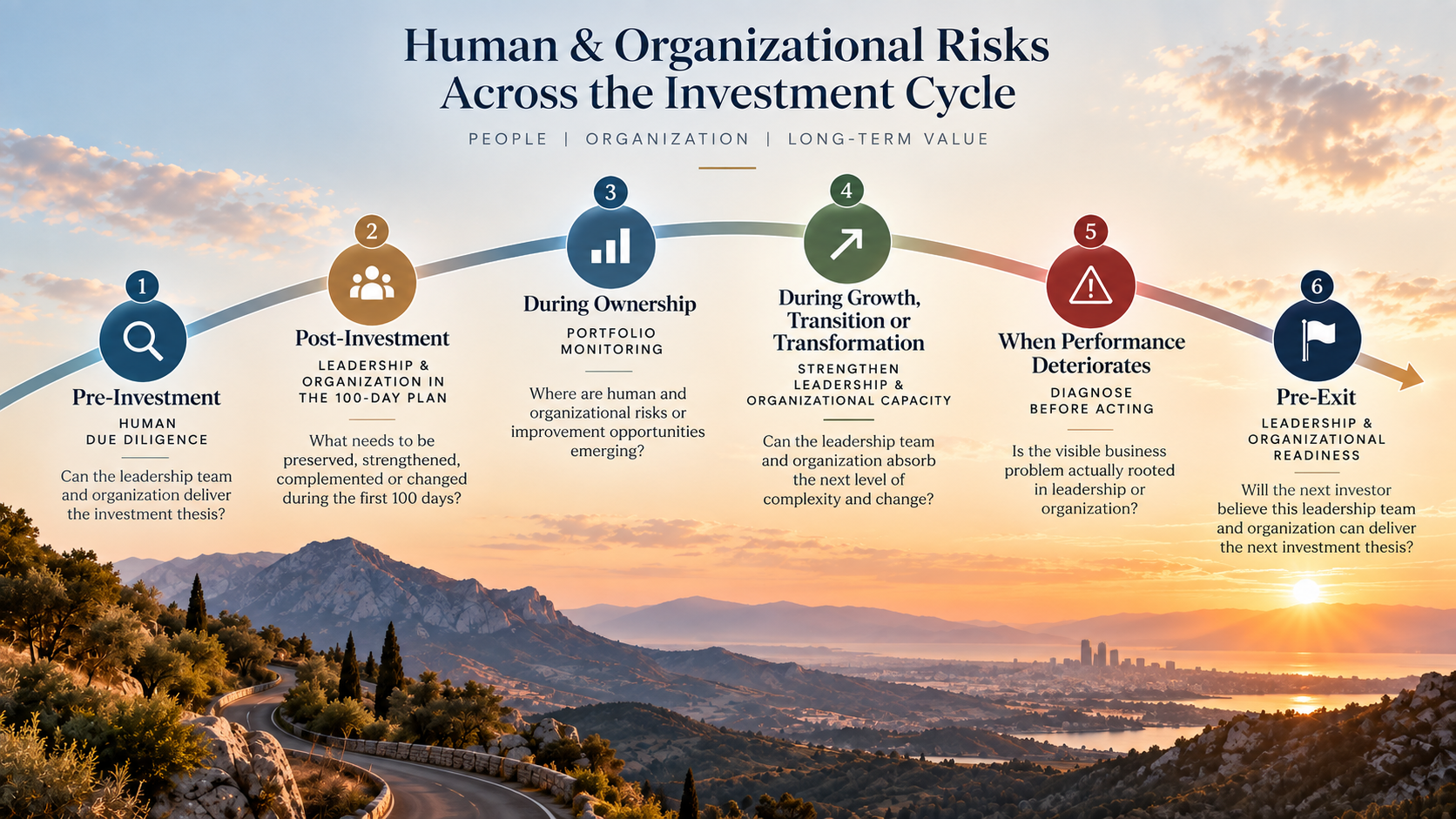
When a company is under pressure, speed matters, but speed does not mean acting without diagnosis. Financial and operational data provide one perspective. Interviews with leaders and managers, leadership assessments and structured organizational diagnostics provide another.
Differences in perception are often particularly useful. The CEO, Board, shareholders, functional leaders and middle managers may have very different explanations for the same performance problem. Understanding where these views converge and where they diverge can reveal important information about the situation.
For investors, early signals should trigger early attention
For investors, the objective should be to understand what is happening early enough to preserve the ability to act. A weak signal can already justify asking more questions, seeking a clearer view of the situation and understanding whether the company is reacting appropriately.
Management teams will naturally try to solve problems themselves. CEOs may also filter information, soften difficult messages or reassure shareholders while they are still trying to regain control of the situation. This is understandable, but it means investors cannot always rely only on the information that reaches them spontaneously.
Being proactive does not mean interfering unnecessarily in management. It means making sure investors have a sufficiently accurate view of what is really happening, drawing the right conclusions from that information and deciding how best to support the management team or whether more significant action is required.
The earlier investors understand whether the issue is temporary, strategic, leadership-related or organizational, the more options they usually retain. Waiting until the deterioration is fully visible in the financials can reduce those options and make the eventual response more disruptive.
In that context, an independent Organizational Assessment or broader Human Due Diligence perspective can help investors obtain a more complete view of the situation and support better decisions.
Recovery does not mean changing everything
Once the problem is better understood, there is another temptation : to change too many things at once. Under pressure, investors, Boards and executives understandably want visible action. But organizations have a limited capacity to absorb simultaneous change.
Sometimes the right response is to strengthen the CEO rather than replace the CEO. In other situations, part of the executive team needs to change, responsibilities need to be clarified, a critical capability needs to be reinforced or resources need to be reallocated. More radical action may also be necessary, but it should result from the diagnosis rather than substitute for it.
The quality of the response therefore depends not only on identifying the right actions, but also on prioritizing them and choosing the right sequence.
What difficult periods reveal
No company can control external shock. Management cannot determine interest rates, geopolitical developments, technological disruption, customer behaviour or the actions of competitors.
What companies can influence is the quality of their response : how quickly they understand what has changed, how openly they discuss the situation, how effectively they make decisions and how well the organization executes them.
Difficult periods therefore reveal a great deal about an organization. They reveal the adaptability of its leadership, the effectiveness and alignment of its executive team, the quality of its information flows and its ability to focus resources on what matters most.
Ultimately, companies that recover well are not necessarily those that avoid adversity. They are those that are able to understand the new situation, adapt their leadership and organization, make sufficiently decisive choices and continue updating their response as the situation evolves.

Founder of WINGMIND, David Chouraqui is an Operating Advisor & Executive Coach to PE/VC investors, boards and CEOs. A former private equity investor and entrepreneur, he specializes in Human Due Diligence, leadership assessments, organizational diagnostics and CEO & Board Advisory, helping organizations strengthen the human drivers of execution and value creation.