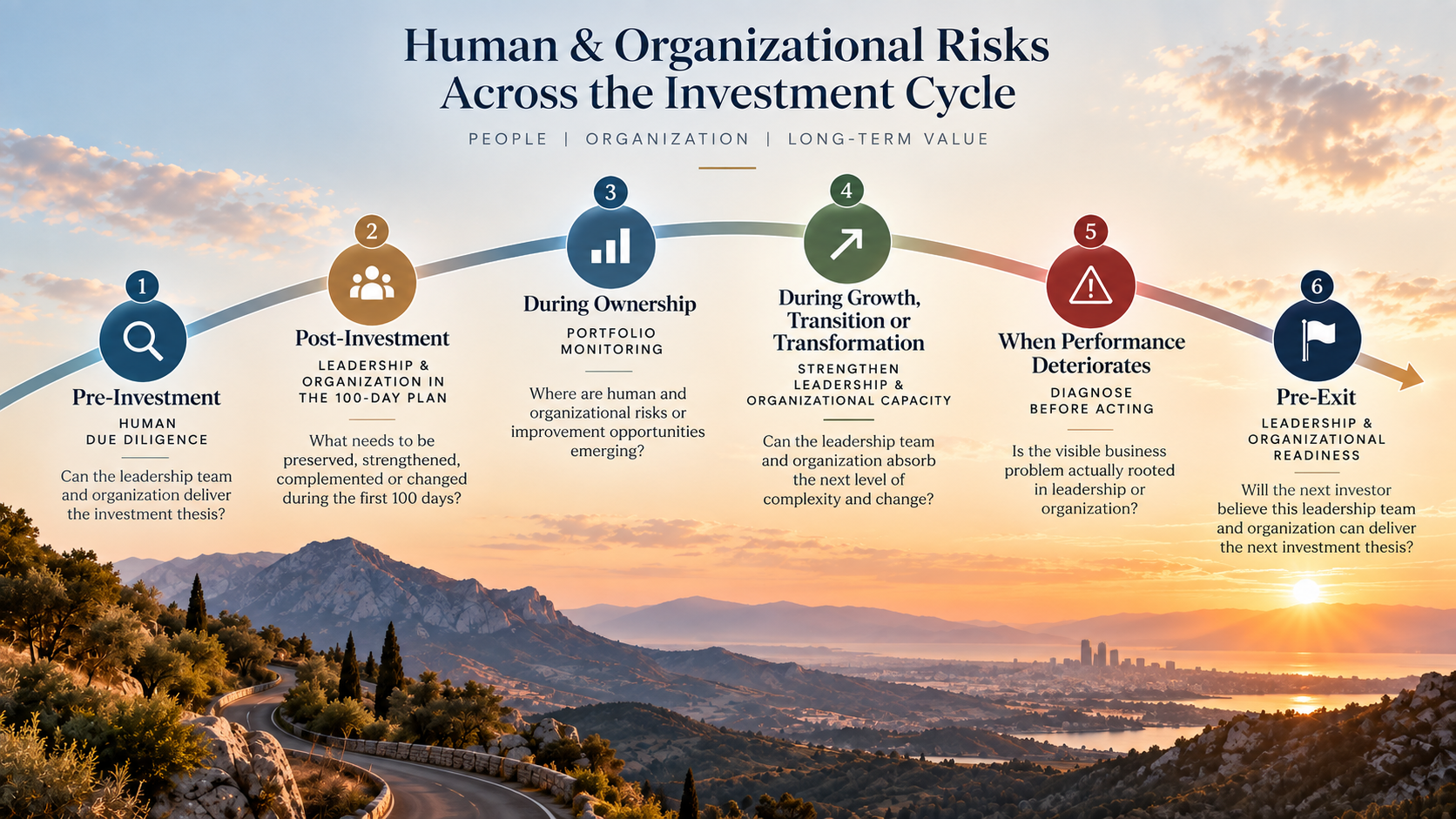

Human Capital Due Diligence
Human Capital Due Diligence helps investors understand whether the people and the organisation can actually deliver the investment thesis.
Financial, commercial and legal due diligence may confirm that a business has an attractive market, sound economics and a credible growth plan. Yet value creation can still fail when leadership, organisation, culture or execution capacity are not strong enough to deliver that plan.
Human Capital Due Diligence examines the human and organisational factors that influence execution and value creation. At WINGMIND, it forms part of a broader Human Due Diligence framework focused on one integrated question:
Can the people and the organisation deliver the plan?
The following ten areas are among the most important leadership, organisational and cultural risks to assess before an investment, acquisition, build-up or major transition.
In this article
- Leadership capability and role fit
- Executive team effectiveness
- CEO, Board and investor alignment
- Strategic clarity and execution alignment
- Organisational design and operating model
- Scalability and management maturity
- Build-up and integration readiness
- Culture, talent and retention
- Change and transformation readiness
- Underperformance and hidden root causes
Risk 1
Leadership capability and role fit
A capable leader in one context may not be the right leader for the next stage. Growth, international expansion, integration, turnaround or institutionalisation can each require a different leadership profile.
What to look for: difficulty delegating, repeatedly delayed decisions, excessive founder dependency, loss of energy or credibility, or a gap between the formal role and actual influence.
Risk 2
Executive team effectiveness
Investors often assess executives individually but underestimate how the team operates as a collective system. Strong individuals do not automatically create an effective leadership team.
What to look for: silos, unresolved conflict, slow collective decisions, contradictory priorities or excessive dependence on the CEO to arbitrate every issue.
Risk 3
CEO, Board and investor alignment
Execution problems often begin with unclear expectations between the CEO, the Board and investors. Misalignment may remain hidden during the transaction and emerge only when difficult trade-offs appear.
What to look for: different interpretations of the value-creation plan, unclear mandate, tension around pace or risk, overly distant or intrusive governance, or loss of trust.
Risk 4
Strategic clarity and execution alignment
A strategy may be convincing in a presentation while remaining poorly understood or inconsistently translated into action across the organisation.
What to look for: too many priorities, different roadmaps across functions, unclear trade-offs, weak accountability or growth initiatives competing for the same resources.
Risk 5
Organisational design and operating model
Underperformance is not always a leadership problem. Sometimes the organisation around the leaders is not designed to support the ambition.
What to look for: overlapping responsibilities, too many approvals, weak cross-functional coordination, unbalanced workloads or bottlenecks around one person or function.
Risk 6
Scalability and management maturity
Companies frequently grow faster than their management systems, processes and leadership practices.
What to look for: informal management, founder dependency, weak delegation, recurring execution failures or processes and tools that lag behind growth.
Risk 7
Build-up and integration readiness
An acquisition creates value only when leadership, governance, organisation and culture are aligned after the deal.
What to look for: competing leadership teams, unclear integration ownership, culture clashes, synergies without accountable owners or key talent at risk of leaving.
Risk 8
Culture, talent and retention
Culture becomes an execution risk when behaviours, incentives and management practices no longer support the strategy.
What to look for: high turnover among key people, low engagement, toxic or political behaviour, weak management practices or critical capability gaps.
Risk 9
Change and transformation readiness
A transformation may be strategically necessary while the organisation is not ready to absorb it.
What to look for: conflicting messages from leaders, passive resistance, overloaded teams, repeated loss of momentum or low confidence in the change plan.
Risk 10
Underperformance and hidden root causes
Visible symptoms can be misleading. A weak function may reflect unclear priorities. Leadership conflict may reveal a governance problem. High turnover may result from management, culture, compensation or organisational design.
The objective is not to assign blame. It is to distinguish symptoms from root causes and identify the few issues that matter most.
Methodology
How are these risks assessed?
A reliable Human Capital Due Diligence should triangulate several sources rather than rely on one interview or one personality test.
Structured interviews
To assess capability, judgement, motivation, relationships and weak signals.
Psychometric assessments
To understand personality, drivers, derailment risks and blind spots.
Stakeholder feedback
To capture trust, alignment, influence and relational impact.
Organisational surveys
To gather collective insight on strategy, structure, culture and engagement.
Document and data review
To connect perceptions with operating evidence.
Decision-oriented outputs
What should a Human Capital Due Diligence deliver?
A useful assessment should not end with generic observations. It should give decision-makers a clear view of the most important risks, their consequences and the actions available.
- a clear assessment of the CEO and key leaders;
- an evaluation of executive team dynamics;
- a structured organisational diagnostic;
- a view of hidden risks and execution blockers;
- priority value-creation levers;
- governance, leadership and organisational recommendations;
- a practical action roadmap.
Terminology
Human Capital Due Diligence, HR Due Diligence and Leadership Due Diligence
These terms are used differently across markets. Human Capital Due Diligence commonly focuses on leadership, talent, organisation and people-related risks in an investment context.
At WINGMIND, these issues are assessed within a broader Human Due Diligence framework that also examines strategic clarity, governance and execution capability.
WINGMIND does not provide legal, payroll, employment-compliance or employment-liability due diligence. The focus is leadership, organisation, culture, talent and execution risk.
From risk identification to action
Human Capital Due Diligence creates value only when its conclusions influence investment, governance and execution decisions.
Founder of WINGMIND, David Chouraqui is an Operating Advisor & Executive Coach to PE/VC investors, boards and CEOs. A former private equity investor and entrepreneur, he specializes in Human Due Diligence, leadership assessments, organizational diagnostics and CEO & Board Advisory, helping organizations strengthen the human drivers of execution and value creation.