
Leadership assessment
Leadership risks are often overlooked, despite their significant impact on execution. They rarely appear as a single dramatic failure. More often, they emerge gradually through everyday behaviours: how a leader prioritises, delegates, decides, collaborates and responds under pressure.
The people working most closely with a leader often notice these patterns first — and sometimes experience their consequences directly. Investors and boards may become aware of them later, once they begin affecting the leadership team, organisational effectiveness or business performance.
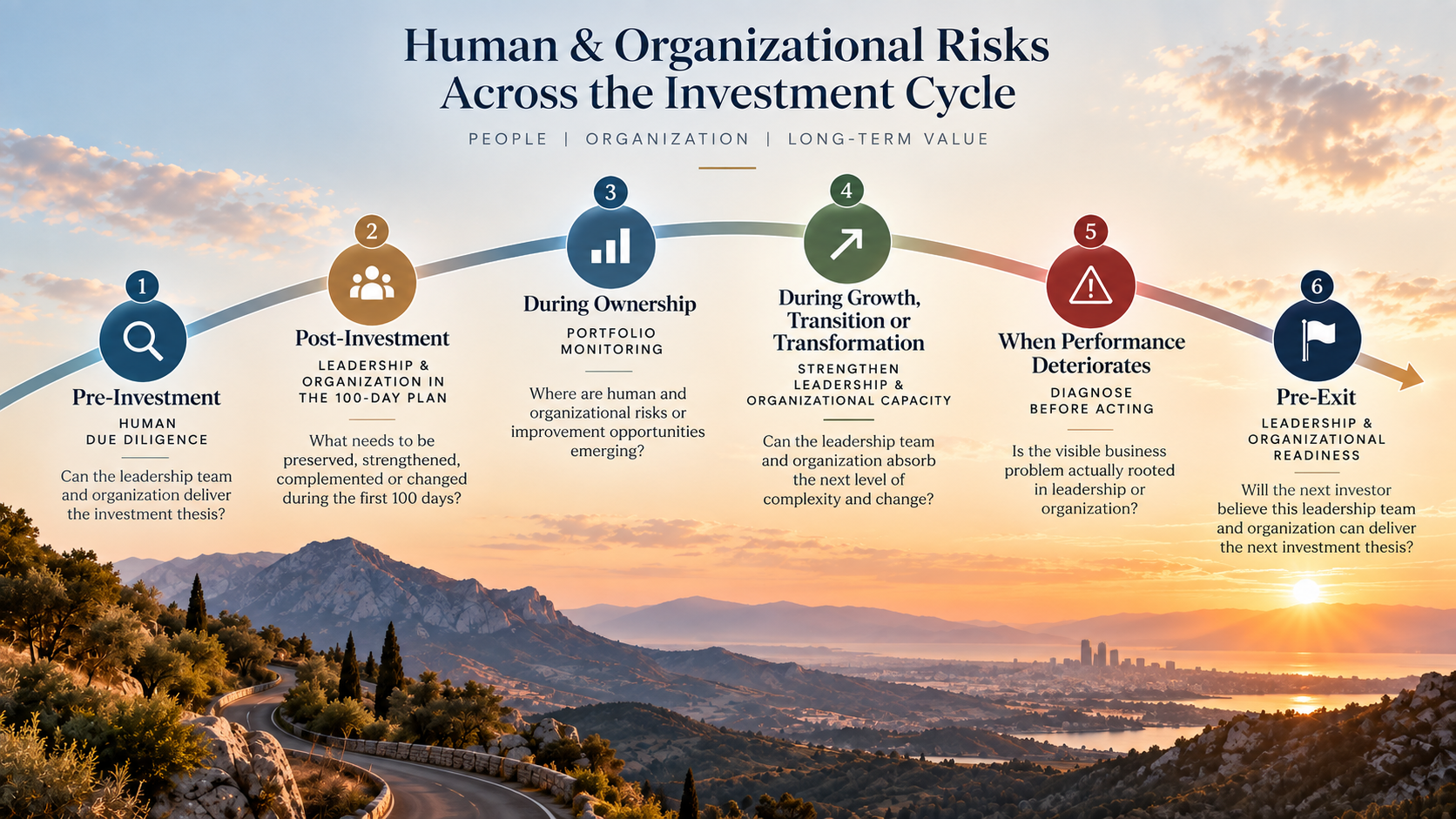
These risks may also be examined as part of a Human Due Diligence when they could affect an acquisition or future value creation.
The ten patterns below are not fixed personality types and should not be used as labels. They are recurring behavioural tendencies whose impact depends on the context, their intensity and the leader’s ability to adapt.
In this article

Leadership pattern 1
The Scattered Leader
Lacks focus
What it looks like. The Scattered Leader spreads attention across too many initiatives without establishing clear priorities. New projects are launched before previous ones have gained traction, diluting both the leader’s effort and the team’s capacity.
Organisational impact. Resources become fragmented, teams lose clarity and execution slows.

Leadership pattern 2
The Overloaded Leader
Cannot prioritise or delegate
What it looks like. The Overloaded Leader centralises decisions and retains too many responsibilities. As the volume of work increases, the leader becomes a bottleneck and the organisation waits.
Organisational impact. Critical decisions are delayed, the leader becomes exhausted and capable team members lose ownership.

Leadership pattern 3
The Operator
Too operational, not strategic enough
What it looks like. The Operator remains absorbed in day-to-day activity and struggles to step back. Immediate issues crowd out long-term priorities, strategic choices and anticipation.
Organisational impact. The organisation reacts rather than leads, innovation weakens and future risks remain insufficiently addressed.

Leadership pattern 4
The Theorist
Strong on ideas, weak on action
What it looks like. The Theorist generates ambitious concepts but struggles to convert them into practical decisions, sequencing and accountable execution.
Organisational impact. Projects remain abstract, teams become frustrated and resources are spent without sufficient progress.

Leadership pattern 5
The Soloist
Does not play collectively
What it looks like. The Soloist makes decisions alone, consults selectively and underuses the collective intelligence of the leadership team.
Organisational impact. Trust declines, executive collaboration weakens and valuable perspectives are excluded from decisions.

Leadership pattern 6
The Overconfident Leader
Too certain and too optimistic
What it looks like. The Overconfident Leader overestimates capabilities, underestimates risk and may dismiss weak signals or uncomfortable feedback.
Organisational impact. Commitments become unrealistic, preventable crises recur and credibility with teams, boards or investors deteriorates.

Leadership pattern 7
The Passive Leader
Allows events to take over
What it looks like. The Passive Leader avoids difficult decisions, delays confrontation and waits too long before addressing critical issues.
Organisational impact. Problems compound, opportunities are missed and teams lose confidence in the organisation’s ability to act.

Leadership pattern 8
The Distrustful Leader
Does not trust the team
What it looks like. The Distrustful Leader micromanages, questions others excessively and finds it difficult to rely on talented people.
Organisational impact. Autonomy declines, strong employees disengage and the organisation becomes slower and more dependent on one person.

Leadership pattern 9
The Reckless Leader
Takes poorly considered risks
What it looks like. The Reckless Leader moves quickly without sufficient analysis, consultation or understanding of downside scenarios.
Organisational impact. The company faces avoidable instability, repeated crises and declining confidence from stakeholders.

Leadership pattern 10
The Rigid Leader
Resists necessary change
What it looks like. The Rigid Leader clings to established beliefs, methods or structures even when the context has changed.
Organisational impact. Adaptation slows, competitiveness erodes and the organisation struggles to attract or retain people who want to build the future.
From diagnosis to decision
Once a leadership risk is identified, there are usually three paths
1. Improve
Help the leader change the pattern through feedback, coaching, development and clearer expectations.
2. Compensate and adapt
Add complementary capabilities, redesign responsibilities, clarify decision rights or adjust the leader’s scope.
3. Replace
When the gap is too significant, too persistent or too costly relative to the company’s needs, leadership change may be necessary.
The key question is not whether a leader is simply “good” or “bad”. It is whether the observed pattern can change, whether it can be effectively compensated for, and whether the leader remains suited to the next stage of the business.
Leadership patterns rarely exist in isolation. Explore the 10 Organizational Dysfunctions That Can Undermine Execution
Assess leadership risks before they become organisational problems
WINGMIND’s Executive Assessment help investors, boards and CEOs evaluate leadership effectiveness, organisational impact and the practical options available.
Frequently asked questions
Leadership risk assessment
What is a leadership risk?
A leadership risk is a recurring behaviour, capability gap or mismatch with the business context that can materially affect decisions, teams or execution.
How can a board identify leadership risks?
Boards can combine structured interviews, stakeholder feedback, observation of decision-making, assessment of team dynamics and evidence from business execution. A single psychometric test is rarely sufficient.
Does identifying a leadership risk mean replacing the leader?
No. Depending on the severity, adaptability of the leader and business context, the appropriate response may be development, role redesign, complementary resources or replacement.
These profiles are illustrative and are not a diagnostic tool on their own.

Founder of WINGMIND, David Chouraqui is an Operating Advisor & Executive Coach to PE/VC investors, boards and CEOs. A former private equity investor and entrepreneur, he specializes in Human Due Diligence, leadership assessments, organizational diagnostics and CEO & Board Advisory, helping organizations strengthen the human drivers of execution and value creation.