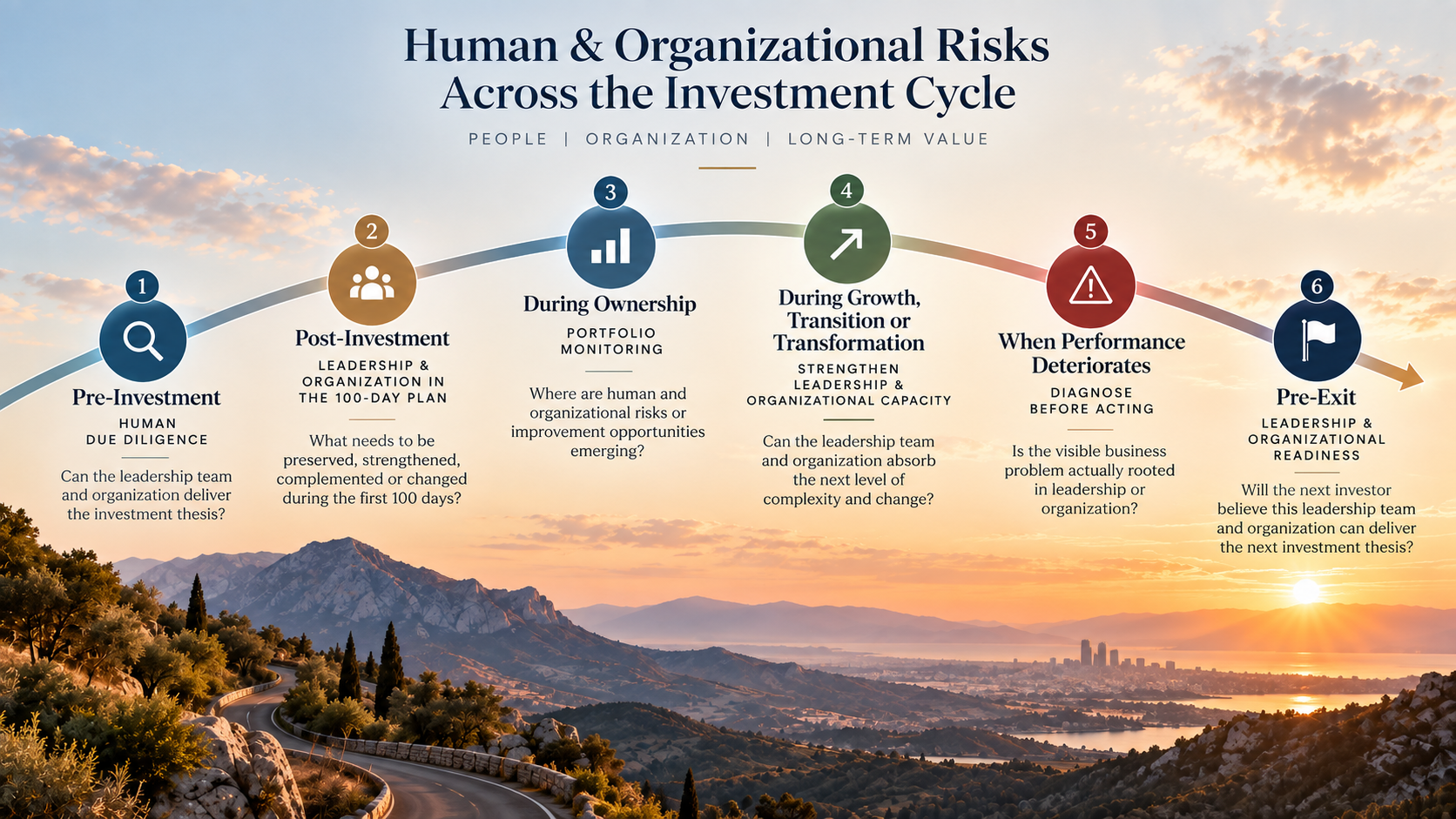

When a portfolio company underperforms, investors and management face a critical question: what needs to change to restore performance and deliver the value creation plan?
The answer may involve strengthening leadership, reshaping the executive team, clarifying strategic priorities or redesigning the organization.
But identifying the right interventions requires understanding what is really holding the business back.
A structured leadership and organizational assessment can help investors, Boards and CEOs diagnose the obstacles to execution and focus on the decisions that matter most.
1. What’s Holding the Company Back?
Underperformance is often triggered by external pressures, such as changing market conditions, increased competition or economic uncertainty.
But how a company responds to these challenges also depends on its internal leadership and organizational capabilities.
Identifying the internal factors that contribute to underperformance or prevent recovery is therefore essential.
Four dimensions deserve particular attention.
Leadership Strength
Does the company have the right leadership to recover?
A CEO who performed well during a period of growth may not necessarily be equipped to lead a turnaround or a more complex organization.
Similarly, an executive team composed of capable individuals may struggle to work effectively as a collective leadership body.
The assessment should examine the CEO’s suitability for the situation, the capabilities and effectiveness of the executive team, and the ability of leaders to make decisions, mobilize people and deliver results.
One particularly important question is:
Is the CEO contributing to the problem, or is the organization constraining the CEO?
Replacing a CEO without addressing structural problems can leave the successor facing the same obstacles. Conversely, delaying a necessary leadership change can further compromise recovery.
Strategic Clarity
Are strategic priorities clear, aligned and translated into action?
A company may have a detailed value creation plan without sufficient clarity about what really matters.
Investors, the Board, the CEO and individual functions may pursue different priorities. Too many initiatives may compete for limited resources and management attention.
The assessment should determine whether strategic choices are understood, difficult trade-offs have been made, resources are aligned with priorities and accountability for execution is clear.
Operational Effectiveness
Is the organization capable of executing the recovery plan?
Even with the right strategy and leadership, an organization may struggle to deliver because of unclear responsibilities, excessive centralization, functional silos or ineffective decision-making.
The assessment should identify where decisions become blocked, coordination breaks down, accountability is fragmented or organizational capabilities are insufficient.
It should also examine whether governance arrangements between investors, the Board and management support effective execution.
The objective is to identify the structural and operational changes that will have the greatest impact on performance.
HR & Culture Readiness
Does the organization have the people and culture required to recover?
Performance recovery often requires capabilities, behaviors and management practices that differ from those that supported the company’s previous development.
Critical talent gaps, weak middle management, limited transparency or resistance to change can undermine even a well-designed recovery plan.
The assessment should examine whether the company has the required capabilities, whether managers can mobilize their teams and whether its culture supports accountability, cooperation and change.
2. What Needs to Change?
A diagnosis is valuable only if it leads to clear decisions.
Depending on the findings, four types of action may be required.
Improve : Strengthen What Already Exists
Support the CEO, develop leadership capabilities, improve executive team effectiveness, clarify priorities or reinforce management practices.
Complement : Add Missing Capabilities
Strengthen the leadership team, recruit critical executives or reinforce functions and management layers that are limiting execution.
Adapt : Change the Organization
Redesign responsibilities, decision rights, governance arrangements, structures or operating processes to restore effectiveness.
Replace : Make Necessary Leadership Changes
When a leader is no longer suited to the situation, prepare and execute a transition based on a clear understanding of the company’s requirements.
These responses are not mutually exclusive. Performance recovery may require several coordinated interventions.
The objective is not to change everything, but to identify the few changes that will make the greatest difference.
3. How to Identify the Right Actions
In an underperforming company, the assessment must be rapid, independent and focused on decisions rather than assigning blame.
A structured approach combines:
- Business and organizational review: understanding the value creation plan, performance challenges, organizational structure and existing corrective initiatives.
- Confidential organizational diagnostic questionnaire: gathering perspectives across leadership and management to identify strengths, weaknesses and differences in perception.
- Targeted interviews: investigating critical issues with the CEO, executive team, selected managers, investors and Board members.
By connecting these sources, the assessment helps distinguish individual leadership limitations from collective, organizational and governance problems.
The outcome should be a clear diagnosis and a prioritized recovery roadmap, identifying what needs to change, who should act and how progress will be monitored.
From Diagnosis to Performance Recovery
Underperformance rarely calls for a single, universal solution.
The CEO may need support rather than replacement. The executive team may need additional capabilities. Strategic priorities may need clarification. The organization may require structural changes.
The challenge for investors and management is to understand which interventions will address the real obstacles to execution.
Restoring performance starts with identifying what needs to change in the leadership and organization — and acting on it.
How WINGMIND Can Help
WINGMIND supports Private Equity investors, Boards and CEOs facing underperformance and execution challenges.
Our Organizational Assessment evaluates Leadership Strength, Strategic Clarity, Operational Effectiveness and HR & Culture Readiness to identify the factors limiting performance and define targeted improvement priorities.
The objective is to help investors and management make better decisions, strengthen execution and restore performance.
Discuss an Underperforming Portfolio Company

Founder of WINGMIND, David Chouraqui is an Operating Advisor & Executive Coach to PE/VC investors, boards and CEOs. A former private equity investor and entrepreneur, he specializes in Human Due Diligence, leadership assessments, organizational diagnostics and CEO & Board Advisory, helping organizations strengthen the human drivers of execution and value creation.