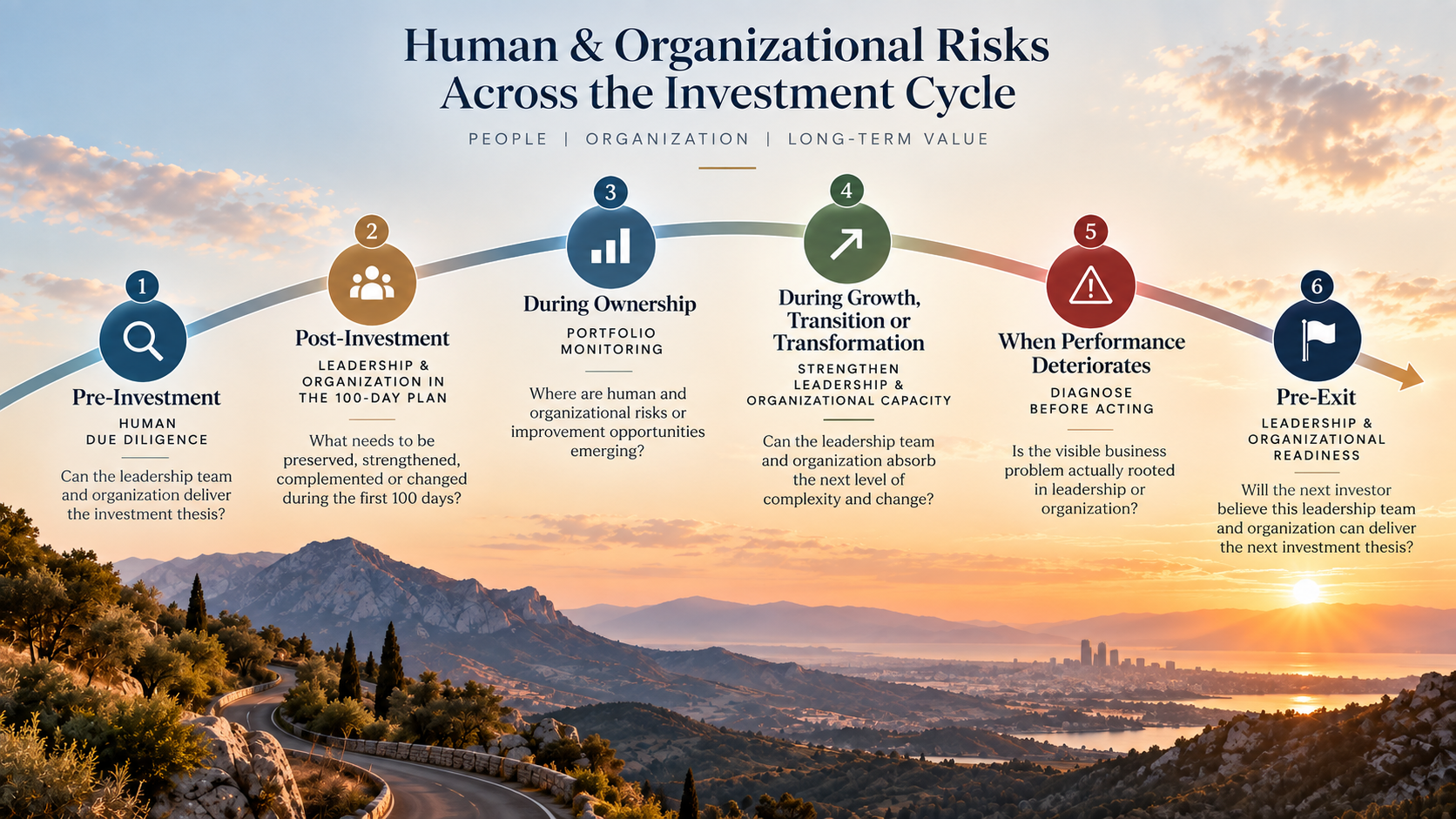

Human Due Diligence is sometimes approached as a series of separate assessments.
The CEO or founders are assessed individually. The executive team may be reviewed separately. The organization may then be examined through its structure, processes, capabilities or culture.
Each perspective can provide useful information.
But the real value comes from connecting them.
A company does not execute through individuals, teams and organizational systems independently. They constantly influence one another.
A strong CEO can be constrained by a weak leadership team. A group of individually impressive executives can fail to operate effectively together. A capable leadership team can struggle within an organization with unclear responsibilities, weak functions or insufficient management capabilities.
Conversely, what appears to be an organizational issue can sometimes originate in the behavior or limitations of one or two key leaders.
A strong Human Due Diligence therefore needs to understand the company across three interconnected levels : individual leaders, the leadership team and the broader organization.
1. Individual leaders : assessing capability, potential and fit
The first level concerns the founder, CEO and other key executives.
The objective is not simply to determine whether someone is a “good leader”. Leadership effectiveness depends heavily on context.
A founder who was highly effective during the first phase of the company may face very different requirements as the business scales. An executive who performed well in a relatively simple organization may struggle when complexity increases. Another may have the potential to grow considerably beyond their current responsibilities.
An Executive Assessment therefore needs to examine both current performance and future requirements.
This may include leadership capabilities, execution, judgment, adaptability, learning agility, self-awareness, ability to make difficult decisions, capacity to attract and lead stronger talent, potential risks and derailers, and fit with the next stage of the business.
But even a detailed individual assessment cannot tell investors everything they need to know.
Leadership does not happen in isolation.
2. The leadership team : where individual capabilities become collective execution
The second level is the leadership team.
This is the critical bridge between individual leadership and organizational effectiveness.
A company may have several highly capable executives and still have a weak leadership team.
They may compete rather than cooperate. Important disagreements may remain unresolved. Decisions may take too long. Functional priorities may dominate company priorities. Some executives may avoid difficult conversations while others create unnecessary conflict.
Conversely, a team composed of leaders with different styles and strengths may become highly effective if those differences are complementary and managed well.
The relevant questions are therefore collective.
Can the leaders challenge one another constructively? Can they make decisions together? Are responsibilities sufficiently clear? Is information shared openly? Can they resolve disagreement? Do they support collective decisions once they are made? Can they align around priorities and mobilize the organization?
A Leadership or Executive Team Assessment needs to examine this collective effectiveness rather than simply aggregate the strengths and weaknesses of individual executives.
The leadership team is where individual capabilities become — or fail to become — collective execution.
It is also where the boundary between leadership assessment and organizational assessment begins to disappear.
3. The organization : can the system execute the strategy?
The third level is the broader organization.
Even a strong leadership team can struggle if the organization around it cannot execute effectively.
The issue may lie in strategic priorities that are not sufficiently clear, responsibilities that overlap, decision rights that create bottlenecks, insufficient management capacity below the executive team or poor coordination across functions.
It may also lie within specific functions, departments or business units.
A commercial function may not yet be structured for the next stage of growth. Finance may lack the capabilities required by a more complex business. HR may be too weak to support rapid hiring and organizational development. Operations may depend excessively on a small number of individuals. A particular geography or business unit may consistently underperform despite strong overall company performance.
An Organizational Assessment therefore needs to look beyond the organizational chart.
It can examine strategic clarity, organizational effectiveness, the strength of key functions and departments, the management layer beyond the executive team, roles and decision rights, cross-functional cooperation, capabilities and resources, culture and human capital, and the organization’s ability to execute and scale.
The objective is not to compare the company with a theoretical model of the perfect organization.
It is to determine whether the organization is fit for the strategy, the investment thesis and the next stage of the business.
The biggest risk is sometimes diagnosing the wrong level
Looking at the three levels together matters because the apparent problem and the underlying cause are not always the same.
A CEO may appear to be underperforming because too many decisions depend on them. The initial conclusion may be that the CEO needs to delegate more. But the deeper issue may be that the company has not built sufficiently strong managers to whom responsibility can realistically be delegated.
In another company, the executive team may appear slow and ineffective. Yet the problem may not be the quality of the executives themselves. Poorly defined roles, overlapping responsibilities or governance arrangements may make effective collective decision-making extremely difficult.
The opposite can also happen.
An organization may repeatedly be restructured when the real constraint is an individual leader who cannot operate differently. New processes may be introduced when the problem is actually a leadership team that avoids difficult decisions. More resources may be added to a function whose leader is simply not capable of taking it to the next stage.
Without connecting the three levels, investors and Boards risk solving the visible symptom rather than the underlying problem.
The same weakness can require very different actions
This distinction matters because different diagnoses lead to different decisions.
If the issue is primarily individual, the answer may involve development, coaching, role clarification, complementing the leader with additional capabilities or, in some situations, replacement.
If the issue lies within the leadership team, the answer may involve changing responsibilities, strengthening complementarity, improving decision-making, resolving conflicts or rebuilding collective accountability.
If the underlying problem is organizational, the action may involve strengthening a function, clarifying decision rights, redesigning a structure, adding management capabilities, reallocating resources or changing the operating model.
Sometimes several of these actions need to happen together.
This is where a framework such as Improve · Complement · Adapt · Replace can help translate assessment into decisions.
The important point is that the appropriate intervention depends on understanding the source of the problem.
Human Due Diligence should assess interactions, not only components
This is why Human Due Diligence should not be treated as a checklist of individual competencies, team dynamics and organizational characteristics.
The most useful insights often lie in the interactions between them.
How does the CEO’s leadership style influence the executive team?
How does the executive team shape the quality of decision-making throughout the company?
Do organizational structures reinforce the behaviors the company needs, or make them harder?
Can strong functions compensate for weaknesses elsewhere, or are they operating in silos?
Is the company dependent on a small number of individuals because of exceptional talent, or because it has failed to institutionalize capabilities?
These questions are particularly important as companies scale. Business, leadership, and organizational requirements evolve together, and weaknesses manageable at one stage can become major constraints at the next.
For investors, the objective is better decision-making
The purpose of connecting the three levels is ultimately practical.
Investors need to understand whether the people and organization are capable of delivering the investment thesis, where the main risks sit and what should happen after the investment.
That may mean developing a founder, strengthening a leadership team, recruiting a key executive, upgrading a particular function, clarifying governance or making a more fundamental leadership change.
A good Human Due Diligence should help distinguish between these possibilities.
It should also help investors avoid two common mistakes: expecting an individual to solve what is fundamentally an organizational problem, or redesigning an organization when the real bottleneck is leadership.
Conclusion
Individual leaders matter. Leadership teams matter. Organizations matter.
But assessing each separately is not enough.
Companies execute through the interaction between all three.
The individual leader influences the team. The leadership team shapes the organization. The organization can either amplify or constrain the capabilities of the people inside it.
This is why Human Due Diligence needs to move continuously between these levels and understand where the real strengths, risks and constraints sit.
The objective is not simply to assess the individual, the leadership team and the organization. It is to understand how they work together, and where change will create the greatest impact.
Founder of WINGMIND, David Chouraqui is an Operating Advisor & Executive Coach to PE/VC investors, boards and CEOs. A former private equity investor and entrepreneur, he specializes in Human Due Diligence, leadership assessments, organizational diagnostics and CEO & Board Advisory, helping organizations strengthen the human drivers of execution and value creation.