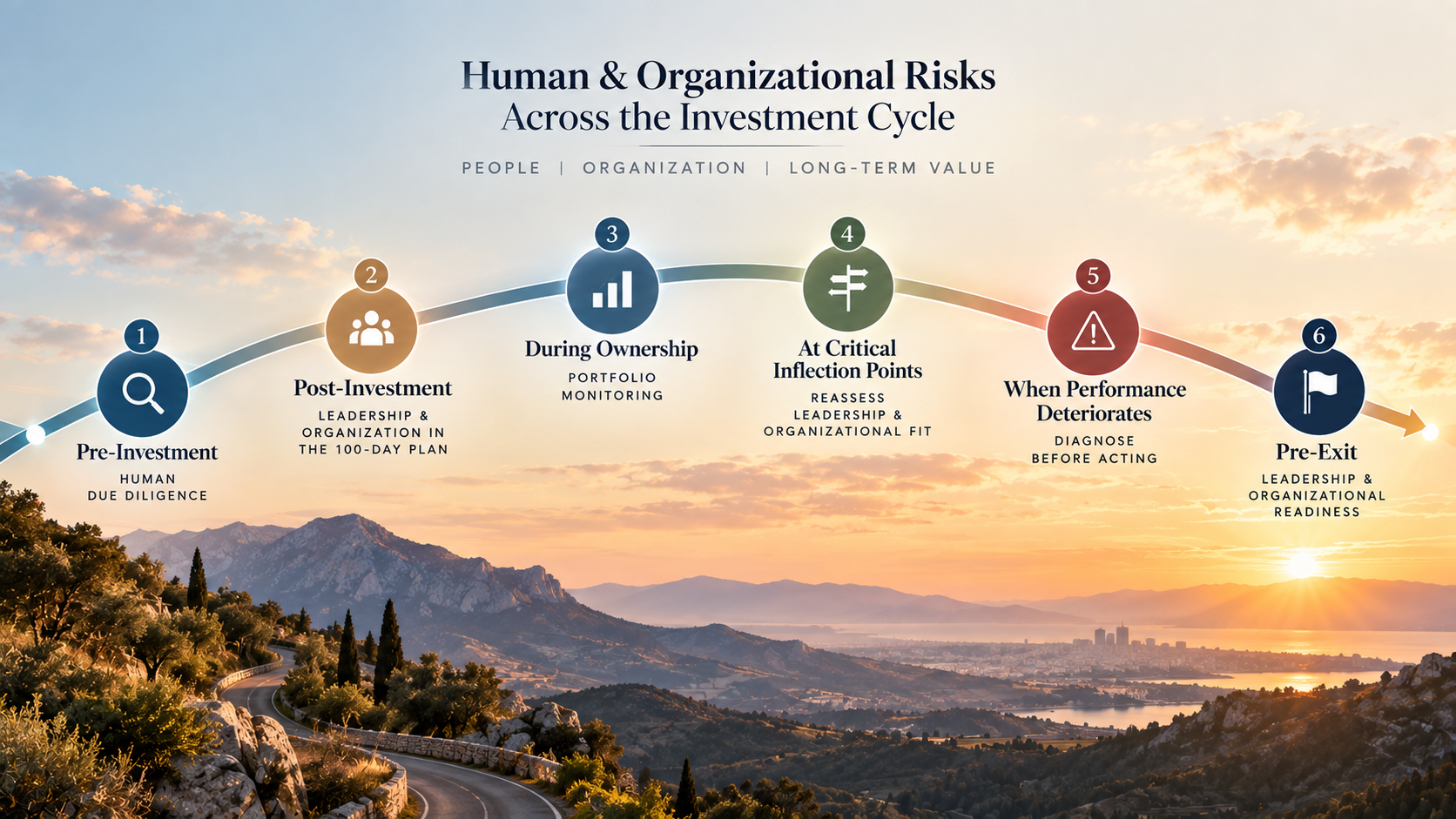

When a portfolio company starts missing expectations, the CEO quickly becomes part of the discussion.
Sometimes rightly.
But replacing the CEO is only one possible answer.
It should not be the diagnosis.
A company may be underperforming because the CEO is no longer the right leader for the stage ahead.
But the issue may also lie elsewhere: an incomplete executive team, insufficient management depth, unclear governance, poorly defined roles, investor-management misalignment or an organization that has simply outgrown the way it used to operate.
The real question is therefore not:
Is this a good CEO?
It is:
Is this the right CEO, in the right role, with the right team and organization, for what the company needs next?
CEO Fit Is Contextual
CEO performance cannot be assessed in isolation from the situation.
A founder who successfully built a company from zero to €20 million may face a fundamentally different challenge when the company needs to become an international, professionally managed €100 million business.
Likewise, a CEO who performs well in a relatively stable environment may struggle through rapid acquisitions, restructuring, international expansion or a major strategic shift.
The individual has not necessarily become a weaker leader.
The requirements of the role may simply have changed.
This is why CEO assessment should consider at least four elements together:
- the leader;
- the executive team;
- the organization;
- the next stage of the investment thesis.
A meaningful Executive Assessment should therefore go beyond personality or leadership style and examine whether the CEO remains fit for the company’s current and future requirements.
When Should Investors Question CEO Fit?
The answer should not be: only once financial performance deteriorates.
Several signals may justify a deeper review earlier:
- recurring execution misses;
- key executives leaving;
- difficulty delegating;
- decisions becoming increasingly concentrated around the CEO;
- inability to build a strong second line;
- repeated tensions with the Board or shareholders;
- difficulty attracting or retaining senior talent;
- organizational complexity growing faster than leadership capability;
- strategic changes failing to translate into execution;
- the company reaching a stage that requires a fundamentally different leadership model.
None of these signals automatically means that the CEO should be replaced.
They mean the situation deserves diagnosis.
Avoid Turning the CEO Into the Default Explanation
When performance deteriorates, there is a natural tendency to personalize the problem.
The CEO is visible.
The CEO has formal accountability.
Replacing one person can also appear simpler than addressing a more complex organizational problem.
But the visible leader may not be the root cause.
A CEO may appear weak because:
- accountabilities across the executive team are unclear;
- the Board repeatedly changes priorities;
- critical capabilities are missing around the CEO;
- acquisitions have increased complexity without adapting the operating model;
- the organization has grown without sufficient management depth;
- governance creates ambiguity rather than clarity;
- the CEO’s role has simply become too broad.
Conversely, what appears to be an organizational problem may genuinely be rooted in the CEO’s inability to adapt.
The purpose of assessment is to distinguish between these situations.
This is why the CEO should be assessed in the context of the wider organization, not as an isolated individual.
Four Possible Responses
A useful CEO review should not begin with a binary choice between keeping and replacing the leader.
There are at least four possible responses.
1. Improve
The CEO remains the right person for the role, but specific leadership capabilities need to evolve.
This may involve delegation, strategic prioritization, communication, team management, decision-making or the transition from founder-led execution to organizational leadership.
Targeted coaching, advisory support or leadership development may be sufficient.
2. Complement
The CEO remains credible, but the leadership system around them is incomplete.
The answer may be to add:
- a stronger CFO;
- a COO;
- commercial leadership;
- international capability;
- stronger functional executives;
- greater management depth.
In these situations, replacing the CEO could destroy value when the real requirement is to strengthen the team.
3. Adapt
The issue may lie partly in the architecture around the CEO.
This can involve changing:
- responsibilities;
- decision rights;
- reporting lines;
- governance;
- Board involvement;
- organizational structure;
- the division of responsibilities between founder and professional management.
Sometimes the person can remain successful if the role itself changes.
4. Replace
Sometimes the conclusion is more fundamental.
The CEO may no longer have the capability, motivation, adaptability or credibility required for the next stage.
In that case, replacement may be the right decision.
But it should be the consequence of the diagnosis, not the starting hypothesis.
Founder Transitions Require Particular Care
The issue becomes even more sensitive when the CEO is also the founder.
The founder may retain extraordinary knowledge, relationships, legitimacy and entrepreneurial energy while no longer being the right person to run an increasingly complex organization.
The question does not necessarily have to be:
Founder stays or founder leaves?
Other configurations may exist:
- the founder remains CEO with stronger executives around them;
- the founder focuses on product, customers or strategy;
- a professional CEO joins while the founder retains a significant leadership role;
- responsibilities evolve progressively rather than through an abrupt transition.
A poorly managed founder transition can destroy value.
A transition avoided for too long can do the same.
This is particularly relevant in Founder Due Diligence, where the question is not only whether the founder is strong today, but whether the leadership model can evolve with the company.
The Board and Investor Relationship Matters Too
CEO performance is not independent from governance.
Sometimes a deteriorating CEO-investor relationship is interpreted as evidence that the CEO is failing.
But disagreement can arise from different expectations, unclear governance or competing views of strategy.
Before concluding that the relationship is broken, investors should understand:
- whether strategic expectations are aligned;
- whether responsibilities are clear;
- whether the CEO has sufficient autonomy;
- whether the Board is providing useful challenge or creating confusion;
- whether disagreements concern performance, strategy, pace or trust.
An independent assessment can provide a common fact base when perceptions have become polarized.
Timing Matters
CEO decisions become harder when they are postponed until the company is in crisis.
Earlier assessment creates more options.
The investor may still be able to strengthen the team, modify roles, coach the CEO, improve governance or prepare an orderly transition.
Later, the choice may become much more binary.
As with other human and organizational risks, early diagnosis preserves optionality.
This is one reason leadership and organizational questions should be reviewed not only in situations of underperformance, but also at major inflection points in the investment cycle.
Assess the System, Not Only the Individual
The most useful CEO assessment is therefore broader than an individual leadership evaluation.
It should examine the interaction between:
CEO → Executive Team → Organization → Governance → Investment Thesis
Leadership problems and organizational problems frequently reinforce each other.
A weak team can overload the CEO.
An overloaded CEO can centralize decisions.
Centralized decisions can weaken managers.
Weak managers can create even more dependence on the CEO.
Without looking at the whole system, investors risk treating one symptom while reinforcing another.
How WINGMIND Approaches CEO Transition Questions
WINGMIND works with PE, Growth and VC investors, Boards and CEOs when there is uncertainty around leadership fit, executive-team capability or the leadership model required for the next stage.
The assessment can combine:
- the CEO or founder’s perspective;
- Board and shareholder perspectives;
- executive-team input;
- selected organizational perspectives;
- leadership and business context;
- the requirements of the investment thesis and next stage.
The objective is to determine whether the situation primarily calls for:
Improve · Complement · Adapt · Replace
and to translate that diagnosis into practical action.
This can lead to:
- CEO advisory or executive coaching;
- executive-team reinforcement;
- role clarification;
- governance changes;
- organizational adjustments;
- preparation for a leadership transition.
The objective is not to protect the CEO or to replace the CEO.
It is to determine what the company actually needs next.
View Selected WINGMIND Engagements

Founder of WINGMIND, David Chouraqui is an Operating Advisor & Executive Coach to PE/VC investors, boards and CEOs. A former private equity investor and entrepreneur, he specializes in Human Due Diligence, leadership assessments, organizational diagnostics and CEO & Board Advisory, helping organizations strengthen the human drivers of execution and value creation.