

Human and organizational risks do not appear only at the time of investment. They evolve throughout the investment cycle.
At certain moments, the level of risk increases: before an investment, immediately after closing, during rapid growth, leadership transitions, acquisitions, periods of underperformance or ahead of exit.
These moments require two complementary approaches.
The first is reactive: when a doubt, tension or question appears, investors need to understand quickly what is really happening and act on the right diagnosis.
The second is proactive: anticipating how leadership, management capabilities and the organization may need to evolve before future risks become visible in performance.
The objective is not to assess continuously. It is to know when to look deeper, where to act, and what to strengthen in order to mitigate future risks and maximize value creation.
This article looks at six moments across the investment cycle when human and organizational factors deserve particular attention.
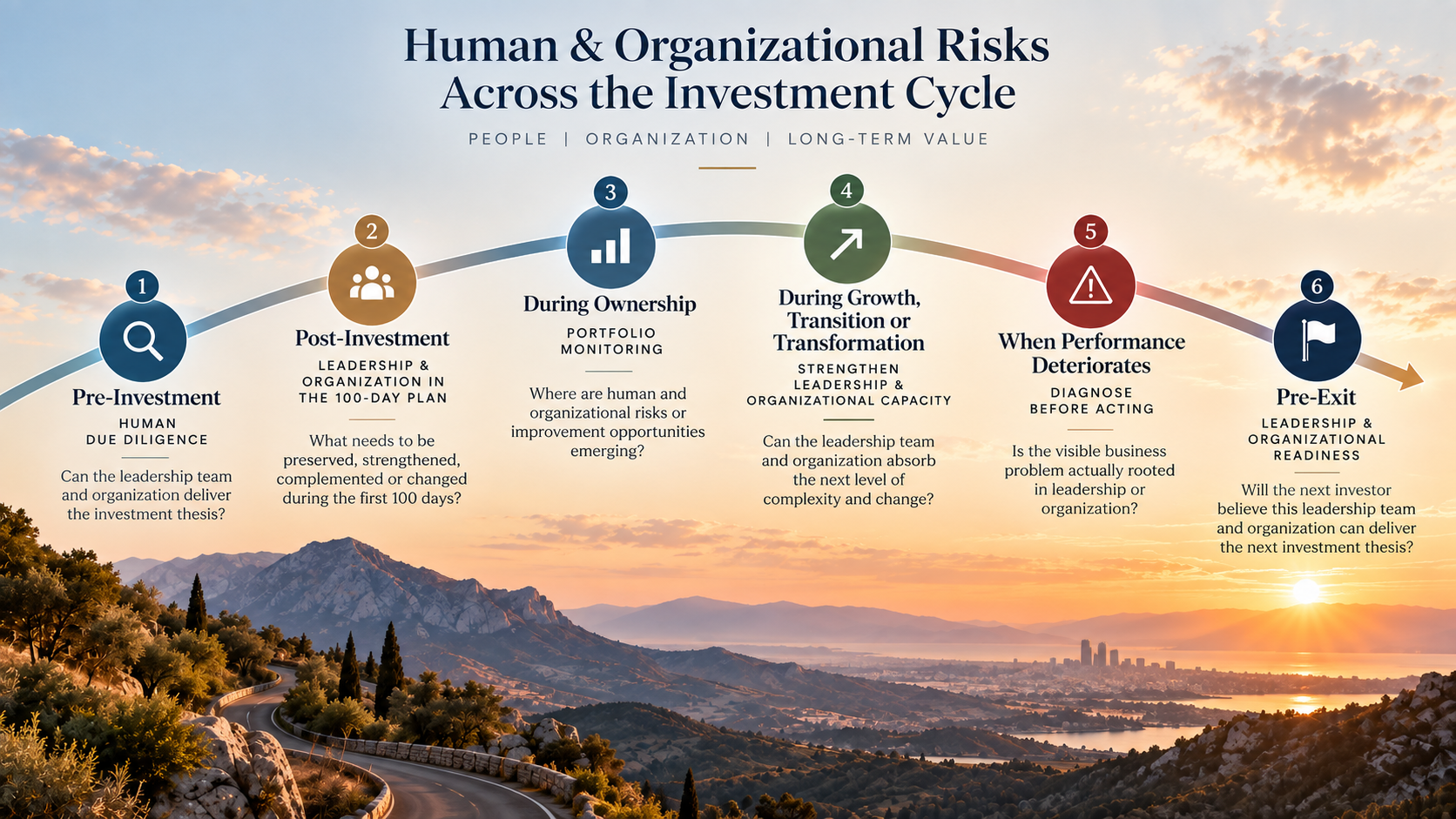
1. Pre-Investment: Establish the Human & Organizational Baseline
Can the leadership team and organization deliver the investment thesis?
Financial, commercial, legal and operational due diligence help investors understand the business they are considering backing.
Human Due Diligence addresses the leadership and organizational side of the investment case.
It looks at three interconnected levels.
The CEO or Founder
Leadership capability, decision-making, adaptability, motivation, role fit, strengths and potential derailers.
The Executive Team
Team effectiveness, complementarity, trust, accountability, decision dynamics and missing capabilities.
The Organization
Management depth, structure, decision rights, strategic clarity, governance, culture and readiness for the next stage.
The objective is to identify:
- strengths that should be preserved;
- leadership or organizational gaps;
- risks that could affect execution;
- issues to address after closing;
- capabilities that may need to evolve.
Human Due Diligence should not only support the investment decision. It can also establish the baseline for the ownership period.
2. Post-Investment: Translate the Investment Thesis Into a 100-Day Leadership & Organizational Agenda
What needs to be preserved, strengthened, complemented or changed after closing?
A full Human Due Diligence is not always possible before closing. Deal timelines may be compressed and access to management limited.
Even where the pre-investment assessment has been thorough, the first months of ownership create another important opportunity: translating the investment thesis into concrete leadership and organizational priorities.
A Post-Investment Leadership & Organizational Review can help clarify:
- what leadership capabilities the investment thesis requires;
- where management needs reinforcement;
- how the CEO or founder’s role may need to evolve;
- whether roles and decision rights are sufficiently clear;
- whether the organization has enough management depth;
- what requires immediate action;
- what should be monitored rather than changed immediately.
A value-creation plan is only as executable as the leadership team and organization behind it.
3. During Ownership: Monitor Human & Organizational Evolution
Where are new risks or improvement opportunities emerging?
Leadership and organizational risks evolve as the company develops.
A CEO who was highly effective at one stage may face a different challenge as the company becomes larger and more complex.
A strong management team may struggle after acquisitions, international expansion or rapid growth.
Decision-making can slow down. Roles can become less clear. Management layers can multiply. Key executives can leave. The founder can become a bottleneck.
These developments may emerge before they are visible in financial reporting.
Portfolio monitoring should therefore include a structured view of human and organizational evolution alongside financial and operational performance.
The objective is not to perform a full assessment of every portfolio company on a recurring basis.
It is to answer three practical questions:
- What is changing?
- Where are risks or opportunities emerging?
- Where does investor attention need to increase?
Different Companies Require Different Levels of Attention
Strong performers
Leadership and organization support execution. The priority is to preserve what works while anticipating the next stage.
Companies with improvement opportunities
The business may be performing adequately, but leadership, team or organizational issues could become future constraints.
Stress or underperformance situations
Execution is deteriorating, leadership tensions are increasing or management gaps are affecting performance. These situations require deeper diagnosis.
The objective is not to rank portfolio companies. It is to understand where additional attention, support or intervention can create the most value.
4. During Growth, Transition or Transformation: Strengthen Leadership & Organizational Capacity
Can the leadership team and organization absorb the next level of complexity and change?
Growth, transition and transformation put organizations under pressure.
Rapid scaling increases complexity. Acquisitions add teams, systems and interfaces. International expansion stretches management capacity. CEO transitions change authority and expectations. Transformation requires people to work differently while continuing to deliver.
Even a successful company can come under strain when leadership and organizational capacity do not evolve fast enough.
This is particularly relevant during:
- rapid scaling;
- international expansion;
- acquisitions and build-ups;
- post-merger integration;
- major strategic shifts;
- professionalization;
- founder or CEO transitions;
- governance changes;
- organizational redesign.
The question is not only whether the existing leadership team is still fit.
The real question is what needs to be reinforced so that the company can continue to execute under greater pressure and complexity.
This may involve:
- strengthening the CEO or executive team;
- adding missing capabilities;
- developing senior managers;
- clarifying roles and decision rights;
- reinforcing governance;
- adapting the operating model;
- improving cross-functional collaboration;
- building greater management depth.
Where the gaps are unclear, a deeper Executive Assessment, leadership team review or Organizational Assessment can help identify what needs to change or strengthen.
The objective is not change for its own sake. It is to ensure that leadership and organizational capacity evolve fast enough to support the next stage of the business.
5. When Performance Deteriorates: Diagnose Before Acting
Is the visible business problem actually rooted in leadership or organization?
Underperformance creates pressure for action.
Replace the CEO. Add a senior executive. Reorganize. Reduce costs. Change incentives. Increase Board involvement.
Any of these actions may be appropriate.
But the first question should be:
What is actually causing the deterioration?
The visible symptom may not be the root cause.
Underperformance may result from:
- a leadership model that no longer fits the company’s stage or complexity;
- unresolved executive-team tensions;
- unclear strategic priorities;
- insufficient management depth;
- organizational complexity;
- ineffective governance;
- poorly integrated acquisitions;
- unclear roles or decision rights;
- cultural issues;
- several of these factors interacting.
A deeper Organizational Assessment can help distinguish symptoms from root causes.
A participative assessment may include the CEO, executive team, selected managers and key people, Board members and shareholders.
The objective is to understand:
- where perspectives converge;
- where they diverge;
- which problems are widely recognized;
- which tensions or dependencies are not visible in formal reporting;
- which issues are symptoms and which appear to be root causes.
Early diagnosis preserves optionality. Late diagnosis often forces more radical action.
The resulting decisions may involve:
Improve existing leadership or organizational practices.
Complement the leadership team with missing capabilities.
Adapt roles, structure, governance or the operating model.
Replace a leader where role fit or capability is no longer sufficient.
The assessment should not predetermine the answer. It should make the right decision easier to see.
6. Pre-Exit: Strengthen Leadership & Organizational Readiness
Will the next investor believe this leadership team and organization can deliver the next investment thesis?
Human and organizational questions become critical again as the investment approaches exit.
A future buyer or investor may ask:
- Is performance overly dependent on the founder or CEO?
- Is there sufficient management depth?
- Is the executive team credible for the next stage?
- Is management aligned on strategy and the next phase of value creation?
- Is succession sufficiently addressed?
- Is governance robust?
- Can the organization continue scaling after the transaction?
- Are key executives likely to remain?
A Pre-Exit Leadership & Organizational Review can identify these issues before they surface during buyer diligence.
This gives shareholders time to address weaknesses, strengthen management credibility and improve transaction readiness.
The question before exit is not only whether the business has performed. It is whether the next investor can believe that the leadership team and organization are ready to perform again.
A Disciplined Perspective Across the Investment Cycle
The key question changes as the investment progresses.
1. Pre-Investment
Can the leadership team and organization deliver the investment thesis?
2. Post-Investment
What needs to be preserved, strengthened, complemented or changed after closing?
3. During Ownership
Where are risks or improvement opportunities emerging?
4. During Growth, Transition or Transformation
What needs to be strengthened so the company can absorb greater complexity and change?
5. When Performance Deteriorates
What is actually causing the problem?
6. Pre-Exit
Will the next investor believe the leadership team and organization can deliver the next investment thesis?
The objective is not more assessment. It is earlier visibility, better diagnosis and better decisions at the moments when human and organizational factors become material to value creation.
How WINGMIND Supports Investors and Portfolio Companies Across the Investment Cycle
WINGMIND supports PE, Growth & VC investors and their portfolio companies on the human and organizational factors that shape execution and value creation.
Depending on the situation, we work with investors, Boards, CEOs, executive teams, senior managers and key people, as well as the broader organization when needed.
Our work can include:
- Human Due Diligence before investment;
- Post-Investment Leadership & Organizational Reviews after closing;
- monitoring of human and organizational evolution during ownership;
- Executive Assessment, leadership team assessment and Organizational Assessment during growth, transition or transformation;
- deeper leadership and organizational diagnosis in situations of stress or underperformance;
- Pre-Exit Leadership & Organizational Reviews ahead of a transaction;
- CEO & Board Advisory and targeted support to translate diagnosis into action.
The objective remains consistent throughout the investment cycle: anticipate human and organizational risks, act quickly when doubts emerge, and strengthen the company’s capacity to execute and create value.
View Selected WINGMIND Engagements
Founder of WINGMIND, David Chouraqui is an Operating Advisor & Executive Coach to PE/VC investors, boards and CEOs. A former private equity investor and entrepreneur, he specializes in Human Due Diligence, leadership assessments, organizational diagnostics and CEO & Board Advisory, helping organizations strengthen the human drivers of execution and value creation.