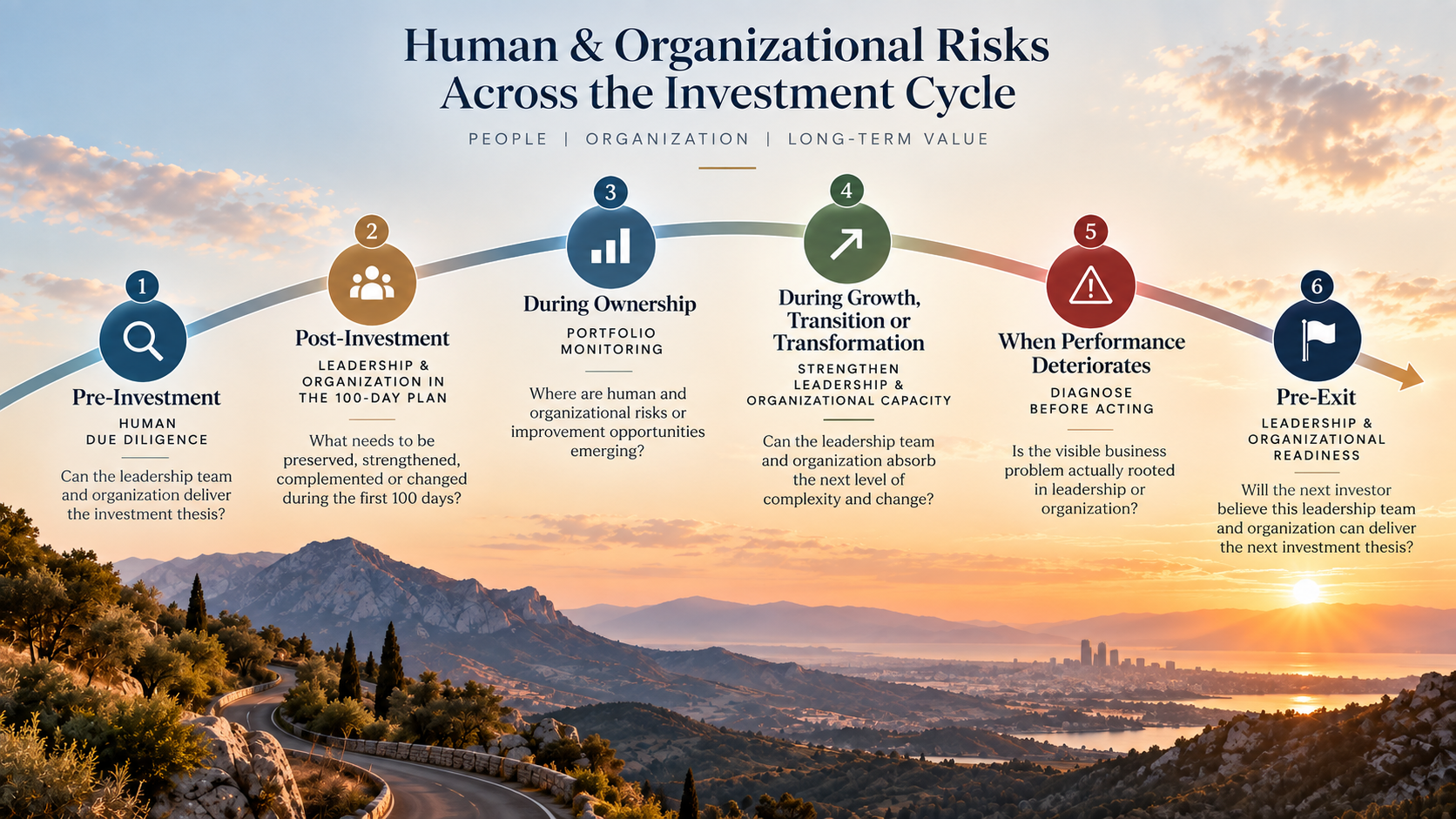

Founders do not all evolve in the same way as their companies grow. One of the most common assumptions in venture investing is that the people who successfully build a company from zero to twenty employees will naturally be the same people who can lead it at two hundred. In practice, the leadership demands of a scaling company change so substantially that this assumption often proves false.
As a startup grows, its operating model becomes more complex, governance becomes more formal, leadership roles become more specialized and the organization depends increasingly on the founder’s ability to delegate, recruit senior talent and lead through others. The role that created value in the early years can therefore become the role that limits value creation later on.
Some founders successfully reinvent themselves and become strong CEOs. Others create greater value by moving into a functional leadership role, by being reinforced with complementary executives or by stepping out of day-to-day operations. Some, however, remain in a role that no longer fits the company’s needs and gradually become a bottleneck.
The most useful question for investors is therefore not whether a founder is “good” in absolute terms. It is whether each founder can continue to create value in the role the company will require during its next stage of development.
1. The Founder Who Becomes a True CEO
In the earliest phase of a startup, the founder is often a “Chief Everything Officer.” They sell, recruit, build the product, raise capital, speak to customers and make most important decisions themselves. This concentration of responsibility is often necessary when the company is small, but it becomes unsustainable as the organization grows.
The transition from founder to CEO requires a fundamental change in role. Instead of personally solving every problem, the founder must build an organization capable of solving problems without their constant involvement. This means creating strategic clarity, delegating authority, recruiting executives who may be more experienced than they are, defining accountability and learning to lead leaders rather than individual contributors.
This is one of the most difficult transitions in the founder journey because it requires the founder to give up direct control while accepting even greater responsibility for the performance of the whole organization. Founders who manage this transition well become force multipliers. Their impact increases because the company no longer depends exclusively on their own energy or expertise.
2. The Founder Who Becomes a Functional Leader
Not every founder should become CEO, and not every transition away from the CEO role should be seen as a failure. Some founders are most effective when they focus on the area where they have exceptional expertise or credibility, such as technology, product, strategy, operations or go-to-market.
A founder may therefore become a highly valuable CTO, Chief Product Officer, Chief Strategy Officer or business leader while another executive takes responsibility for the company as a whole. This can be a particularly successful outcome when the founder retains strong influence over the company’s mission and core capabilities without being forced into a general management role that does not fit their strengths or motivations.
For investors, the key is to recognize this trajectory early enough. If the founder’s contribution is understood clearly, role evolution can preserve both execution and founder engagement. If the discussion is delayed, however, the company may spend years trying to make an unsuitable role work because the title has become emotionally or politically difficult to question.
3. The Founder Whose Role Is Strengthened
In some situations, the founder remains the right leader but needs stronger support around them. The company may have reached a stage where the founder’s vision, energy and influence remain essential, yet the organization requires more operational depth, greater financial discipline or stronger management infrastructure.
The appropriate response is not necessarily replacement. It may be to hire an experienced COO or CFO, strengthen the leadership team, appoint a seasoned Chair, introduce co-leadership or provide targeted advisory and executive coaching. These measures can significantly increase the founder’s effectiveness without undermining continuity.
This trajectory is often underestimated because investors sometimes frame the choice too narrowly: either the founder remains fully in charge or the founder must be replaced. In reality, strengthening the role can be one of the healthiest ways to accelerate growth. The quality of the outcome depends on whether responsibilities are clear, trust is established and the founder is genuinely willing to share authority.
4. The Founder Who Becomes the Bottleneck
The most difficult trajectory is the founder who was instrumental in creating the company but gradually becomes its main constraint. These founders are rarely incapable or unsuccessful. The problem is that the organization has changed faster than their leadership approach.
Typical signs include excessive centralization of decisions, reluctance to delegate, resistance to hiring stronger executives, weak management routines, repeated interference in operational details and tension with governance. Over time, the company becomes increasingly dependent on the founder’s availability and judgment. Decisions slow down, executives become frustrated and the organization struggles to scale beyond the founder’s personal capacity.
This situation rarely produces an immediate collapse. More often, it causes the company to perform below its potential. Growth continues, but more slowly than the market opportunity would allow. Senior talent leaves. Strategic priorities change too frequently. The company remains promising, yet the leadership model prevents it from becoming truly scalable.
For investors and boards, the challenge is to distinguish between a founder who can still evolve with support and a founder whose resistance to change has become structural. Waiting too long can turn a manageable leadership issue into a significant value creation problem.
5. The Founder Who Leaves the CEO Role
Some founders eventually leave the CEO role voluntarily, while others do so following a board decision. Neither outcome should automatically be interpreted as failure. As companies grow, they may require a different type of leadership, and many founders recognize that another executive is better equipped to lead the next phase.
The healthiest transitions are anticipated and prepared before performance deteriorates or relationships break down. This allows the company to define the future role of the founder, communicate the change credibly, preserve trust and ensure continuity with employees, customers and investors.
When the transition is delayed until a crisis, the process becomes far more difficult. Questions of identity, control, status and ownership can quickly overshadow the needs of the business. A founder succession plan is therefore not merely a governance mechanism; it is also a way to protect value creation and the founder’s long-term contribution.
6. The Founder Who Steps Out of Operations
Some founders remain important to the company without participating in day-to-day execution. They may become board members, strategic advisors, major shareholders or long-term guardians of the company’s mission while operational leadership transfers to a professional CEO and executive team.
This trajectory can be highly effective when the boundaries are explicit. The founder can continue to contribute vision, relationships and institutional memory without unintentionally undermining the authority of the new leadership. The arrangement becomes problematic only when the founder formally steps back but continues to intervene unpredictably in operations.
When managed well, stepping out of operations can preserve the founder’s unique value while giving the organization the space and leadership discipline required for the next stage.
The Central Question: Founder-Stage Fit
These six trajectories illustrate a broader principle: leadership quality is contextual. A founder who is highly effective during the early stage may not be the right CEO during international expansion, just as a strong product visionary may not be motivated by the demands of leading a large and complex organization.
The relevant issue is therefore not whether the founder has succeeded in the past. It is whether the founder’s capabilities, motivations and role remain aligned with the company’s future needs. This is what can be described as founder-stage fit.
Assessing founder-stage fit requires investors to look beyond past achievements and examine the founder’s ability to learn, delegate, recruit, work with governance, build an executive team and rethink their own role. It also requires an understanding of the founding team as a collective, because one founder’s evolution often affects the responsibilities and influence of the others.
What Founder Due Diligence Should Clarify
Founder Due Diligence should not reduce founders to personality profiles or attempt to predict success with false certainty. Its purpose is to help investors understand how founders are likely to respond to the company’s next stage and what leadership decisions may be required after the investment.
A robust assessment should therefore clarify:
- the current strengths and limitations of each founder;
- the fit between each founder and their present role;
- the quality of alignment and decision-making within the founding team;
- the ability to recruit, empower and retain senior executives;
- the founder’s capacity to delegate and accept governance;
- the risks of founder dependency or leadership bottlenecks;
- the most realistic role each founder can play as the company scales;
- the support, reinforcement or succession measures that may be required.
The value of this analysis lies not only in helping investors decide whether to invest. It also helps them define how to invest, what conditions to establish, what support to provide and which leadership risks should be monitored from the outset.
Conclusion
Scaling does not require perfect founders. It requires the right founders in the right roles at the right stage.
Some founders will become outstanding CEOs. Others will create more value as functional leaders, board members or strategic contributors. Some will need stronger executives around them, while others may eventually need to leave the operating role altogether.
The companies that navigate these transitions successfully are usually those in which founders, investors and boards address the question early and honestly. They do not assume that the founding structure should remain unchanged forever. They recognize that the organization must evolve, and that the founder’s role must sometimes evolve with it.
The most important question is therefore not whether a founder deserves to keep a title. It is which role will allow each founder to create the greatest value during the company’s next stage of growth.
At WINGMIND, we help Venture Capital, Growth Equity and technology investors assess founders and founding teams through Founder Due Diligence. Our work identifies leadership strengths, founder-stage fit, founding team dynamics, scalability risks and the decisions required to support long-term value creation.
Founder of WINGMIND, David Chouraqui is an Operating Advisor & Executive Coach to PE/VC investors, boards and CEOs. A former private equity investor and entrepreneur, he specializes in Human Due Diligence, leadership assessments, organizational diagnostics and CEO & Board Advisory, helping organizations strengthen the human drivers of execution and value creation.