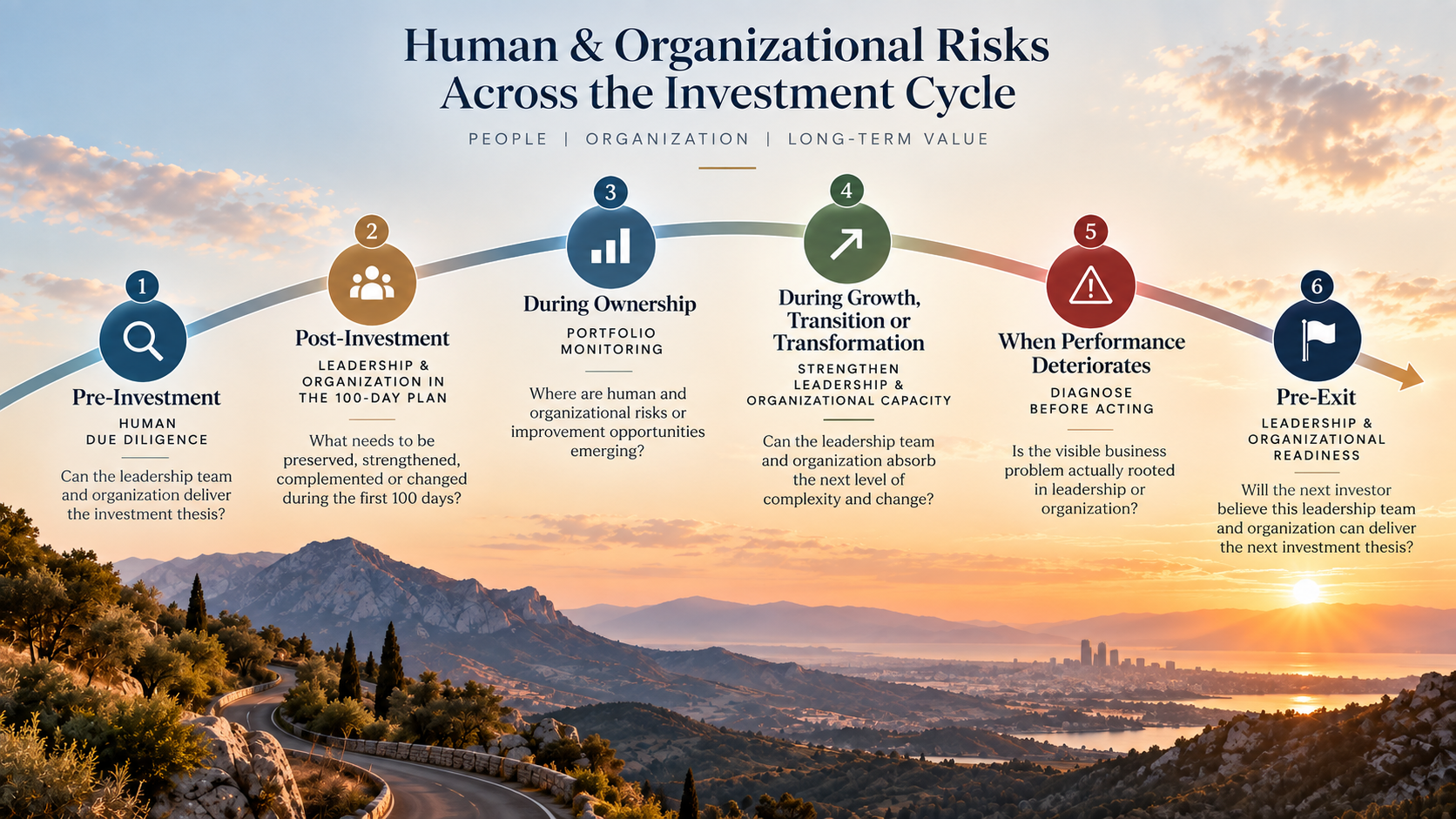

Scaling a company is not simply about doing more of what already works.
As a business grows, its priorities change. The challenge may move from proving the value proposition to building repeatable sales, expanding into new markets, improving margins, integrating acquisitions or managing a much more complex organization.
Each of these business transitions creates a corresponding leadership and organizational transition.
A company can have an attractive market, a strong product and significant commercial momentum and still become constrained because its leadership model, team or organization has not evolved at the same pace as the business.
Every stage of scaling therefore requires two questions: what does the business need to achieve next, and what must leadership and the organization become in order to deliver it?
Phase 1 : Prove the business
Business challenge : find what really works
At the earliest stage, the priority is to prove that the company is solving a real problem for customers. The business needs to refine its value proposition, find product-market fit, win its first customers, understand pricing and begin identifying a viable business model.
Much of the strategy is still being discovered through direct interaction with the market. The founders may need to change the product, positioning, target customers or even parts of the original business model as they learn.
Leadership & organizational challenge : stay close, fast and adaptable
At this stage, founder involvement is usually an advantage. Founders are directly connected to customers, product decisions, recruitment and most important operational issues. Roles can remain relatively fluid and the organization can operate with very little structure.
The most important leadership qualities are often vision, resilience, adaptability and execution. Founders need enough conviction to pursue the opportunity, but also enough learning agility to recognize when reality requires them to change direction.
Too much structure too early can slow the company down. The objective is therefore not to professionalize everything, but to establish a strong base: capable founders, an effective initial team and a way of working that supports rapid learning and execution.
Phase 2 : Build a repeatable growth engine
Business challenge : turn traction into repeatability
Once the company has demonstrated initial demand, the challenge becomes making growth more repeatable. Sales need to become less dependent on the founders, customer acquisition needs to become more predictable and delivery needs to support a larger number of clients without quality deteriorating.
The company may also need to improve unit economics, strengthen cash management and decide which customer segments, products or channels deserve the greatest investment.
This is often the transition from proving that something works to proving that it can work repeatedly and economically.
Leadership & organizational challenge : move beyond founder-led execution
The founders can no longer personally manage every customer, decision or operational problem. They need to begin building a real organization around them.
This usually means recruiting stronger functional leaders, clarifying responsibilities, introducing basic processes and starting to delegate genuine authority. The quality of the first senior hires can have a disproportionate impact on the company’s trajectory.
The founders themselves also need to evolve. They move progressively from doing much of the work directly to leading people who do it, while remaining close enough to the business to preserve speed and customer understanding.
The challenge is to introduce enough structure to create repeatability without losing the entrepreneurial energy that enabled the company to succeed in the first place.
Phase 3 : Scale across products, markets and geographies
Business challenge : manage several growth engines at once
As the business becomes larger, growth often becomes more complex. The company may expand into new customer segments, products or geographies, strengthen pricing and margins, professionalize key functions or use acquisitions as an additional growth lever.
Resources also become more significant, which means that allocation decisions matter more. Management needs to decide where to invest, which initiatives deserve priority and where the company has the strongest probability of creating value.
The business challenge is no longer simply to grow, but to manage multiple sources of growth while maintaining execution quality and economic discipline.
Leadership & organizational challenge : build a real leadership system
At this stage, the CEO can no longer coordinate the company primarily through direct relationships. The executive team becomes a central organizational asset.
Its members need to be individually strong, but also complementary and capable of working together. Cross-functional trade-offs become more frequent, and disagreements around resources, priorities or responsibilities can become significant constraints if the team cannot resolve them effectively.
Middle management also becomes increasingly important. Strategy must travel through several layers of the organization, which means managers need to understand priorities, translate them into execution and surface problems early.
Decision rights, resource allocation, management depth and cross-functional coordination therefore become much more important. A broader Organizational Assessment can help identify where organizational complexity is beginning to constrain execution.
Phase 4 : Manage scale while continuing to create growth
Business challenge : combine performance, renewal and capital allocation
At larger scale, the business often needs to manage several priorities simultaneously: defend its position, continue innovating, expand internationally, integrate acquisitions, improve profitability and allocate capital across different businesses or growth opportunities.
The challenge is no longer only to build the original growth engine. It is to keep renewing growth while managing a much more complex and potentially less agile company.
Acquisitions, new businesses or geographic expansion can also create different cultures, operating models and performance levels inside the same group.
Leadership & organizational challenge : lead through the organization
Leadership therefore needs to evolve again. Senior executives increasingly lead through other leaders rather than through direct involvement in operational issues.
The CEO needs to create strategic clarity across a larger system, build a strong executive team, establish effective governance and ensure that responsibilities are sufficiently distributed across the organization.
Succession, leadership development and the quality of management below the executive team become increasingly important. The company also needs to balance autonomy and control: enough standardization to operate effectively at scale, while preserving the ability of teams and business units to make decisions close to customers and markets.
One of the major risks at this stage is that the company becomes stronger structurally but slower behaviorally. Processes, reporting and governance should support execution rather than create additional layers of decision-making.
The founder’s role evolves because the business evolves
The question of founder evolution should not be considered separately from the business trajectory. The demands placed on the founder change because the company itself changes.
At the beginning, direct involvement, speed and personal control may create enormous value. Later, the same behaviours can become constraints if they prevent strong executives from taking responsibility or make every important decision dependent on one person.
Some founders successfully evolve into CEOs of much larger organizations. Others create more value by focusing on product, technology, customers or strategy while additional leadership is introduced around them.
The relevant question is not whether a founder is strong in absolute terms, but whether their capabilities and role remain aligned with what the business now requires. A structured Executive Assessment can help evaluate this fit and future potential.
The executive team must evolve with the strategic agenda
As the business changes, the leadership team may also need to change.
A team that was perfectly suited to building the first version of the company may not collectively provide all the capabilities required for international expansion, operational excellence, acquisitions or a much larger organization.
The challenge is therefore not simply to retain or replace people. It is to understand which capabilities the next stage requires, where the current team is strong, where it needs to develop and where additional or different leadership may be necessary.
Collective effectiveness matters just as much as individual capability. A group of strong executives will create limited value if they cannot align on priorities, manage disagreement or mobilize the organization consistently. An Executive Team Assessment can help evaluate both dimensions.
The organization should evolve because the business model is evolving
Organizational change is sometimes treated as a separate internal topic. In reality, it should follow the needs of the business.
A new geography may require different decision rights. A more complex product portfolio may require stronger product management. Acquisitions may create integration and governance challenges. Faster sales growth may expose weaknesses in operations or customer service. A larger workforce may require stronger management and talent systems.
The objective is therefore not to create the “perfect organization”. It is to build an organization that is appropriate for the business at its current stage while remaining capable of evolving toward the next one.
Human Due Diligence should evolve with the stage of the company
For investors, Human Due Diligence should also reflect the stage of the company they are considering backing. The leadership and organizational questions that matter in an early-stage business are not the same as those that matter in a larger scale-up or a more mature company.
At an earlier stage, investors may focus more heavily on the founders themselves: their ability to execute, learn, adapt, make difficult decisions and build a team around them. As the company scales, the assessment needs to broaden toward the quality and complementarity of the executive team, management depth, decision-making, organizational structure, governance and the ability to operate across greater complexity.
The objective is therefore not to assess leadership and organization against a fixed model of what a “good company” should look like. It is to determine whether the leadership capabilities and organizational setup are appropriate for the company’s current stage, and whether they are strong enough to support the next one.
This is where Human Due Diligence can complement financial, commercial and stragegic analysis by assessing whether the people and organization are aligned with the growth strategy and the requirements of the investment thesis.
Scaling means repeatedly aligning the business, leadership and organization
There is no single operating model that can take a company from its first customers to large-scale market leadership.
The business strategy changes. The leadership required to deliver it changes. The organization supporting that leadership must change as well.
This is why investors, Boards and CEOs should look at these dimensions together. When growth begins to slow or execution becomes more difficult, the issue may not be the attractiveness of the market or the quality of the strategy itself. The company may simply have reached a point where its leadership or organization no longer matches what the business now requires.
Successful scaling depends on keeping business ambition, leadership capability and organizational capacity aligned as the company evolves.
Founder of WINGMIND, David Chouraqui is an Operating Advisor & Executive Coach to PE/VC investors, boards and CEOs. A former private equity investor and entrepreneur, he specializes in Human Due Diligence, leadership assessments, organizational diagnostics and CEO & Board Advisory, helping organizations strengthen the human drivers of execution and value creation.