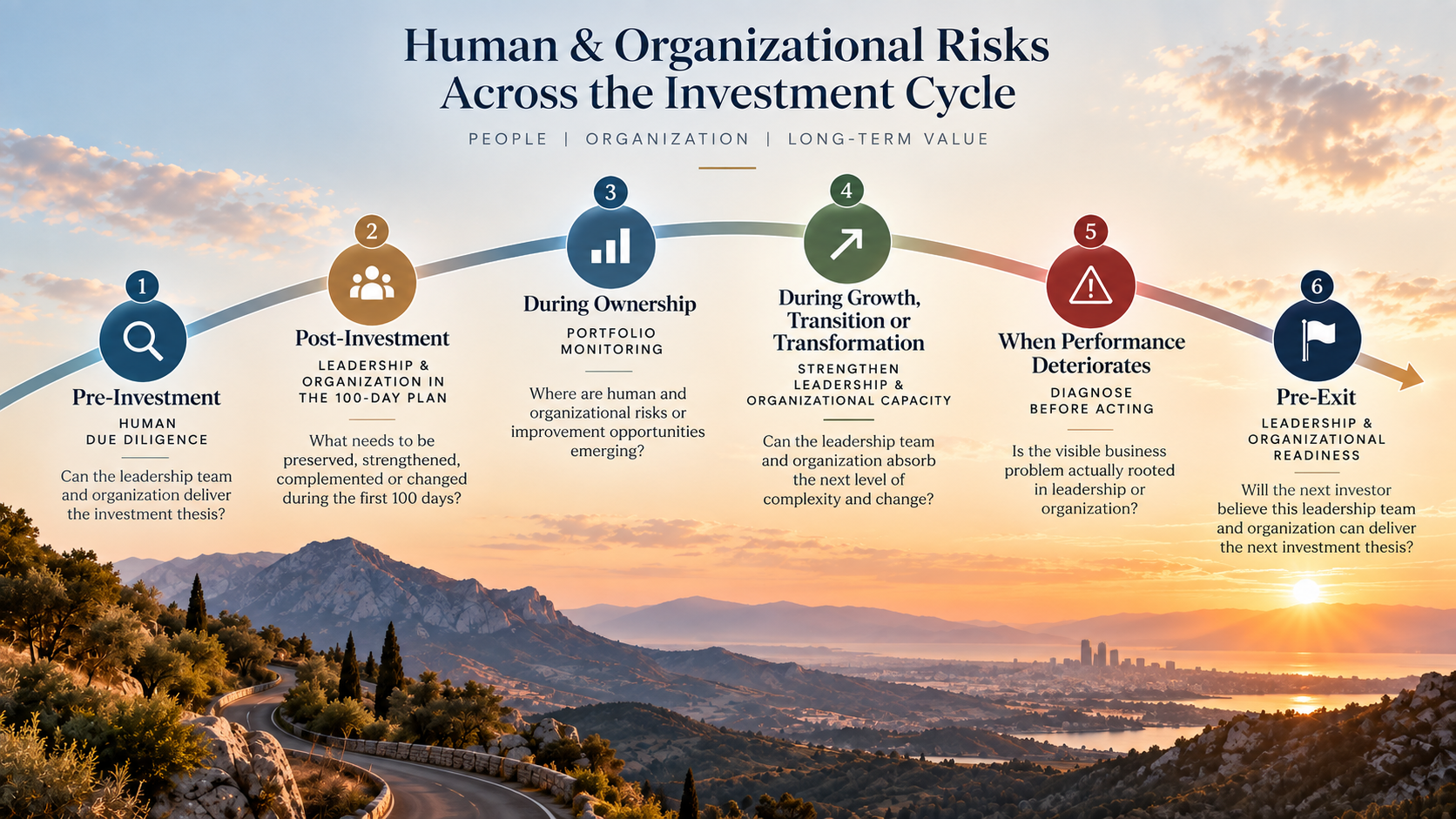

Growth and transformation are about capturing opportunities. But they also put companies under pressure.
New markets, acquisitions, products, technologies or business models can create significant value. But they also require companies to do things they have not done before, often at greater speed and with more complexity.
What worked at one stage may no longer be sufficient for the next one.
Leaders face more difficult situations. Strategic choices become more important. Functions and departments need to build new capabilities. Teams need to coordinate across more priorities and absorb more change. Existing ways of working may need to evolve while the company continues to deliver.
The challenge is therefore not simply to pursue growth or transformation.
It is to make sure the company is building the leadership, strategic, organizational and human capabilities required to capture those opportunities successfully.
The objective is not simply to diagnose what is under pressure. It is to strengthen the capabilities required to succeed through the next stage.
Growth changes what the company needs
One of the challenges of growth is that success itself creates new requirements.
A founder who could personally oversee most important decisions may need to lead through a much stronger management team. An informal executive team may need to become a genuinely collective leadership team. Functions that worked with a relatively small organization may need to become significantly more professionalized.
Transformation creates similar challenges.
An acquisition may require integration capabilities. International expansion may require new commercial, operational and management practices. A new product strategy may require different technical or go-to-market capabilities. A major technology shift may force the company to rethink roles, processes and the way work gets done.
These are not necessarily signs of failure.
They often indicate that the requirements of the business have evolved faster than the capabilities around it.
The central question becomes:
What does the company now need to be able to do that it did not need to do before?
Weak signals often appear before performance deteriorates
The first signs of strain are not always visible in the financial results.
Leaders may start spending more time resolving operational issues and less time looking ahead. Decisions take longer. Priorities multiply. Important topics repeatedly return to the executive team without resolution. Functions begin to protect their own agendas. Managers escalate decisions that should be made lower in the organization.
Teams may become overloaded or fatigued. Engagement begins to fall. Some employees no longer understand where the company is going or why priorities keep changing. Others may understand the strategy but lack the resources or capabilities to deliver what is expected.
Execution can also begin to drift. Timelines become unrealistic. Too many initiatives compete for the same people and resources. Coordination becomes harder and new projects start weakening performance in the core business.
None of these signals necessarily represents a major problem on its own.
But together they may indicate a growing gap between what the business is trying to achieve and what the leadership and organization are currently equipped to deliver.
This is often the right moment for an Organizational Assessment: before pressure has developed into sustained underperformance.
Leadership and governance : leaders are stretched by greater complexity
Growth and transformation place leaders in situations that are often fundamentally more complex than those they have managed before.
A founder may need to delegate responsibilities that have always remained close to them. Functional executives may need to become broader enterprise leaders. The CEO may need to manage a larger executive team, more stakeholders, more uncertainty and increasingly difficult trade-offs.
This can test both capabilities and resilience.
Leaders can become overloaded, lose perspective or remain too involved in activities that should now be handled elsewhere. Some may struggle to adapt their leadership style. Others may simply become exhausted by a sustained level of pressure.
The leadership team also becomes increasingly important.
Individual executives need to work together across functional boundaries, challenge one another constructively, share information, resolve disagreements and support collective decisions. As complexity increases, poor cooperation at the top can quickly become poor execution throughout the company.
Alignment matters as well. Leaders need to understand the direction, agree on priorities and work collectively rather than allow functional agendas or individual interests to dominate.
Governance may also need to evolve. Decision-making between founders, executives, the Board and investors may need greater clarity as the number and significance of decisions increase.
The question is therefore not only whether the company has strong leaders.
It is whether those leaders, individually and collectively, can manage the level of complexity the next stage requires.
An Executive Assessment or Executive Team Assessment can help identify where capabilities need to develop, where roles need to evolve and where additional leadership strength may be required.
Strategic clarity : making the right choices under pressure
Growth and transformation tend to generate more opportunities than a company can realistically pursue.
New markets, acquisitions, products, technologies, partnerships and organizational initiatives can all appear attractive. The danger is that activity itself begins to be confused with progress.
Not every growth initiative creates value.
A company can enter too many countries, launch too many products, acquire businesses it cannot integrate or pursue diversification without a sufficiently clear strategic rationale.
Sometimes the organization is not failing to execute the transformation. The transformation itself is simply too broad, too fast or insufficiently selective.
This makes strategic clarity particularly important during periods of pressure.
Leadership needs to agree on what really matters, what should be prioritized, what should be delayed and what should be stopped. The implications for capital allocation, management attention and organizational resources need to be explicit.
Trade-offs cannot remain theoretical.
If everything is a priority, the organization ultimately makes the trade-offs itself through overload, delays and declining execution quality.
Before asking whether the organization can execute the agenda, leadership should make sure the agenda itself is sufficiently focused and capable of creating value.
Organizational and operational effectiveness : can the company actually deliver what is new?
Even when the strategic choices are right, the organization still needs the capabilities to deliver them.
This is where many transformations become difficult.
The company may need functions and departments to perform at a level they have never reached before. Finance may need to support a more complex business. The commercial organization may need to scale beyond founder-led selling. Operations may need to manage significantly greater volume. HR may need to recruit, develop and retain people at a much faster pace.
Specific departments, business units or geographies may become bottlenecks even when the overall organization remains strong.
The management layer beyond the executive team also becomes increasingly important. Senior leaders need managers who can translate priorities into execution, make decisions, coordinate teams and take responsibility without constantly escalating upward.
There is also a question of execution discipline.
Are resources being allocated to the real priorities? Are there enough people and capabilities to deliver what is being promised? Are timelines realistic? Are initiatives properly sequenced? Is the organization trying to change too many things at the same time?
Decision rights, roles and cross-functional coordination also matter more as complexity increases.
The objective is not to introduce process for its own sake.
It is to ensure that the organization has enough clarity, capability and discipline to deliver the strategy without overwhelming itself or weakening execution elsewhere.
Culture, HR practices and readiness : can people absorb the change?
Growth and transformation are not only structural or operational events. They are also experienced by people.
Teams can become tired, overwhelmed or disengaged. Employees may struggle to understand why priorities are changing or what the transformation means for them personally. New leaders, reorganizations or changes in responsibility can affect status, influence and established relationships.
Some employees may resist change. Others may appear resistant simply because the direction is unclear or because the workload is unrealistic.
The ability of the company to absorb change therefore depends on more than communication.
It requires managers who can provide clarity and support, HR practices capable of developing and retaining the people the company needs, and a culture in which information flows sufficiently well for problems to surface early.
It also requires cooperation.
Growth and transformation usually increase interdependence between teams and functions. Commercial, operations, finance, technology and HR may all need to change together. If people continue to optimize only for their own area, transformation becomes much harder.
Readiness therefore means asking whether employees understand the direction, whether they have the capabilities and resources required, whether management practices support the change and whether the organization is able to maintain engagement while asking people to operate differently.
From diagnosis to action
Assessment has limited value if it does not lead to decisions.
Once the main gaps are understood, the objective is to determine what needs to be strengthened or changed.
Some leaders may need development, coaching or a clearer role. The leadership team may need to improve its collective effectiveness. A function may need stronger capabilities or additional resources. Priorities may need to be reduced. Decision rights may need to change. The management layer may need to be reinforced.
Sometimes a role or organizational structure needs to evolve more substantially.
A useful decision framework is:
Improve · Complement · Adapt · Replace
Existing capabilities can often be improved. Gaps can sometimes be complemented with additional people or expertise. Roles, structures and ways of working can be adapted. And when a gap is too significant or the ability to evolve is insufficient, replacement may eventually become necessary.
The important point is not to jump to a solution before understanding where the real constraint sits.
Act early, but avoid overreacting
There is a balance to strike.
Companies should not wait until weak signals have become serious performance problems before acting.
But pressure is also a natural part of growth and transformation. Every difficulty does not justify a reorganization, an executive change or a major intervention.
The right approach is to understand the most important gaps, prioritize the changes that matter most and observe how the system responds.
One intervention can change several other problems.
Strengthening a critical function may reduce pressure on the CEO. Clarifying strategic priorities may resolve what initially looked like an execution problem. Improving cooperation within the leadership team may accelerate decisions across the organization.
The objective is not maximum change. It is the right change, at the right level, early enough to preserve options.
For investors, growth and transformation require active attention
Investors do not need to intervene in every operational or organizational issue.
But high-growth and transformation periods deserve particular attention because this is when previously manageable weaknesses can become constraints on value creation.
Financial and commercial indicators remain important, but they may not show the entire picture early enough.
Investors and Boards should also ask whether the leadership and organization are keeping pace with what the strategy requires.
Are leaders coping with the increased complexity? Is the executive team aligned and working effectively together? Are strategic choices sufficiently focused? Are resources being allocated with enough discipline? Are critical functions developing quickly enough? Can the organization absorb the changes being asked of it?
As explored in the scaling journey, each new stage of business development creates different leadership and organizational requirements.
The companies that navigate these transitions successfully are not necessarily those that experience the least pressure.
They are often those that recognize what the pressure is revealing and strengthen the right capabilities before the gaps become too large.
Conclusion
Growth and transformation put companies under pressure because they require them to do things they have not done before.
Leaders face greater complexity. Strategic choices become more important. Functions, managers and operating models need to evolve. Employees need to absorb significant change while continuing to deliver.
The challenge is not simply to push the organization harder.
It is to make sure the strategy is sufficiently focused, understand where capabilities are falling behind and strengthen the leadership and organization accordingly.
Successful growth and transformation depend on whether leadership, strategic clarity, organizational effectiveness and people readiness evolve fast enough to meet the new demands of the business.

Founder of WINGMIND, David Chouraqui is an Operating Advisor & Executive Coach to PE/VC investors, boards and CEOs. A former private equity investor and entrepreneur, he specializes in Human Due Diligence, leadership assessments, organizational diagnostics and CEO & Board Advisory, helping organizations strengthen the human drivers of execution and value creation.