
Artificial intelligence is creating a period of major transformation for companies.
Business models are being challenged. Products and services are evolving. New competitors can emerge quickly. Roles, workflows and operating models may need to be redesigned. Capabilities that were valuable yesterday may become less important, while entirely new ones become critical.
For many companies, the exact impact of AI is still uncertain. What is already clear is that leaders and organizations will need to navigate significant change.
In that environment, investors cannot assess a company only on the basis of the business as it exists today.
They also need to understand whether the people behind it are capable of adapting as the environment, the strategy and potentially the company itself evolve.
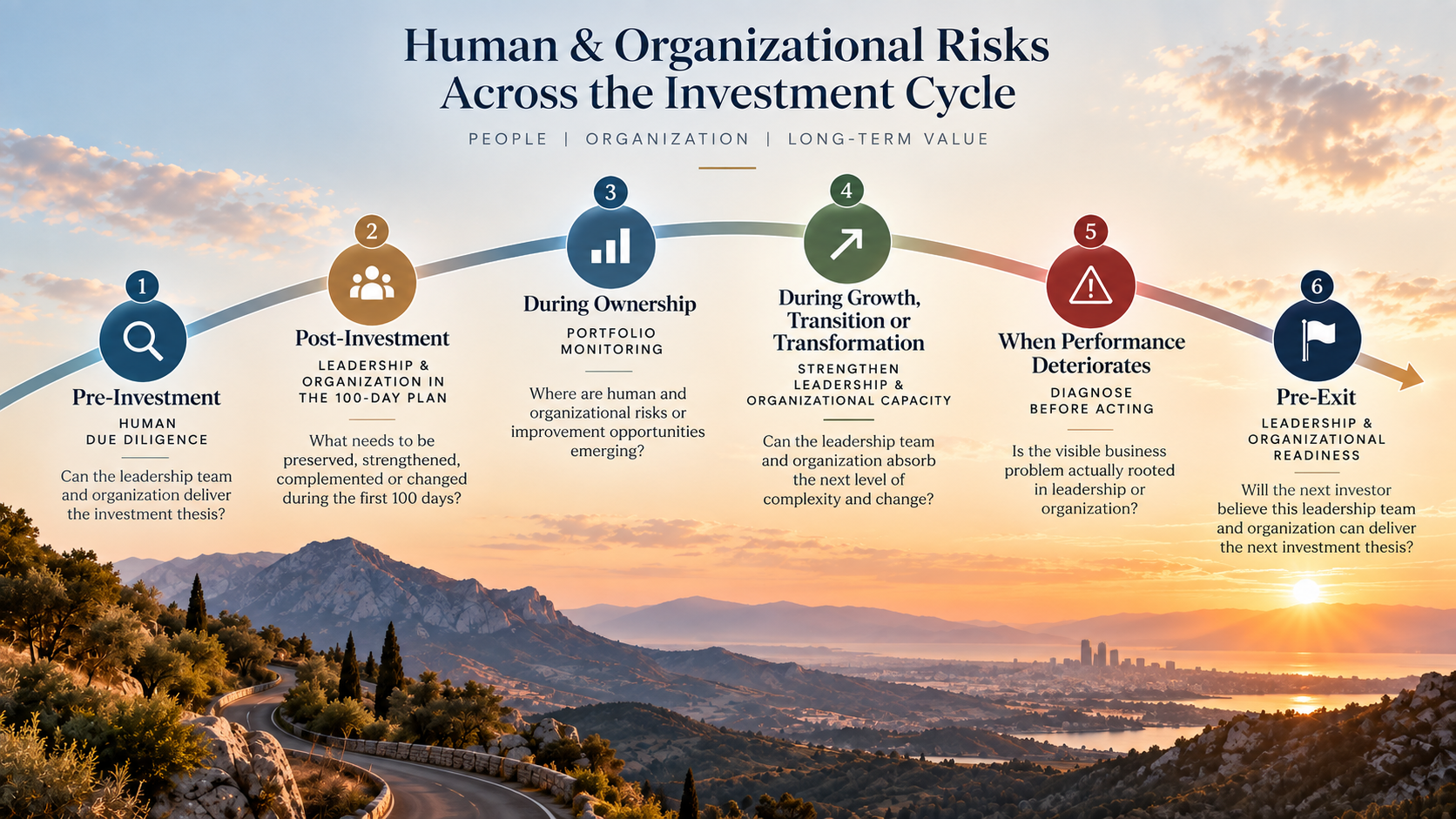
This is why Human Due Diligence matters more than ever.
The AI transition will be a human and organizational challenge
Technology will clearly matter. Access to the right tools, data and technical capabilities can create significant advantages.
But technology alone will not determine which companies succeed.
The same technological shift can produce very different outcomes depending on how leaders respond to it.
Some companies will identify the relevant opportunities, make clear choices and redesign their organizations around them.
Others may hesitate for too long, pursue too many initiatives at once, protect existing ways of working or struggle to translate strategic intentions into actual change.
AI is also creating a powerful mix of fear and excitement inside companies.
Some leaders will feel pressure to move faster than they understand. Others will delay difficult changes. Employees may worry about the future of their roles. Functions may compete for ownership of AI initiatives. Management teams may oscillate between overreaction and inertia.
This makes the human and organizational side of the transition particularly important.
Companies will need not only new tools and capabilities, but also leaders able to provide direction, teams able to align around difficult choices, organizations able to absorb substantial change without losing execution, and people able to navigate transformations that may significantly affect their own roles.
The companies that succeed in the AI transition will not simply be those with access to the best technology. They will be those whose leaders and organizations can turn technological change into effective execution.
From an investor perspective, this places particular importance on four interconnected dimensions: the individual leaders, the leadership team, the broader organization and the ability to mobilize people through transformation.
1. Founders and CEOs : adaptability without losing focus
AI creates a particular leadership challenge for founders and CEOs.
They need to remain open to significant change without reacting to every new development.
A leader may need to rethink a product, reconsider part of the business model, change the way the company serves customers, reallocate resources or build entirely new capabilities.
But the constant flow of new technologies, competitors and possibilities also creates a risk of dispersion.
The challenge is therefore not simply to be adaptable.
It is to combine adaptability with focus.
A leader needs to be capable of questioning previous assumptions when the evidence changes, while remaining sufficiently disciplined to distinguish a fundamental shift from noise.
For investors, this raises a number of important questions:
- How does the leader react when an important assumption is challenged?
- Can they learn quickly and change direction when necessary?
- Can they distinguish structural change from short-term excitement?
- Do they remain focused when confronted with multiple new opportunities?
- Can they make difficult decisions when previous choices no longer make sense?
- Can they accept feedback and integrate perspectives that challenge their own?
- Can they continue to provide clarity and direction when uncertainty increases?
This forward-looking perspective is central to Executive Assessment: not simply whether a leader is effective today, but whether they have the capabilities and potential required for the next stage of the business.
Past performance matters. But in a period of significant technological change, the ability to learn and adapt may become just as important.
2. Leadership teams : aligning and deciding through uncertainty
Major transformations cannot be led by the CEO alone.
As the implications of AI become clearer, companies will face choices involving strategy, technology, commercial priorities, operations, people and capital allocation.
Different executives may legitimately have different views.
Technology leaders may want to move faster. Operational leaders may be concerned about disruption. Finance may question the return on new investments. Business leaders may see very different opportunities across markets or customer segments.
Healthy disagreement is not the problem.
The real test is whether the leadership team can turn disagreement and uncertainty into decisions, alignment and collective action.
Alignment matters, but collective action matters just as much.
Once a direction has been chosen, the leadership team needs to communicate it clearly, align priorities and act consistently behind the changes required.
A Leadership or Executive Team Assessment can therefore examine questions such as:
- Are the executives genuinely complementary?
- Can they challenge one another constructively?
- Can they make decisions despite uncertainty?
- Can they align behind a decision once the debate is over?
- Do they communicate a coherent direction to the rest of the company?
- Can they mobilize the organization around difficult changes?
- Can they maintain trust and collective accountability when pressure increases?
Strong individual executives do not automatically create a strong leadership team.
Periods of transformation often reveal the difference.
3. Organizations : the ability to redesign how work gets done
AI will not only require strategic choices at the top.
In many businesses, it will progressively change how the organization itself operates.
Some tasks may disappear or be automated. Others may become more valuable. Roles may change. Functions may need different skills. Existing workflows may need to be redesigned. Resources may need to move from one part of the business to another.
The challenge is therefore not simply to deploy AI tools.
It is to rethink how the company works where necessary — and to execute those changes without damaging the business in the process.
This may involve:
- redesigning roles and responsibilities;
- changing workflows and operating processes;
- strengthening or transforming specific functions, departments or business units;
- developing new technical, commercial or managerial capabilities;
- reallocating people and resources;
- changing decision rights;
- strengthening the management layer beyond the executive team;
- improving coordination across functions;
- and supporting employees through significant changes in how they work.
An Organizational Assessment can help investors and leadership teams understand whether the company has the capabilities, structure, management and culture required to make those changes successfully.
This matters because transformations often expose weaknesses that were less visible during more stable periods.
A company can function reasonably well despite unclear responsibilities when the environment is predictable. The same ambiguity can become a major obstacle when multiple decisions need to be made quickly.
A weak management layer may be manageable while the founders remain close to every decision. It can become a serious constraint when the company needs to transform several functions simultaneously.
Poor cooperation between departments can remain tolerable during incremental growth. It can become highly damaging when a major transformation requires technology, operations, sales, finance and HR to change together.
4. People : mobilizing teams through difficult transformation
AI transformation creates a particularly difficult people challenge.
Companies may need employees to actively contribute to changes that could fundamentally reshape their own roles — and, in some cases, eventually reduce the number of people required to perform the work.
Resistance in that context should not automatically be seen as a lack of adaptability. Some concerns may be entirely rational.
The challenge for leadership is therefore more complex than simply overcoming resistance to change.
Companies need to create enough clarity and trust to mobilize people through a transformation whose consequences are still uncertain.
Leaders need to explain why change is necessary, be transparent about what they know and what they do not know, involve teams where their contribution matters, build new capabilities and make difficult workforce decisions when necessary.
This creates a difficult paradox: companies may need to mobilize people to help build a future organization that may ultimately need fewer people — or need them in very different roles.
For investors, this raises another set of important questions:
- Does management understand how employees perceive the transformation?
- Can leaders distinguish legitimate concerns from resistance to change?
- Is there sufficient trust in management to undertake difficult changes?
- Can the company mobilize people despite uncertainty about future roles?
- Can management reskill and redeploy people where relevant?
- Can difficult workforce decisions be made when necessary without unnecessarily damaging engagement, execution or critical talent?
The ability to transform an organization is not only about designing the right target organization. It is also about bringing people through the transition.
AI can amplify both strengths and weaknesses
One important consequence of technological acceleration is that it can amplify what is already present in the company.
A focused leadership team with clear priorities may be able to use AI to move faster and increase productivity.
A fragmented leadership team may use the same technology to generate more initiatives, more competing priorities and more confusion.
An organization with clear responsibilities and strong managers can redesign work effectively.
An organization already suffering from weak accountability may simply add new tools on top of old problems.
AI may accelerate what organizations can do. It does not determine whether they do the right things.
That still depends heavily on leadership judgment, collective effectiveness, organizational capability and the ability to bring people through change.
Human Due Diligence needs to become increasingly forward-looking
Human Due Diligence should therefore not simply assess whether today’s leadership team and organization are performing well.
It should also consider what the business may require from them tomorrow.
This is particularly relevant for Venture Capital and Growth Equity investors, who are often backing companies that are still being built.
A founder may need to become a different type of leader.
The executive team may need to become more experienced and more collective.
Functions that are currently informal may need to become significantly stronger.
The management layer below the executive team may need to expand.
The operating model may need to change as the company adds products, enters new markets or incorporates AI into the way it works.
These challenges already exist throughout the scaling journey. AI may increase both the speed and the magnitude of the transitions companies need to navigate.
For investors, the relevant question is therefore not only:
Can this company execute its current strategy?
It is also:
Do its leaders, its leadership team and its organization have the capacity to evolve — and bring their people with them — as the environment changes?
Investors should strengthen their own capabilities in this area
The implications are not only for management teams.
Investors will also need to become increasingly capable of understanding the human and organizational side of transformation.
The coming years are likely to put many portfolio companies through substantial change. Some will need to rethink parts of their strategy. Others will need to redesign functions, build new capabilities, change leadership roles or reconsider how work is organized.
Investors do not need to become AI operators or organizational consultants.
But they do need to become better at identifying whether leadership and organizational capabilities are keeping pace with the changes required by the business.
This means being able to recognize weak signals early, challenge management constructively, distinguish temporary difficulties from deeper capability gaps and determine when additional support or more significant change may be required.
It also means understanding the human dynamics created by transformation: resistance, fear, excitement, overconfidence, hesitation and the difficulty of changing established ways of working.
Investors who strengthen their ability to assess these dimensions will be better positioned not only to select the right companies, but also to help them navigate the transition after investing.
Assessing the human capacity to navigate what comes next
No investor can predict exactly how AI will reshape every company over the coming years.
That uncertainty is precisely why the human dimension matters.
When the future is relatively predictable, organizations can optimize around a stable model.
When the future is less predictable, the ability to learn, decide, align, mobilize and transform becomes increasingly important.
Human Due Diligence can help investors assess that capacity across four interconnected dimensions:
- individual leaders : their adaptability, focus, judgment and ability to evolve;
- the leadership team : its ability to align, decide and act collectively;
- the organization : its ability to build new capabilities and redesign how work gets done;
- people and transformation : the ability to mobilize teams, manage legitimate resistance and bring people through difficult change.
These dimensions cannot eliminate uncertainty.
But they can help investors understand whether the company has the human and organizational capacity to navigate it.
Conclusion
AI is likely to create significant opportunities. It will also require companies to make difficult choices and undertake substantial transformations.
The winners will not necessarily be those that predict every technological development correctly.
They are more likely to be those that can learn quickly, remain focused, align around the right choices, mobilize their organizations and transform when necessary.
Investors should therefore pay increasing attention to these capabilities, both when selecting companies and when supporting them after the investment.
The AI transition will not only be a technology challenge. It will be a leadership, organizational and human test; and investors should be prepared for it.

Founder of WINGMIND, David Chouraqui is an Operating Advisor & Executive Coach to PE/VC investors, boards and CEOs. A former private equity investor and entrepreneur, he specializes in Human Due Diligence, leadership assessments, organizational diagnostics and CEO & Board Advisory, helping organizations strengthen the human drivers of execution and value creation.