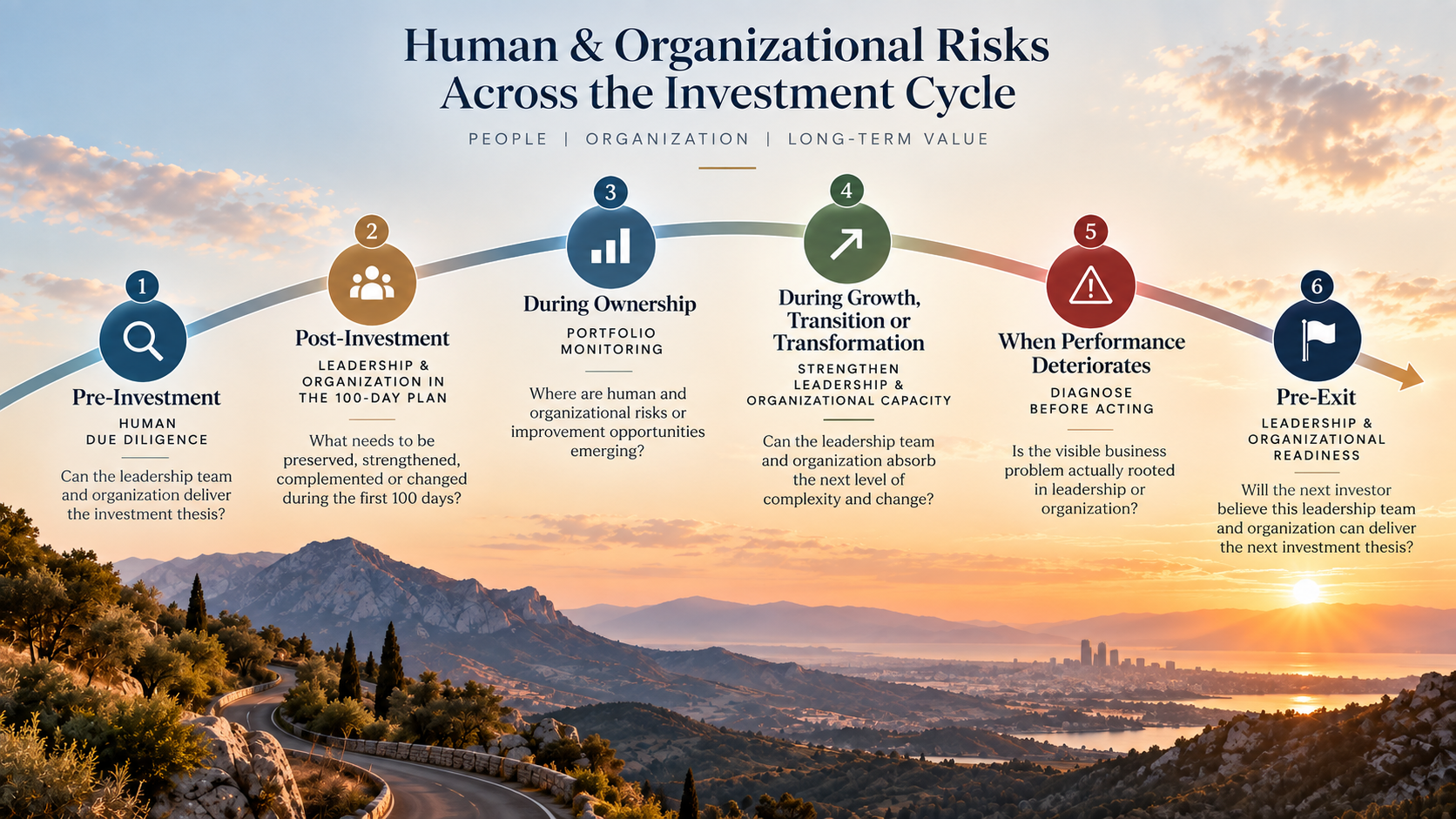

Why Assessing Founders Requires More Than Experience, References and Intuition
Every Venture Capital investor claims to invest primarily in people. It has almost become an industry mantra. Markets change, products evolve, technologies become obsolete, but exceptional founders continue to create value because they learn, adapt and build organizations capable of evolving with their environment.
Yet despite this widespread belief, the assessment of founders often remains surprisingly informal. Investment teams spend weeks analysing markets, products, competition, technology and financial projections, while the individuals who will ultimately determine whether the investment succeeds are frequently assessed through a combination of interviews, reference checks and intuition.
These approaches certainly provide useful information. They reveal how founders communicate, how they are perceived by others and how they present themselves under pressure. However, they rarely provide a structured understanding of how founders are likely to behave once the company enters a new stage of growth, when the leadership challenges become fundamentally different from those encountered during the early life of the business.
Most founder-related problems are therefore not discovered before the investment. They emerge afterwards, once the organization grows, governance becomes more demanding and execution depends increasingly on the founder’s ability to evolve.
In my experience, five categories of human risk deserve particular attention because they repeatedly influence long-term value creation.
These risks are precisely the kinds of issues a structured Founder Due Diligence process is designed to surface before they become constraints on execution or value creation.
1. Capability Gaps Are Often Hidden by Early Success
Successful founders are, by definition, capable individuals. The question is rarely whether they possess talent. The more relevant question is whether they possess the capabilities required for the next stage of the company’s development.
Early-stage companies naturally reward different strengths than scaling organizations. Technical excellence, product intuition or commercial drive may be sufficient to reach product-market fit, but they do not necessarily prepare founders to recruit senior executives, build governance, allocate capital, structure an organization or lead hundreds of employees.
This explains why investors sometimes discover leadership limitations only after the investment has been completed. The founder has not become less capable; the role itself has changed.
Founder Due Diligence should therefore seek to understand not only what founders have accomplished, but also whether their capabilities remain aligned with the challenges they are about to face.
2. Founding Team Alignment Can Deteriorate Long Before Performance Does
Most investment processes evaluate founders individually. Far fewer examine how the founding team actually functions as a leadership system.
Co-founders often begin their journey with strong personal relationships and a shared vision. Over time, however, differences naturally emerge regarding ambition, decision-making, governance, risk tolerance or the future direction of the business.
These differences rarely lead to immediate conflict. More often, they progressively reduce the quality of discussions, slow strategic decisions and create ambiguity about roles and responsibilities. Because financial performance may initially remain strong, investors often underestimate these dynamics until they begin affecting execution.
Understanding the quality of alignment within the founding team is therefore just as important as understanding the capabilities of each founder individually.
3. Leadership Strengths Can Become Leadership Constraints
One of the most interesting aspects of founder assessment is that many future leadership risks originate from qualities that initially contributed to success.
- Determination may gradually become rigidity.
- High standards may evolve into perfectionism.
- Strong ownership may become excessive control.
- Confidence may develop into overconfidence.
- Persistence may become resistance to change.
None of these characteristics should automatically be viewed as weaknesses. On the contrary, they often explain why founders succeeded in the first place. The challenge arises when these strengths are applied indiscriminately despite increasing organizational complexity.
Rather than attempting to classify personalities, Founder Due Diligence should seek to identify the conditions under which these qualities are likely to remain productive—or, conversely, become constraints for the organization.
4. Sustainable Energy Is a Leadership Asset
Leadership is often discussed in terms of competence, vision or decision-making. Energy receives considerably less attention, despite its direct influence on execution.
Scaling a company places founders under constant pressure. Recruiting senior talent, managing investors, fundraising, responding to customers, adapting the strategy and making high-impact decisions all require sustained emotional and cognitive resources over long periods of time.
The objective of assessment is not to determine whether founders are resilient in absolute terms. Every entrepreneur experiences periods of doubt, fatigue or reduced motivation.
The more important question is how founders manage these inevitable fluctuations. How quickly do they recover? What situations drain their energy? Which activities restore it? Do they continue creating energy for the organization, or does the organization increasingly compensate for their exhaustion?
Leadership energy is rarely visible in financial models, yet it often determines whether organizations maintain momentum through periods of uncertainty.
5. Adaptability Is Often the Best Predictor of Long-Term Success
If one characteristic consistently differentiates founders who continue creating value from those who struggle as companies grow, it is adaptability.
The ability to question assumptions, abandon behaviours that no longer work, recruit stronger leaders, accept governance, delegate meaningful responsibility and continuously redefine one’s own role becomes progressively more important than any specific technical expertise.
History repeatedly demonstrates that successful founders are not necessarily those who begin with the strongest capabilities. More often, they are those who continue learning faster than the increasing complexity of the business.
Founder Due Diligence should therefore evaluate not only what founders know today, but also how they are likely to evolve tomorrow.
Founder Due Diligence Is About Better Investment Decisions
A structured Founder Due Diligence is not intended to replace investor judgment. Nor is its purpose simply to identify reasons to reject an investment.
Its objective is to improve decision quality by providing an independent perspective on the human factors that will influence value creation after the investment.
A robust assessment should identify leadership strengths, organizational implications, execution risks, governance challenges and development priorities. It should also highlight potential red flags when they are sufficiently significant to threaten the investment thesis.
Sometimes the assessment confirms the investor’s conviction.
Sometimes it suggests additional governance, coaching or leadership reinforcement.
And sometimes it reveals risks that fundamentally change the way the investment should be structured—or whether it should proceed at all.
Founder Due Diligence does not simply help investors decide whether to invest. It helps them decide how to invest.
Conclusion
Technology evolves. Markets evolve. Strategies evolve. Leadership must evolve as well.
The founders who create the greatest long-term value are not necessarily those who start with the strongest profile. They are those who continue adapting as their company becomes more complex.
For investors, understanding this potential for evolution may be just as important as understanding the business itself.
Founder Due Diligence provides that perspective by helping investors move beyond intuition and better understand the people who will ultimately determine whether the investment thesis becomes reality.
At WINGMIND, we help Venture Capital, Growth Equity and technology investors assess founders and founding teams through Founder Due Diligence. Our assessments identify leadership strengths, execution risks, organizational dynamics and founder development priorities to support better investment decisions and stronger post-investment value creation.
Founder of WINGMIND, David Chouraqui is an Operating Advisor & Executive Coach to PE/VC investors, boards and CEOs. A former private equity investor and entrepreneur, he specializes in Human Due Diligence, leadership assessments, organizational diagnostics and CEO & Board Advisory, helping organizations strengthen the human drivers of execution and value creation.