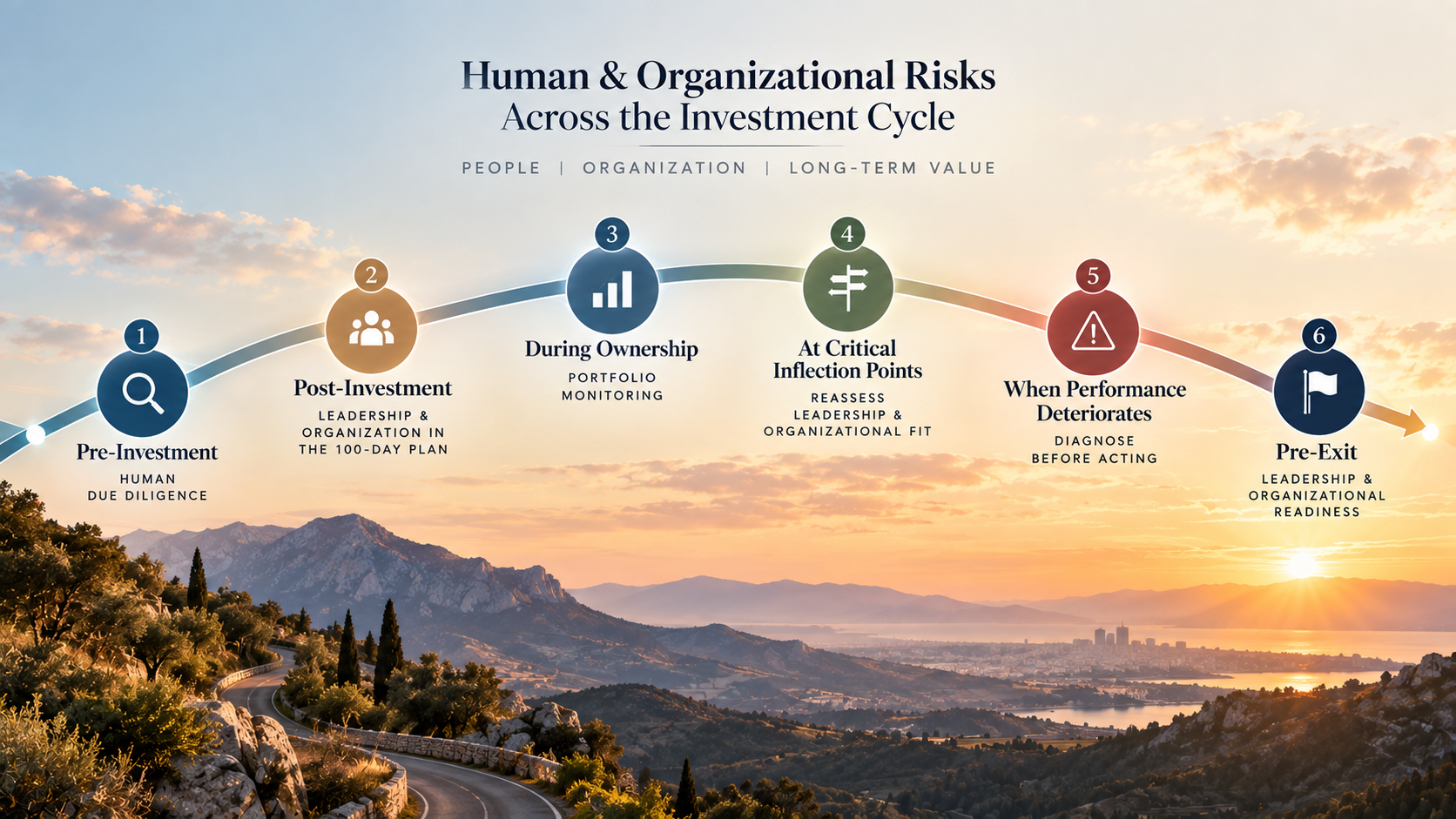

Most PE, Growth and VC investors already recognize that leadership and organization are critical to investment performance.
The issue is not awareness.
The issue is visibility.
Investors interact regularly with CEOs and management teams. They sit on Boards, follow key hires, discuss succession, challenge management and observe execution.
It can therefore feel as if the human and organizational dimension is already well covered.
But many human and organizational risks are difficult to see before they become consequences.
Leadership tensions can remain below the surface. Management depth may appear sufficient until the company scales. Decision-making can gradually slow down without appearing clearly in a Board pack. A founder can become a bottleneck while the business is still growing. Organizational complexity can accumulate before it materially affects performance.
The risk is therefore not necessarily that investors ignore human and organizational issues. It is that they may believe they are sufficiently covered when the information available remains partial, informal or lagging.
By the time the issue becomes obvious, it may already appear as executive turnover, missed execution, governance conflict, deteriorating performance or the need for a more radical intervention.
Human and organizational risks are often visible only through their consequences. Structured assessment and monitoring aim to identify them before that point.
Visible Problems Do Not Always Reveal the Real Cause
A second challenge appears once performance actually starts to deteriorate.
Investors naturally look at market conditions, product, competition, pricing, sales effectiveness, operational execution or the macroeconomic environment.
These factors may indeed explain part of the problem.
But they are not always the root cause.
Financial and operational underperformance can also be the consequence of internal leadership and organizational problems that have been building for some time.
A company may appear to have a commercial problem when the deeper issue is unclear accountability.
It may appear to have an execution problem when the executive team no longer works effectively together.
It may appear to have a market problem when the organization has become too slow, too complex or unable to translate strategy into action.
It may appear to need more resources when the existing organization is simply not using its resources effectively.
The risk is therefore twofold: failing to see the issue early, and diagnosing the wrong issue once the symptoms become visible.
This is why human and organizational risks should be assessed and monitored throughout the investment cycle rather than only when a significant problem has already emerged.
1. Pre-Investment: Establish the Baseline Through Human Due Diligence
Ideally, the process starts before the investment.
Financial, commercial, legal and operational due diligence help investors understand the business they are considering backing.
Human Due Diligence addresses another critical question:
Can these leaders, this team and this organization deliver the investment thesis?
This requires looking beyond individual personalities and assessing three interconnected levels.
The CEO or Founder
Leadership capability, decision-making, adaptability, motivation, role fit, strengths and potential derailers.
The Executive Team
Team effectiveness, complementarity, trust, accountability, decision dynamics, missing capabilities and ability to operate collectively.
The Organization
Management depth, structure, decision rights, strategic clarity, governance, culture and readiness for the next stage.
Human Due Diligence matters first for the investment decision itself.
But its value can extend much further.
It can establish the human and organizational baseline for the ownership period.
It helps investors identify:
- strengths that should be preserved;
- risks that should be monitored;
- leadership or organizational gaps;
- issues to address after closing;
- capabilities that may need to evolve;
- questions that should be revisited as the company develops.
Human Due Diligence can therefore become the starting point of an ongoing process rather than a one-off assessment attached only to the transaction.
2. Post-Investment: Make Leadership and Organization Part of the 100-Day Plan
A full Human Due Diligence is not always possible before closing.
Deal timelines may be compressed. Access to management may be limited. Some questions may be difficult to explore deeply while the transaction is underway.
When that happens, the period immediately after closing becomes the next critical window.
A focused leadership and organizational review can establish the missing baseline and provide important input into the 100-day plan.
The investor can ask:
- What leadership capabilities will the investment thesis require?
- Where does management need reinforcement?
- What may need to evolve in the CEO or founder’s role?
- Are responsibilities and decision rights sufficiently clear?
- Does the organization have the management depth required?
- What needs immediate action?
- What should be monitored rather than changed immediately?
The 100-day plan should not only define commercial, financial and operational priorities.
It should also test whether the leaders, team and organization expected to execute those priorities are equipped to do so.
A value-creation plan is only as executable as the leadership team and organization behind it.
3. During Ownership: Monitor Human & Organizational Risks Across the Portfolio
Once the initial priorities are established, human and organizational risks continue to evolve.
A CEO who was highly effective at one stage may face a very different leadership challenge as the company becomes larger and more complex.
A management team that operated effectively in a relatively simple organization may struggle after acquisitions, international expansion or rapid growth.
Decision-making can slow down.
Roles can become less clear.
Management layers can multiply.
Strong executives can leave.
The founder can become a bottleneck.
The organization can grow faster than its management capability.
These developments often emerge gradually and may not immediately appear in financial reporting.
Portfolio monitoring should therefore include a structured view of human and organizational evolution, alongside financial and operational performance.
The objective is not to perform a full assessment of every portfolio company every year.
It is to establish a light and recurring process that helps answer three questions:
- What is changing?
- Where are risks or improvement opportunities emerging?
- Where does the fund need to allocate more attention?
Different Companies Require Different Levels of Attention
A portfolio-wide view can help distinguish between three broad situations.
Strong performers
Leadership and organization are supporting execution. Investor involvement may remain relatively light, while anticipating the next stage and preserving what is working.
Companies with improvement opportunities
The business may be performing adequately, but leadership, team or organizational issues could become future constraints.
This is often where preventive support can create significant value before the problem becomes more difficult to address.
Stress or underperformance situations
More serious signals are emerging. Execution may be deteriorating, leadership tensions may be increasing, governance may be weakening or management gaps may be affecting performance.
These situations can require a deeper diagnosis and more intensive intervention.
The objective is not to create a simplistic ranking of portfolio companies.
Different companies operate in different markets, at different stages and with different investment theses.
The objective is to create enough consistency to understand relative strength, risk and change across the portfolio while preserving the context of each company.
This supports an important portfolio-management decision:
Where should the fund allocate its limited time, operating resources and external support?
Not every portfolio company needs the same level of attention.
Some need observation.
Some need targeted support.
Some require intervention.
4. At Critical Inflection Points: Reassess What the Next Stage Requires
Human and organizational risks do not only matter when a company is struggling.
A successful business can simply outgrow the leadership model and organization that made it successful.
This commonly happens during:
- rapid scaling;
- international expansion;
- acquisitions and build-ups;
- post-merger integration;
- major strategic shifts;
- professionalization;
- founder or CEO transition;
- governance changes;
- significant organizational redesign.
At these moments, past performance alone is not enough to assess future fit.
A founder may have been exactly right for the previous stage and still need to change significantly for the next one.
A strong executive team may need additional capabilities.
An informal organization may need clearer roles, stronger management depth or more explicit governance.
The question becomes:
Is the leadership team and organization that brought the company here capable of taking it where the investment thesis requires it to go next?
Where that answer is uncertain, a deeper Executive Assessment, leadership team review or Organizational Assessment may be appropriate.
Leadership fit is contextual. Organizational effectiveness depends on the stage, strategy and complexity of the business.
5. When Performance Deteriorates: Diagnose Before Acting
Underperformance naturally creates pressure for action.
Replace the CEO.
Add a senior executive.
Reorganize.
Reduce costs.
Change incentives.
Increase Board involvement.
Any of these actions may ultimately be appropriate.
But the first question should be:
What is actually causing the deterioration?
The visible symptom may not be the root cause.
Underperformance may result from:
- a leadership model that no longer fits the company’s stage or complexity;
- unresolved executive-team tensions;
- unclear strategic priorities;
- insufficient management depth;
- organizational complexity;
- ineffective governance;
- poorly integrated acquisitions;
- unclear roles or decision rights;
- cultural issues;
- several of these factors interacting.
This is where a deeper Organizational Assessment can become particularly valuable.
A participative assessment can gather perspectives from the CEO, executive team, selected managers and employees, Board members and shareholders.
The objective is not simply to accumulate opinions.
It is to understand:
- where perspectives converge;
- where they diverge;
- where leadership sees the organization differently from others;
- which problems are widely recognized;
- which tensions or dependencies are not visible in formal reporting;
- which issues are symptoms and which appear to be root causes.
The purpose is not to delay action.
It is to avoid taking decisive action on the wrong diagnosis.
Early diagnosis preserves optionality. Late diagnosis often forces more radical action.
The resulting decisions may involve:
Improve existing leadership or organizational practices.
Complement the leadership team with missing capabilities.
Adapt roles, structure, governance or the operating model.
Replace a leader where the evidence shows that role fit or capability is no longer sufficient.
The assessment should not predetermine the answer.
It should make the right decisions easier to see.
6. Pre-Exit: Make Leadership and Organization Part of Exit Readiness
Human and organizational questions become important again as the investment approaches exit.
A future buyer or investor may ask:
- Is performance overly dependent on the founder or CEO?
- Is there sufficient management depth?
- Is the executive team credible for the next stage?
- Is succession sufficiently addressed?
- Is governance robust?
- Can the organization continue scaling after the transaction?
- Are key executives likely to remain?
A Pre-Exit Leadership & Organizational Review can identify these issues before they appear during buyer diligence.
This gives shareholders time to address weaknesses before entering the sale process.
It can also strengthen the equity story.
A company with credible leadership, sufficient management depth, effective governance and lower dependence on individuals may be easier for the next investor to underwrite.
The question before exit is therefore not only whether the business has performed. It is whether the organization appears capable of sustaining performance under its next owner.
A Continuous Approach Across the Investment Cycle
The relevant question changes as the investment progresses.
1. Pre-Investment
Who and what are we backing?
2. Post-Investment
What human and organizational priorities should shape the 100-day plan?
3. During Ownership
What is improving, what is deteriorating and where should investor attention be allocated?
4. At Critical Inflection Points
Does the existing leadership model and organization still fit what comes next?
5. When Performance Deteriorates
What is actually causing the problem?
6. Pre-Exit
Will leadership and organization support the next owner’s investment case?
Human and organizational assessment should therefore not be treated as a series of disconnected interventions. It can become a continuous discipline across the investment cycle.
The logic is simple:
Assess → Monitor → Prioritize → Diagnose → Act.
How WINGMIND Supports Investors Across the Investment Cycle
WINGMIND works with PE, Growth and VC investors, Boards and CEOs at each of these stages.
This can include:
- Human Due Diligence before investment;
- leadership and organizational review after closing and as an input into the 100-day plan;
- portfolio monitoring during ownership;
- Executive Assessment, leadership team review and Organizational Assessment at critical inflection points;
- participative organizational diagnosis in situations of stress or underperformance;
- pre-exit leadership and organizational review ahead of a transaction.
WINGMIND Business Scan
For recurring portfolio monitoring, WINGMIND can use its proprietary Business Scan.
The Business Scan provides a fast and structured view of four dimensions:
- Leadership Performance
- Strategic Clarity
- Organizational Effectiveness
- Culture & HR Readiness
It can combine investor perspectives, management input and selected business, organizational and people indicators to provide a recurring view of each portfolio company’s situation.
Repeated over time, it can help identify:
- what is improving or deteriorating;
- where new risks are emerging;
- which companies have improvement opportunities;
- which situations require deeper attention;
- where investors may want to allocate additional time, operating resources or external support.
The Business Scan does not replace a deeper assessment.
It helps determine where a deeper assessment may be useful.
At portfolio level, it also creates a common framework for identifying relative areas of strength, risk and change without reducing different companies to a simplistic ranking.
The objective is not more assessment. It is earlier visibility, better prioritization and better decisions while investors still have multiple options available.
View Selected WINGMIND Engagements
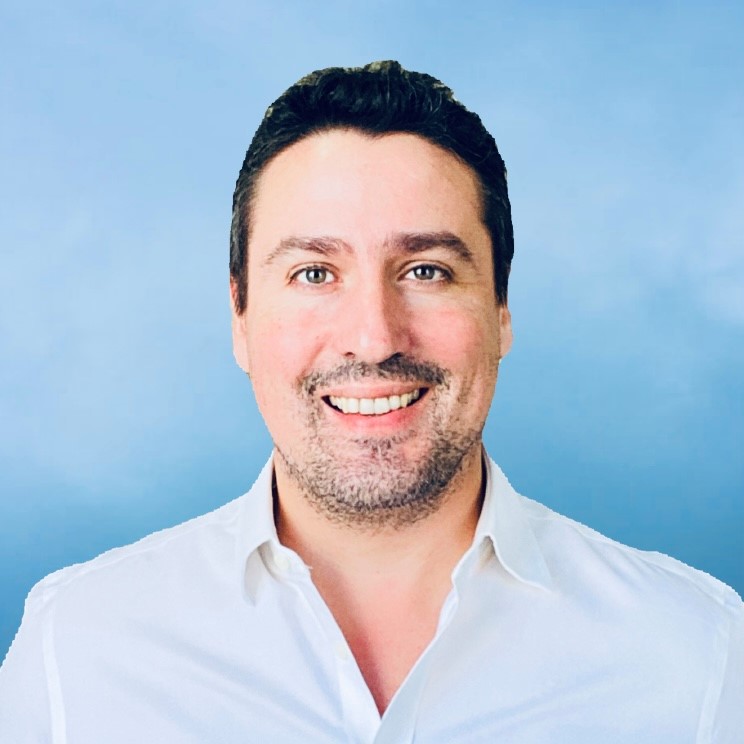
Founder of WINGMIND, David Chouraqui is an Operating Advisor & Executive Coach to PE/VC investors, boards and CEOs. A former private equity investor and entrepreneur, he specializes in Human Due Diligence, leadership assessments, organizational diagnostics and CEO & Board Advisory, helping organizations strengthen the human drivers of execution and value creation.