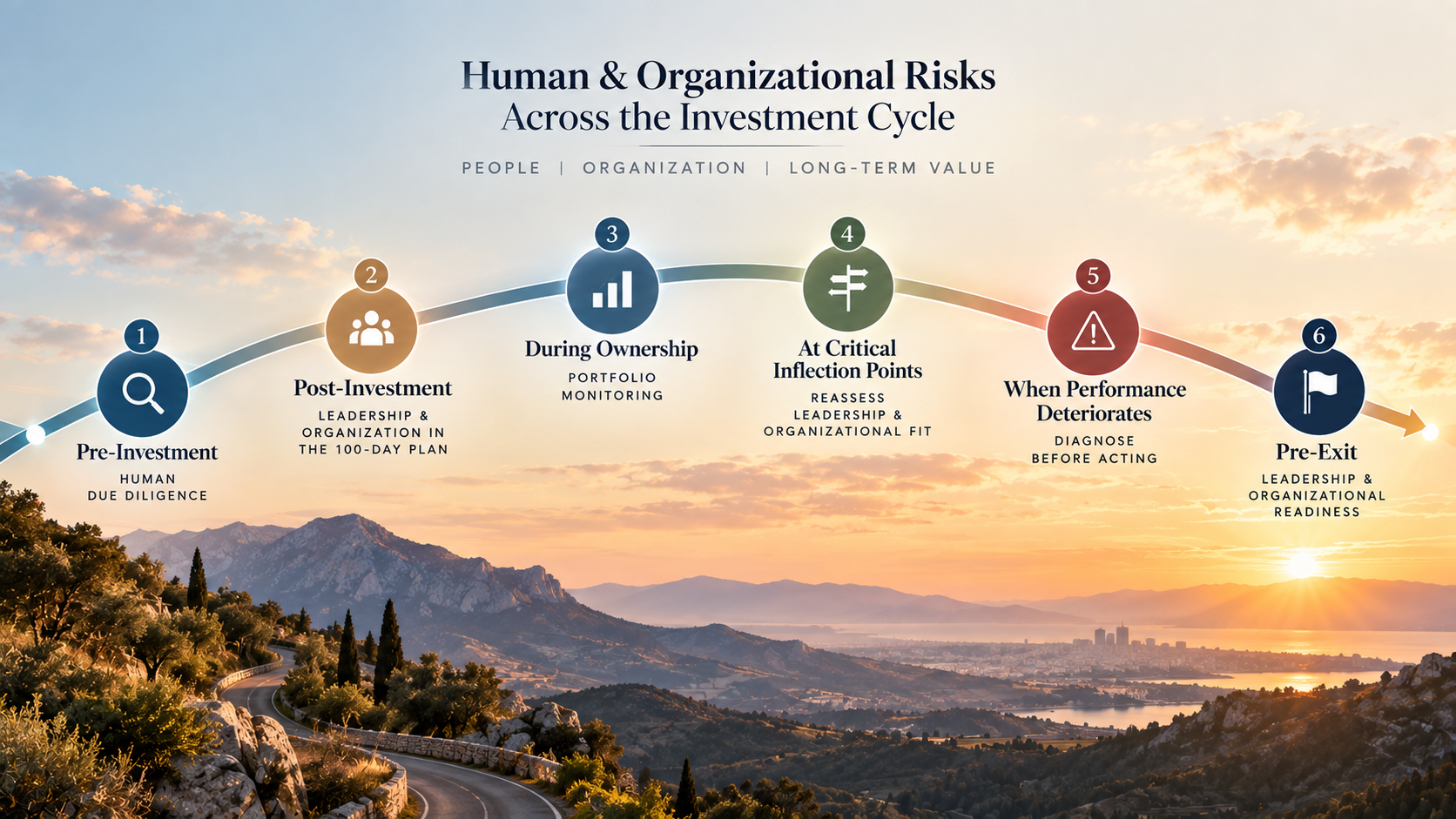

When a portfolio company starts to underperform, one of the most useful moves is also one of the least comfortable: launch an Organizational Assessment early.
Not every investor, Board or CEO is immediately ready to do it.
A serious assessment can surface uncomfortable questions about leadership, strategy, management depth, governance, culture or the organization itself. It can challenge existing beliefs and sometimes contradict the preferred explanation for what is going wrong.
But in my experience, it is often the most instructive and intelligent first move.
Before changing the CEO, restructuring the company, adding resources or launching a turnaround plan, it creates the opportunity to understand what is really deteriorating, where the breakdown sits and what kind of intervention is actually required.
The objective is not to delay action. It is to avoid acting decisively on the wrong diagnosis.
Underperformance rarely has one clear cause
Portfolio companies rarely deteriorate because of one isolated issue.
The visible symptoms may include repeated missed targets, slower execution, margin pressure, leadership tensions, rising employee turnover, poor coordination, unclear priorities or declining confidence between the Board and management.
But the causes can be very different.
A revenue problem may reflect weak commercial execution, poor strategic focus, insufficient management depth, a dysfunctional executive team, unclear decision rights or an organization that has become too complex for its current leadership model.
The real question is therefore not only what is going wrong, but where the breakdown actually sits: individual, team or organization.
The assessment looks at leadership, team dynamics, strategy and organizational design together, to understand where the problem sits and what needs to change.
Sometimes the issue is structural. Sometimes it is linked to leadership or role fit. Often, several factors interact.
The biggest risk is moving too quickly from symptoms to solutions
When performance declines, pressure to act rises quickly.
Common responses include:
- changing the CEO;
- replacing one or several executives;
- launching a cost-reduction programme;
- reorganizing the company;
- adding senior commercial leadership;
- changing incentives;
- increasing Board involvement.
Any of these actions may be appropriate.
But they can also be wrong if the diagnosis is incomplete.
A CEO may appear to be the problem because the organization has become extremely difficult to manage. A leadership team may appear weak because priorities keep shifting. High turnover may look like a culture problem when the deeper cause is leadership instability or poor management practices.
The first decision should therefore not always be what to change.
It should often be:
What is actually causing the deterioration?
Diagnose early while more options are still available
The earlier the diagnosis starts, the easier it is to understand what is really happening.
Early in the deterioration, people are usually more willing to speak openly. Key employees may still be in place. Leadership tensions may still be manageable. The Board and CEO may still have enough trust to work through difficult questions constructively.
As the situation worsens, positions harden, executives build competing narratives, strong employees leave and trust deteriorates.
The diagnosis becomes more political and more difficult.
Timing also affects the range of actions still available.
Early on, the company may still be able to:
- clarify priorities;
- realign the leadership team;
- strengthen the CEO;
- add missing capabilities;
- adjust roles and decision rights;
- simplify the organization;
- improve management practices before the issues become structural.
Later, the room for gradual intervention narrows.
The available options may become more radical:
- leadership replacement;
- major restructuring;
- cost reduction;
- governance changes;
- turnaround measures;
- rapid simplification of the business.
Early diagnosis preserves optionality. Late diagnosis often forces more radical action.
What happens if the diagnosis does not happen early?
Not launching an assessment early is also a decision.
In practice, three alternatives often emerge.
Act too quickly.
The Board or investor may make a radical decision before the root causes are understood. A CEO may be replaced, a team reorganized or a restructuring launched, only to discover later that the underlying problem sat elsewhere.
Wait and let the situation deteriorate.
When nobody is sufficiently clear about what is happening, action can be postponed. Performance continues to decline, tensions increase, strong people may leave and the cost of recovery rises.
Act without a shared understanding of the problem.
Even when the chosen action is directionally right, implementation can face strong resistance if leaders, managers and employees do not share the same understanding of what is wrong.
A participative Organizational Assessment helps reduce all three risks.
A participative assessment reveals what leadership alone cannot see
Organizational Assessment should not rely only on the perspective of the CEO or executive team.
WINGMIND assessments are participative. They collect perspectives from the people who are closest to the way the organization actually operates.
Depending on the situation, this can include:
- the CEO and executive team;
- selected managers and key employees;
- Board members or shareholders;
- cross-functional stakeholders;
- and, in some situations, a much broader employee population.
The objective is not to turn the process into an opinion survey.
It is to understand where perspectives converge, where they diverge and what those differences reveal.
This broader evidence base helps identify:
- areas of genuine consensus;
- important disagreements between leadership and the organization;
- differences in perception across functions or management levels;
- weak signals that may not yet be visible in financial or operational data;
- hidden dependencies, tensions or execution barriers;
- issues that people experience but do not always raise directly with senior leadership.
Differences in perspective are often as informative as points of agreement.
They can reveal whether the problem is understood in the same way across the company, whether leadership messages are translating into execution and whether the organization is aligned around the changes required.
In broader situations, the assessment can also include organization-wide employee input to identify recurring patterns at scale.
The result is a deeper view of the organization: not only what leaders believe is happening, but how the company is actually experienced across different levels.
What an Organizational Assessment should clarify
The objective is not to audit everything.
It is to create enough clarity to identify the real sources of execution risk.
A useful assessment should examine four connected dimensions.
1. Leadership Performance
Can the CEO and leadership team still lead the company effectively through the current situation?
This includes leadership capability, role fit, decision quality, adaptability, resilience, team effectiveness and governance contribution.
See Executive Assessment and Executive Team Assessment.
2. Strategic Clarity
Is the company genuinely aligned around what matters now?
The assessment should test whether the strategy is still relevant, priorities are clear, trade-offs are explicit, the roadmap is realistic and accountabilities are understood.
3. Organizational Effectiveness
Is the organization still designed to execute?
The assessment should examine structure, roles, decision rights, operating model, cross-functional collaboration, management depth, resource allocation and execution capacity.
See Organizational Assessment.
4. Culture & HR Readiness
Are people practices supporting or undermining the recovery?
The practical questions include whether strong people are leaving, trust is deteriorating, incentives are aligned, managers can carry difficult messages and the organization is ready for the required changes.
Distinguish symptoms from root causes
This distinction is essential.
Symptoms may include slow growth, missed forecasts, high turnover, conflict, poor accountability or weak execution.
The root causes may be very different:
- a leadership model that no longer fits the company’s stage or complexity;
- an executive team with unresolved role conflicts;
- a strategy that is no longer sufficiently clear;
- an operating model that has become too complex;
- insufficient management depth;
- poorly integrated acquisitions;
- an organization overloaded with priorities;
- a culture that discourages challenge or accountability.
Acting on the symptom may create movement without creating improvement.
Who usually initiates the assessment?
An Organizational Assessment can be initiated by different stakeholders depending on the ownership and governance context.
The majority shareholder or lead investor
This is common when performance is deteriorating, confidence in management is weakening or the investor needs an independent view before making a significant decision.
The Board
The Board may initiate the assessment when it needs a clearer view of the CEO, leadership team, governance or organizational issues before deciding how to intervene.
The CEO
A CEO may also initiate the assessment when the organization is becoming harder to manage, execution is slowing, the leadership team is struggling or a major transformation requires a clearer diagnosis.
In some situations, the assessment is initiated jointly by the investor and the CEO.
Who sponsors the assessment matters almost as much as who conducts it.
The sponsor influences access, trust and the way the process is perceived.
The objective should be clear from the outset: understand what is happening, create a reliable fact base and support better decisions, rather than validate a conclusion that has already been reached.
The assessment must lead to decisions
An Organizational Assessment has little value if it ends with observations.
The purpose is to create enough clarity to decide what needs to change, at what level and with what degree of urgency.
Depending on the findings, the decisions may concern leadership, the composition of the executive team, management depth, governance, strategic priorities, structure, decision rights, operating processes or culture.
A useful way to frame the possible responses is:
Improve
Strengthen the existing leadership or organization through coaching, clearer priorities, better management practices or stronger execution disciplines.
Complement
Add missing capabilities, reinforce the leadership team or strengthen management depth.
Adapt
Change roles, governance, structure, decision rights, incentives or the operating model.
Replace
Change a leader when the evidence shows that the current role fit or leadership model is no longer sufficient.
The assessment should not predetermine the answer. It should make the right decisions easier to see.
From diagnosis to an action roadmap
The conclusions should then be translated into a limited number of priorities.
Not everything needs to be fixed at once.
The key is to distinguish:
- what must change immediately;
- what should be addressed over the next few months;
- what requires further evidence;
- what can remain unchanged.
The objective is not more action. It is better-targeted action.
An independent perspective can help in sensitive situations
Underperformance often creates tension between investors and management.
Each side may gradually become more convinced of its own interpretation.
An independent external assessment can help create a third perspective.
This can be particularly useful when:
- the Board and CEO disagree on the cause of underperformance;
- several executives have different explanations for what is going wrong;
- investors are divided internally;
- a CEO change is being considered;
- the company has already tried several fixes without improvement;
- the organization needs to hear difficult messages without turning the process into a personal confrontation.
The objective is not neutrality for its own sake. It is to create enough independent evidence to make a better decision.
The assessment can become the starting point for support
The value of the diagnostic does not stop when the findings are presented.
The person who has assessed the company already understands the leadership team, organizational context, key tensions and assumptions behind the diagnosis.
That knowledge can be used to support what happens next.
This may include CEO or founder support, executive coaching, leadership-team alignment, organizational change, governance clarification, management reinforcement, leadership transition support or ongoing advice to the investor or Board.
The assessment can therefore become the starting point for action, not the end of the process.
How WINGMIND approaches underperforming portfolio companies
WINGMIND works with investors, Boards and CEOs when leadership and organizational factors may be contributing to underperformance.
The starting point is usually a focused diagnosis of the situation.
Depending on the company and the questions involved, the work can combine CEO and executive assessment, leadership-team assessment, management-depth review, organizational diagnosis, Board, management and employee perspectives, and strategic alignment and execution analysis.
The objective is to determine where the breakdown sits and what intervention is most likely to restore execution.
The assessment may lead to leadership support, team reinforcement, organizational changes, governance adjustments, management transitions or targeted advisory support.
When portfolio performance starts to deteriorate, the most useful first move is often not to choose the fix.
It is to understand what is really breaking, early enough to preserve more options and act with greater confidence.
Explore Organizational Assessment
·
Human Due Diligence
·
Executive Assessment
·
View Selected Engagements

Founder of WINGMIND, David Chouraqui is an Operating Advisor & Executive Coach to PE/VC investors, boards and CEOs. A former private equity investor and entrepreneur, he specializes in Human Due Diligence, leadership assessments, organizational diagnostics and CEO & Board Advisory, helping organizations strengthen the human drivers of execution and value creation.