
A private equity investment does more than change a company’s ownership structure.
It changes the way the business is governed, measured, financed, led and managed.
For CEOs and management teams, the arrival of a private equity investor can bring significant opportunities: additional capital, strategic support, M&A capabilities, access to expertise and a stronger platform for growth.
It also brings greater scrutiny, more explicit commitments and a faster pace of execution.
Private equity firms differ in their investment strategies, cultures, time horizons and levels of involvement. A majority investor will normally exercise more control than a minority shareholder. Some funds are highly operational, while others prefer to influence through the Board and leave management substantial autonomy.
However, most private equity investors share a number of expectations.
They invest behind a value-creation thesis, a defined financial return and a limited ownership horizon. They expect the CEO, the leadership team and the organization to convert the investment plan into measurable results.
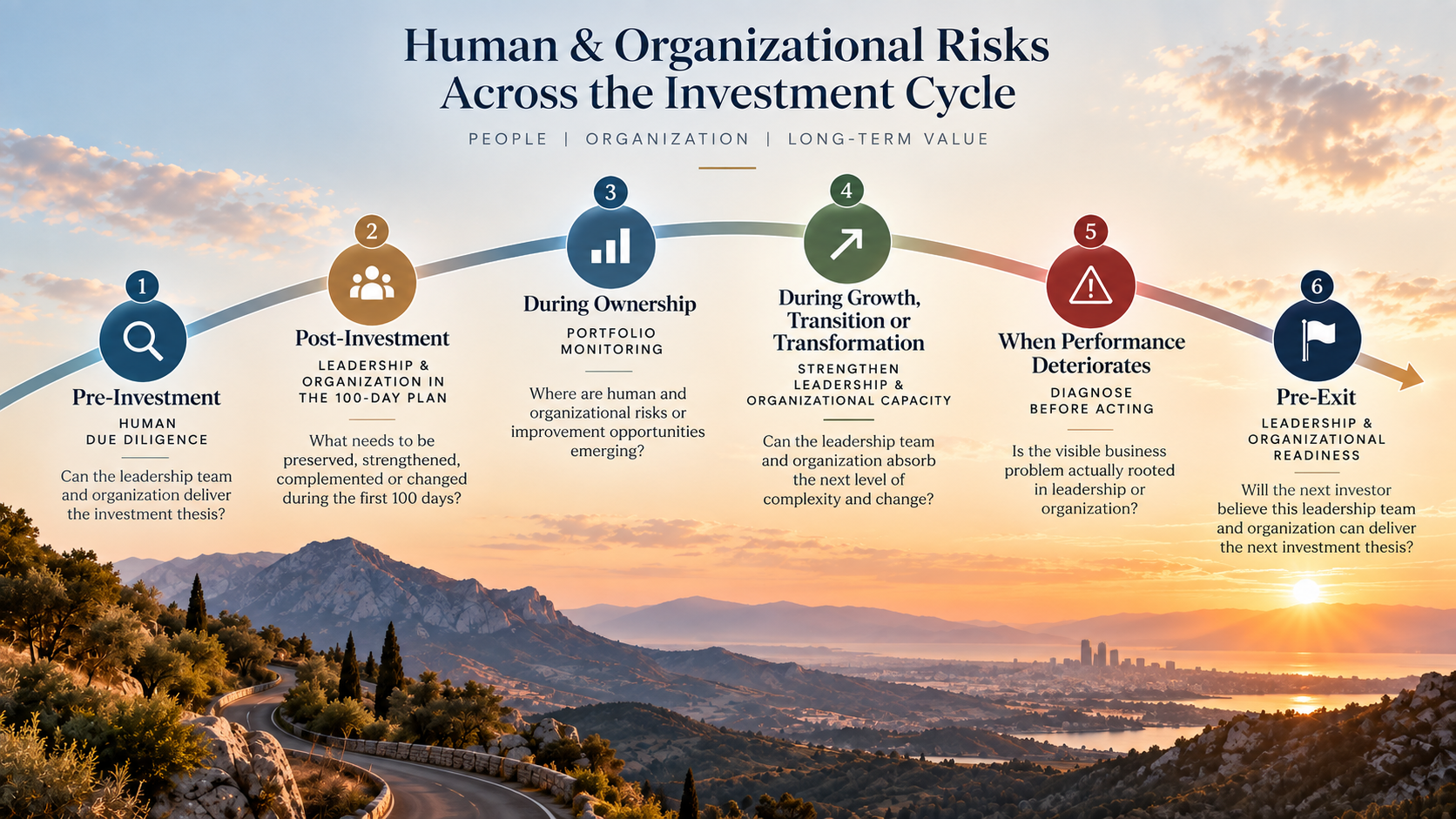
The changes also begin before the investment is completed. Investors increasingly need to determine whether the management team and organization are capable of delivering the investment thesis. This is one of the central purposes of Human Due Diligence.
Here are ten important changes CEOs and management teams should expect after a private equity investment.
1. A Clearer and More Demanding Value-Creation Plan
Private equity firms invest on the basis of a detailed investment thesis and business plan.
The plan normally describes how the company will increase its value during the investment period. It may rely on organic growth, international expansion, new products, operational improvement, margin expansion, digital transformation, acquisitions or a combination of these levers.
Management may already have had a strategic plan before the transaction. The difference under private equity ownership is that the plan becomes more explicit, more quantified and more closely connected to the expected return on investment.
Strategic ambitions must therefore be translated into a practical roadmap:
- the main value-creation initiatives;
- the financial and operational results expected;
- the timetable for delivery;
- the executives responsible for each priority;
- the resources and organizational changes required.
The CEO will be expected to explain not only where the company is going, but how it will get there, what may prevent success and how management will respond if the original assumptions prove wrong.
This creates a more disciplined connection between strategy and execution.
It can also reveal weaknesses that were less visible before the transaction. A roadmap is only credible if priorities are clear, responsibilities are explicit and the leadership team is aligned around the main choices.
An Executive Team Assessment can help determine whether the team has the collective capabilities, role clarity and decision-making effectiveness required for the next stage.
2. Greater Focus on EBITDA, Revenue Growth and Margin Improvement
Private equity investors are focused on increasing enterprise value during their period of ownership.
Although company valuations depend on many factors, EBITDA growth is often an important component of value creation. Improving profitability can increase the value of the company, strengthen its financing capacity and create additional strategic options.
Management will therefore face sustained attention on both sides of the profit equation.
On the revenue side, investors may encourage:
- commercial acceleration;
- pricing improvement;
- international expansion;
- new products or services;
- greater cross-selling;
- strategic acquisitions.
On the profitability side, they may expect better margins, stronger procurement, improved productivity, portfolio simplification or tighter cost management.
The management challenge is to avoid treating EBITDA improvement as a purely financial exercise.
Growth initiatives depend on sales capacity, leadership attention, operational resources and organizational readiness. Cost reductions may improve short-term profitability while weakening customer service, innovation or key capabilities if they are poorly designed.
The CEO and leadership team must therefore connect financial objectives with the operating model required to deliver them sustainably.
When performance falls behind plan, investors will want to understand whether the problem comes from the market, the strategy, execution, leadership or the organization.
An Organizational Assessment can identify unclear accountability, weak coordination, capability gaps and operating-model issues that are limiting performance.
3. Stronger Attention to Cash Generation and Working Capital
Cash becomes a central management topic under private equity ownership.
A profitable company can still create financial pressure if it consumes too much working capital, invests without sufficient discipline or converts earnings poorly into cash.
Cash generation matters for several reasons.
It can be used to repay acquisition debt, reduce net debt, fund growth initiatives, finance add-on acquisitions, build resilience or distribute proceeds to shareholders.
For an LBO-backed company, the ability to service debt and interest obligations is naturally critical.
Management teams should therefore expect greater attention to:
- working-capital performance;
- customer payment terms;
- inventory levels;
- supplier terms;
- capital expenditure;
- cash forecasting;
- the cash impact of strategic projects.
This may require a change in management behavior.
Commercial teams must consider the cash implications of contracts. Operations must manage inventory and capacity more rigorously. Business leaders must distinguish investments that are strategically necessary from those that are merely desirable.
The CFO will often play a stronger role in bringing financial discipline into operational decisions.
4. More Structured KPIs, Reporting and Performance Reviews
Private equity investors need regular, reliable and decision-useful information.
The Board will normally expect management to report against a defined set of financial and operational indicators. These may include revenue, EBITDA, cash, working capital, sales pipeline, customer retention, productivity, headcount, project milestones and other business-specific measures.
The objective is not only to produce more reports.
It is to identify deviations early, understand their causes and take corrective action before a temporary issue becomes a structural problem.
This requires three forms of discipline.
First, the information must be reliable. Weak data, inconsistent definitions or frequent restatements undermine confidence and slow decision-making.
Second, management must focus on the indicators that genuinely explain performance. Too many KPIs can create the appearance of control while obscuring the few issues that matter most.
Third, performance reviews must lead to decisions. Reporting that simply documents the past without changing priorities, resources or actions has limited value.
Under private equity ownership, management will generally be expected to move from reporting results to actively managing the drivers behind them.
5. A More Formal and More Active Governance Model
The arrival of a private equity shareholder normally formalizes the governance of the company.
A Board may be created or strengthened. Investor representatives become involved in strategic decisions, senior appointments, major investments, acquisitions, financing and other reserved matters.
The exact level of investor control depends on the ownership structure and shareholder agreement.
A majority investor may have the final say on important decisions. A minority investor may rely more heavily on influence, information rights and specific veto rights.
In both cases, the CEO must adapt to a more structured relationship with shareholders.
Board meetings become important decision-making forums rather than primarily informational events. Management will be expected to present clear options, explain trade-offs, anticipate questions and be transparent about difficulties.
The relationship works best when roles are clear.
The Board should challenge, support and protect the investment. The CEO remains responsible for leading the company and delivering the plan. Problems emerge when investors become operationally intrusive or when management treats Board oversight as an obstacle rather than part of the governance model.
The strongest CEO–investor relationships combine open challenge, mutual respect and clarity over who decides what.
When governance tensions, CEO performance questions or sensitive decisions arise, CEO & Board Advisory can help clarify the situation and prepare the relevant decisions and conversations.
6. Greater Scrutiny of the CEO and Executive Team
Private equity investors generally prefer to back an effective management team rather than replace it.
However, their support is not unconditional.
The CEO and key executives will be assessed continuously against the requirements of the investment plan. Investors will observe not only financial results, but also the quality of decisions, leadership behavior, organizational impact and capacity to adapt.
The questions evolve over time.
Can the CEO lead the next stage of growth? Can the CFO meet the new reporting and financing requirements? Does the commercial leadership have the capacity to accelerate revenue? Can the executive team manage acquisitions, transformation and increasing complexity?
A leader who was highly effective before the investment may not automatically possess everything required for the next phase.
The company may need stronger functional leadership, a more experienced CFO, a COO, a new commercial leader or a more collective executive team.
This does not mean that every limitation should lead to replacement.
Investors and Boards generally have four broad options:
- develop the leader;
- strengthen the team around them;
- adapt the role or governance;
- replace the executive when the risk is too significant.
An Executive Assessment provides an independent view of an executive’s role fit, critical strengths, leadership risks, adaptability and conditions for success.
7. Faster Strategic Transformation and Organizational Change
Private equity investors often act as a catalyst for change.
They invest behind an ambitious plan and expect management to move quickly on the initiatives required to deliver it.
These changes may include:
- international expansion;
- digital transformation;
- reorganization;
- strengthening the executive team;
- new commercial capabilities;
- operational improvement;
- M&A and build-up;
- integration of acquired businesses.
The challenge is rarely a lack of ideas.
It is the organization’s capacity to absorb several transformations while continuing to run the existing business.
Management teams can underestimate the amount of leadership attention, coordination and change capacity required.
Projects compete for resources. Managers are asked to deliver current results while redesigning the organization. New executives need to be integrated. Acquired companies bring additional systems, cultures and leadership teams.
The investment thesis may therefore be financially coherent but operationally overloaded.
The CEO and Board must sequence priorities, protect management bandwidth and identify the organizational foundations required for transformation.
8. More Transparent Communication and Earlier Escalation of Problems
Trust between investors and management depends heavily on information quality and transparency.
Investors do not expect every quarter to unfold exactly according to plan. They do expect problems to be identified early, explained honestly and addressed decisively.
One of the fastest ways for management to damage the relationship is to delay difficult information, soften the reality or surprise the Board with an issue that has been developing for months.
Good communication therefore involves more than formal reporting.
It requires regular dialogue between meetings, early discussion of emerging risks and a shared understanding of when an issue should be escalated.
CEOs sometimes fear that disclosing problems will weaken investor confidence.
In practice, confidence is often weakened more by late disclosure than by the problem itself.
Transparent communication allows investors to contribute experience, networks and additional resources. It also makes difficult decisions easier to prepare collectively.
The relationship becomes particularly strained when management consistently presents optimistic forecasts that are later missed, or when different executives provide conflicting explanations.
Clarity, consistency and openness are therefore essential leadership disciplines under private equity ownership.
9. Stronger Alignment of Interests Through the Management Package
Private equity investors generally want senior management to be financially aligned with the success of the investment.
A management package may include equity, stock options, sweet equity, performance shares, bonuses or other incentive mechanisms.
Executives may also be asked to invest personally in the company.
The intention is to create a shared interest in increasing enterprise value and achieving a successful exit.
This can be highly motivating, but it also changes the personal and professional relationship between management and the company.
Executives are no longer only employees or corporate officers. They may also become co-investors whose financial outcome depends on the performance of the business and the terms of the eventual exit.
Management teams need to understand both the opportunity and the risks.
The mechanisms may be complex, subject to vesting rules, performance conditions, leaver provisions and different exit outcomes.
Financial alignment can strengthen commitment, but it cannot by itself create an effective leadership team or resolve strategic disagreement.
A strong management package should support an already credible leadership and governance model, not substitute for it.
10. Earlier Preparation for Exit and the Next Ownership Transition
A private equity investor is a temporary shareholder.
The investment may last three, five, seven or more years, but the possibility of exit is considered from the beginning.
This influences the way the company is developed.
Management will be expected to build not only a more valuable company, but also a company that another investor or strategic buyer can understand, trust and acquire.
This may require:
- stronger financial reporting;
- a more professional organization;
- less dependence on individual leaders;
- a credible second level of management;
- clear growth opportunities;
- documented processes and governance;
- better visibility on future performance.
The exit may take the form of a sale to another private equity fund, a strategic acquisition, an IPO or another ownership transition.
For the CEO, this creates a dual responsibility.
The company must deliver current performance while also becoming increasingly attractive, transferable and scalable.
Preparing for exit should not become a short-term cosmetic exercise. The strongest exits are usually the result of genuine improvements in performance, leadership, organization and strategic positioning.
The Financial Plan Depends on Human and Organizational Execution
The ten changes described above are closely connected.
EBITDA improvement depends on commercial and operational execution. Cash optimization depends on accountability across functions. Transformation depends on management bandwidth and organizational capacity. Governance depends on trust and information quality.
A private equity investment thesis therefore contains important assumptions about people and organization, even when they are not explicitly written in the financial model.
Investors are effectively assuming that:
- the CEO can lead the next phase;
- the executive team can deliver collectively;
- the organization can absorb growth and transformation;
- key talent will remain and perform;
- the culture will support rather than resist change;
- governance will enable faster and better decisions.
If these assumptions prove wrong, even an attractive strategy and a well-constructed financial model may underperform.
This is why Human Due Diligence should not be treated as a separate HR exercise.
It assesses the leadership, organizational and cultural conditions required to deliver the investment thesis and create value.
What Investors Should Assess Before and After the Investment
A useful assessment should connect the human and organizational analysis directly to the business plan.
It should examine four dimensions.
Leadership Performance
Can the CEO and key executives lead the next stage, make the required decisions and adapt under pressure?
Strategic Clarity
Is the value-creation plan understood, prioritized and translated into clear ownership and action?
Organizational Effectiveness
Are the structure, roles, capabilities and operating model designed to execute at the expected pace?
Culture and Human-Capital Readiness
Will the company retain key talent, mobilize employees and absorb the level of change required?
A rigorous Human Due Diligence can identify these risks before investing, shortly after closing or when a portfolio company begins to underperform.
How CEOs Can Prepare for Private Equity Ownership
CEOs should not wait for the investment to be completed before adapting.
They can prepare by clarifying the strategic roadmap, strengthening the finance function, improving data quality and identifying the capabilities required in the leadership team.
They should also discuss governance expectations early.
How involved will the investor be? Which decisions will be reserved? How frequently will information be shared? What will happen if performance falls behind plan? How will the CEO and Board evaluate the leadership team?
The most successful relationships are generally built on realistic commitments rather than optimistic promises.
Management should be ambitious, but also transparent about constraints, risks and organizational readiness.
Private equity ownership can be highly stimulating for a company. It provides resources, discipline and momentum.
But it also exposes weaknesses more quickly.
CEOs and management teams that understand the model, engage openly with investors and strengthen their organization early will be better positioned to use the partnership as a genuine accelerator of value creation.
Conclusion
A private equity investment does not only introduce a new shareholder.
It creates a new operating environment.
The company will be managed against a clearer value-creation plan. Financial performance, cash and KPIs will receive greater attention. Governance will become more structured. Strategic transformations may accelerate. The CEO and executive team will be evaluated against the requirements of the next stage.
These changes can create pressure, but they can also strengthen the business.
The critical issue is whether the financial ambition is matched by the leadership, organization and execution capacity required to deliver it.
The companies that create the greatest value under private equity ownership are not simply those with the most attractive plans.
They are those whose CEOs, management teams and organizations can turn those plans into results.
Assess the Human Drivers of the Investment Thesis
WINGMIND supports private equity and venture capital investors, Boards and portfolio-company CEOs before and after investment.
Our work connects the investment thesis with the human and organizational conditions required for execution:
- CEO and key-executive assessment;
- executive-team effectiveness;
- strategic clarity and alignment;
- organizational scalability and execution capacity;
- culture, talent and readiness for change;
- governance and value-creation priorities.
The objective is to identify hidden execution risks, clarify the actions required and strengthen the company’s ability to deliver the expected value creation.
Discuss a Private Equity Leadership or Organizational Assessment

Founder of WINGMIND, David Chouraqui is an Operating Advisor & Executive Coach to PE/VC investors, boards and CEOs. A former private equity investor and entrepreneur, he specializes in Human Due Diligence, leadership assessments, organizational diagnostics and CEO & Board Advisory, helping organizations strengthen the human drivers of execution and value creation.