

TEAM Index
Employee Energy, Engagement & Voice Diagnostic
Measure employee energy and engagement, identify what energizes or drains teams, and turn employee feedback into targeted priorities for management, organization and collective performance.
Listen to teams to understand where energy is created — and where it is lost
TEAM Index is WINGMIND’s proprietary methodology for understanding the real employee experience and informing executive decisions.
The approach combines a quantitative foundation, the ENERGY Score, eNPS, employee-selected energy and dissatisfaction drivers, detailed open-ended feedback, and segmented analysis.
It goes beyond measurement: WINGMIND interprets the findings, identifies root causes, develops recommendations, and supports executive and local teams through implementation.
Why TEAM Index is different
The ENERGY Score: measuring team energy
One overall score, two complementary dimensions
The ENERGY Score, expressed on a 100-point scale, assesses employee well-being, balance, and fulfilment at work.
Les réponses sont aussi analysées selon la part d’opinions favorables, neutres et défavorables, et comparées aux enquêtes précédentes lorsqu’un historique existe.
It is to understand their actual energy level, what supports it, and what weakens it.
Personal Energy
- Physical health
- Emotional and mental health
- Manageable stress level
Professional Energy
- Satisfaction at work
- Sense of performance
- Motivation at work
Employees identify what gives them energy and what drains it
Select
The 3 to 4 factors that provide the most energy or satisfaction.
Prioritize
The 3 to 4 factors that drain the most energy or create the greatest dissatisfaction.
Explain
For each selection, an open-ended question captures the specific underlying causes.
Act
Responses are analyzed to identify genuinely actionable priorities.
16 dimensions of the employee experience
Participants choose from sixteen dimensions covering their relationship with work, management, and how the organization operates. These dimensions are deliberately kept distinct to reveal their true priorities.
Atmosphere & conviviality
Relationship with direct manager
Missions & objectives
Products & services
Workspace & working conditions
Learning & growth opportunities
Compensation & benefits
Company project, vision & strategy
Customer relationships
Managerial culture & leaders
Positive impact of the company
Company values & behaviors
Workload
Information sharing & communication
Resources, tools & equipment
Organization & processes
eNPS complements the overall picture
But the score is not enough
TEAM Index helps explain the underlying causes through the ENERGY Score, the factors selected, and the detailed qualitative responses.
Quantitative and qualitative analysis by employee segment
Understand the causes, not only the scores
- Distinguish a company-wide issue from a local one
- Identify whether the issue relates to management, organization, or resources
- Identify the most vulnerable employee groups
- Understand differences between executives, managers, and non-managers
- Prioritize the highest-impact levers
Pinpoint where differences occur
- Countries and geographic regions
- Business units
- Departments and functions
- Sites and locations
- Managerial levels
- Tenure and cohorts
- Age groups
- Gender
- Manager / non-manager status
- Other relevant segments
Additional modules tailored to the company’s priorities
Values & culture
Strategic project or transformation
Management quality
Organization or collaboration
What executives receive
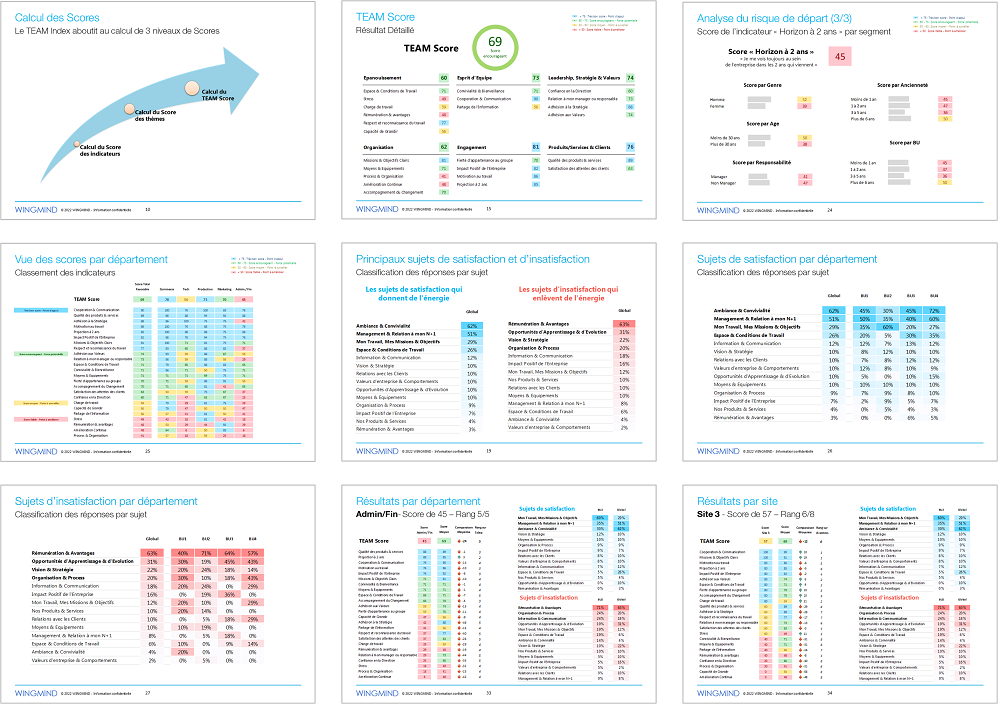
- Participation and representativeness
- Overall ENERGY Score
- Personal Energy
- Professional Energy
- eNPS
- Change over time
- Energy drivers
- Dissatisfaction drivers
- Detailed qualitative analysis
- Results by employee segment
- Strengths and attention points
- Priority recommendations
The Executive Team report goes much further than the presentation shared with employees.
It provides detailed results by segment, highlights significant differences, and sets out recommendations tailored to the company’s priorities.
A process tailored to the organization’s size and complexity
Scoping
Objectives, scope, employee populations, historical data, segmentation, and additional modules.
Preparation & communication
Questionnaire finalization, data preparation, and employee communication.
Survey launch
Confidential online survey, with invitations and reminders managed by WINGMIND.
Analysis & debrief
Comprehensive report, diagnosis, executive debrief, and recommendations.
Local rollout
Employee presentations, workshops by country, business unit, or department, and targeted action plans.
A strictly confidential framework
Trust determines the quality of the feedback collected
TEAM Index does not stop at presenting the findings
The results may reveal managerial, organizational, or local issues that require further investigation. WINGMIND then supports the company in implementing the most relevant actions.
Manager assessment
360° feedback
Individual or team coaching
Targeted deep dive
Pratiques managériales
Values & culture
Organizational Assessment
When should TEAM Index be used?
- Declining motivation or engagement
- Transformation or reorganization
- Rapid growth
- Merger or acquisition
- Tensions between teams, countries, or functions
- Management difficulties
- Retention challenges
- Workload or psychosocial risks
- Problèmes locaux difficiles à identifier
- Assessment of a strategic project
- Measurement of progress since a previous survey
- Need to rebuild trust and employee voice
A one-off, annual, or longer-cycle survey
What our clients say about TEAM Index
“TEAM Index is a surprising and highly insightful tool. It is particularly well suited to an international group like ours, as it enabled us to quickly reveal the specific issues affecting teams across our subsidiaries and address them more effectively.”
Olivier Binet
“By giving every employee a voice, TEAM Index provides a rich picture of collective performance and well-being at work. It enabled us to identify both areas to celebrate and attention points that led to rapid action.”
Martin Coriat
“The survey provided new and highly valuable insights that helped us better understand and support our teams. It is a very practical tool that turns feelings and opinions into a clear collective intelligence report that facilitates decision-making.”
Caroline Réminy
“TEAM Index proved extremely useful during a period of organizational transformation and rapid international growth. It helped us confirm several people-related issues and move into action by developing a plan for each office.”
Samson Loufrani
Frequently asked questions
Is TEAM Index an annual engagement survey?
It can be used annually, every two years, or on a one-off basis. The frequency depends on the organization’s size, the issues to address, and the desired level of support.
Is the questionnaire standardized or customized?
TEAM Index is built on a stable core that enables comparison over time. Additional modules can be added on values, management, a strategic project, transformation, or any specific issue.
How is confidentiality protected?
Individual responses are not accessible to the client company. Results are reported collectively and only when a segment contains at least five respondents.
Is TEAM Index suitable for international companies?
Yes. The approach can be deployed across several countries and languages, with analysis by geographic region, business unit, department, and managerial level.
What happens after the survey?
WINGMIND presents the findings to executives, develops recommendations, and can facilitate local sessions or support resulting actions involving management, organization, coaching, 360° feedback, values, or targeted deep dives.
Turn employee voice into concrete decisions
Speak with David Chouraqui

David Chouraqui
A former Private Equity investor and entrepreneur, David Chouraqui has supported investors, Boards, CEOs, and executive teams since 2012 on leadership, organization, engagement, transformation, and performance.