

Selected Engagements
Examples of Human Due Diligence, Leadership & Organizational Assessment Assignments
WINGMIND supports PE, Growth & VC investors and their portfolio companies when leadership and organizational factors can materially affect an investment, execution or value creation.
Our work ranges from Human Due Diligence before investment to leadership and organizational assessments during growth, transformation, underperformance and other critical situations.
Depending on the question, we work with investors, Boards, CEOs, executive teams, senior managers and key people, or across the broader organization.
The objective is not assessment for its own sake. It is to generate the insight required to make a better decision and act on the right issue.
Focused, independent and designed for decision-making
The scope follows the question and the decision to be made
A WINGMIND engagement may focus on one leader, an executive team or the broader organization depending on where the issue sits and what evidence is required.
Most assignments can be conducted remotely, across geographies and time zones, with limited disruption to management teams and within a few weeks.
Focused when it can be. Broader when it needs to be.
Selected situations
Different situations. Different questions. Better-informed decisions.
The examples below are anonymized to protect client confidentiality while preserving the nature of the situation, assessment and decision involved.
ENGAGEMENT 01 · PRE-INVESTMENT
Growth Investment
Human Due Diligence
The question: Can the founders and leadership team sustain the next stage of growth, and what risks should the investor factor into the investment?
Situation
An investor was assessing a fast-growing company facing increasing financing pressure and questions around the organization’s ability to sustain its growth trajectory.
What we assessed
Founders and senior leaders, management depth, organizational structure, decision-making and execution capability.
What emerged
The review highlighted leadership maturity gaps, key-person dependencies and weaknesses in the operating model that could constrain execution at the next stage.
Decision informed
The investor gained an independent view of the leadership and organizational risks to factor into the investment decision and potential post-deal priorities.
ENGAGEMENT 02 · UNDERPERFORMANCE
PE-Backed Company Facing CEO & Organizational Questions
Leadership & Organizational Assessment
The question: Is the CEO the main issue, or is the organization itself contributing to underperformance?
Situation
A PE-backed company was experiencing declining revenue, continued cash pressure and strategic drift. The Board needed to understand whether the problem sat primarily with the CEO or more broadly within the organization.
What we assessed
CEO and leadership team, strategic alignment, organizational effectiveness and employee perspectives across the company.
What emerged
The diagnosis separated CEO-related issues from broader organizational weaknesses and identified leadership instability, strategic misalignment and significant execution gaps.
Decision informed
The Board was presented with two actionable scenarios, including a possible CEO transition and the organizational priorities associated with each option.
Explore Organizational Assessment →
·
CEO & Board Advisory →
ENGAGEMENT 03 · CRISIS / TURNAROUND
Founder-Led Company in Crisis
Leadership & Organizational Assessment
The question: What needs to change in the leadership model and organization for the company to regain control and restore performance?
Situation
A founder-led company was facing cash-flow pressure, operational inefficiencies and high employee turnover, raising concerns about its ability to continue operating effectively.
What we assessed
The founders, executive-team dynamics, strategic priorities, decision-making and organizational effectiveness.
What emerged
The review identified excessive centralization around the founders, dysfunctional executive dynamics, unclear priorities and unnecessary business complexity.
Decision informed
The recommendations contributed to management changes, the closure of non-core activities and a simpler operating model. The company subsequently returned to profitability.
Explore Executive Assessment →
·
Organizational Assessment →
ENGAGEMENT 04 · ORGANIZATIONAL BREAKDOWN
Company Facing Declining Performance & Employee Turnover
Leadership & Organizational Assessment
The question: What is really driving deteriorating performance: leadership, structure, accountability, culture or a combination of factors?
Situation
Following a period of declining performance, rising employee turnover and a deteriorating internal climate, shareholders wanted to understand what was actually driving the deterioration.
What we assessed
The executive team, organizational structure, accountabilities, management practices and employee feedback across multiple levels of the company.
What emerged
The review identified unresolved leadership conflicts, overlapping responsibilities, weak accountability and structural friction that had progressively impaired execution.
Decision informed
The findings informed leadership changes and organizational restructuring. Employee turnover subsequently declined and revenue growth resumed.
Explore Organizational Assessment →
·
Portfolio Execution Reviews →
ENGAGEMENT 05 · PRE-FUNDRAISING
Founder-Led Growth Company Preparing for Fundraising & International Expansion
Leadership & Organizational Assessment
The question: Is the leadership model and organization ready to support the next stage of growth and give investors confidence ahead of fundraising?
Situation
A profitable founder-led company preparing for a new fundraising round and international expansion wanted to assess whether its leadership model, executive team and organization were ready for the next stage.
What we assessed
The founder’s evolving role, executive-team effectiveness, management depth, organizational structure and decision-making.
What emerged
The review highlighted excessive dependency on the founder and identified leadership responsibilities, management capabilities and organizational mechanisms that needed to evolve.
Decision informed
The work helped clarify the leadership transition and organizational changes required to strengthen scaling readiness and support the next phase of growth and fundraising.
Explore Executive Assessment →
·
Organizational Assessment →
ENGAGEMENT 06 · POST-MERGER INTEGRATION
Newly Combined Executive Team
Executive Team Assessment & Integration
The question: Are the tensions within the newly combined executive team interpersonal, or are roles, governance and organizational design reinforcing them?
Situation
Following a merger, the newly combined executive team was experiencing significant internal tensions, unclear roles and ineffective decision-making.
What we assessed
Executive-team dynamics, individual roles, accountabilities, governance and the structural factors reinforcing conflict.
What emerged
Several apparently interpersonal tensions were rooted in unclear responsibilities, decision rights and organizational design.
Decision informed
The work helped clarify roles, strengthen executive-team alignment and improve coordination and decision-making.
Explore Executive Team Assessment →
·
Build-up Integration →
Examples of engagement scope
The right level of depth depends on the question
There is no standard WINGMIND engagement.
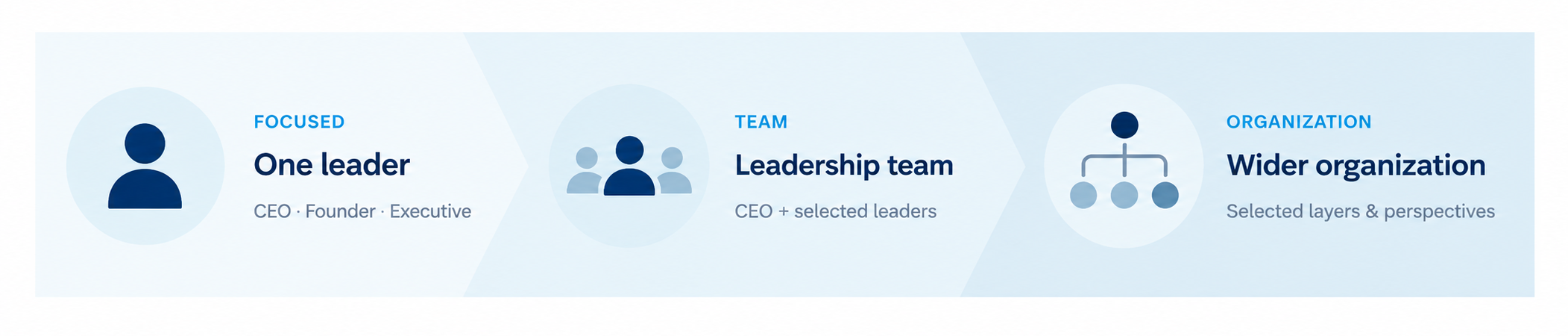
The scope depends on the company’s stage, the complexity of the situation and the decision at stake. The same perspective can be applied to one leader, an executive team or selected parts of the wider organization.
 01 · Focused Executive Assessment
One leader, while still looking beyond the individual
A focused engagement may involve one CEO, founder or senior executive. The assessment looks at leadership capabilities, potential risks and development priorities, while also capturing the leader’s perspective on strategy, the business and the organization.
Typical situations: investment decisions, founder assessment, CEO transition, leadership development or determining whether a leader can deliver the next stage of growth.
02 · Executive Team Assessment
Understanding individual capability and collective effectiveness
When the question extends beyond one leader, individual perspectives can be combined with an assessment of team complementarity, alignment, role clarity, governance, decision-making and the executive team’s ability to execute the strategy.
Typical situations: scaling, post-investment priorities, build-ups, leadership-team transitions, international expansion or questions around management depth.
03 · Organizational Assessment
Going wider when understanding execution requires broader evidence
Where the issue may sit beyond the executive team, the assessment can include selected management layers and targeted employee input. The objective is to understand how leadership, strategic clarity, structure, capabilities, management practices and culture affect execution.
Typical situations: scale-ups, mid-market companies, underperformance, transformation, international growth or situations where organizational complexity has increased faster than the management model.
Focused by design. Broader only when the question requires additional perspective and evidence.
Scalable when needed
From focused assessments to broader organizational evidence
Most WINGMIND engagements are deliberately compact and decision-focused. When the situation requires broader evidence, the same approach can scale significantly without changing its underlying purpose.
100+ engagements
Leadership, team and organizational assignments across critical business situations.
10 countries
International experience supporting investors and portfolio companies.
Up to 120 executives in one programme
Leadership assessment deployed across multiple management levels within a single organization.
Up to 3,000 employee voices in one diagnostic
Organization-wide input gathered within a single company when broader evidence was required.
Across the investment cycle
Different moments create different human and organizational questions
Human and organizational risks evolve throughout ownership. WINGMIND interventions are designed around the question that becomes material at each stage.
1. Pre-Investment
Can the leadership team and organization deliver the investment thesis?
Assess leadership, management depth, organization and execution capacity before investing.
2. Post-Investment
What needs to be preserved, strengthened or changed after closing?
Translate the investment thesis into concrete leadership and organizational priorities.
3. During Ownership
Where are risks or improvement opportunities emerging?
Maintain visibility on leadership, organization and execution as the company develops.
4. Growth, Transition & Transformation
Can leadership and organization absorb greater complexity and change?
Strengthen management capability, alignment, roles and organizational capacity.
5. Underperformance
What is actually causing the deterioration?
Separate visible symptoms from underlying leadership and organizational causes before acting.
6. Pre-Exit
Will the next investor believe this leadership team and organization can deliver the next investment thesis?
Assess management alignment, depth, succession, governance and organizational readiness before sale.
Explore Human & Organizational Risks Across the Investment Cycle →
Facing a leadership or organizational question?
Whether you are evaluating an investment, preparing for fundraising, supporting a company through growth or transformation, diagnosing underperformance or preparing for exit, an independent perspective can help clarify what is really happening and what decision should follow.